23 May 2014

May 16

Some of you might have followed along when I worked at Whitefish Point Bird Observatory last fall.  I blogged every day for that season and although I enjoyed doing it, I won’t be following that trend on St. Paul.  I mean, I could but…

However, the first couple of days on St. Paul were interesting enough (to me, at least) that this post will just cover one day.

I’m not entirely sure where to begin but the alcids seem like a good place to start… this places is LOADED with them.  Not a couple, a couple hundred, or a couple of thousand… but way more.  A big part of that number comes down to one of the smallest alcid species; LEAST AUKLET.   They breed on the rocky cliffs and even moreso in rocky areas with boulders.  There are a few walls and bouldery areas here that spawn these things out by the thousands.  Here’s a quick look at a few I digiscoped with my phone:

I’m sure we’ll get back to alcids later.  For now, though, we’ll switch to shorebirds.  There is one thing you’ll learn VERY quickly upon arriving to St. Paul and that is the ROCK SANDPIPERS are nothing short of omnipresent.  They’re likely the first bird you’ll hear when you get off the plane and they’ll be hardly out-of-sight for the rest of your stay.  They are EVERYWHERE.  Perched on vehicles in town, sitting in the road, hovering over you wherever you might be, you name it.  In truth, I cannot think of a single square foot of this island where I’d be surprised to see one.  With that said, they’re freaking cool birds.  The subspecies here is endemic to the Pribs and oh, they’re absolutely enormous too:
 
We did see one ROCK SANDPIPER that stood out as being smaller and darker.  Without having looked into this topic any, it seems possible that this is of a different subspecies (which does happen here from time to time).  Here’s a picture of it (lower right):
 
Being fairly early in the year yet, it’s no surprise that waterfowl were here waiting for us.  The most abundant diving duck that breeds on the island is the LONG-TAILED DUCK which you can see on a number of inland lakes here.  Here’s a male:
 
We also have had “ALEUTIAN” CACKLING GEESE around too which is ironic considering I spend my winters with these very birds.  I haven’t seen a collared one but that’d be pretty ridiculous if I managed that.  One species of goose I was very keen to see was my long-awaited lifer EMPEROR GOOSE.  We managed a few at Polovina Point which was a relief; those might be the last I see until fall.  Here's a digiscoped picture I took with my phone:

Last but not least, it was fun to find a SHORT-EARED OWL up by Webster Lake late that day.  Listed as uncommon in the spring, we all hope it departed right away (there are no mice or voles on this island to feed owls).   Regardless, here the owl is diving for something (it didn’t catch anything and honestly, we have no idea what it could have seen):
 

No true rarities had shown up by this point and I seem to recall getting kind of anxious.  Oh, but that thirst would be quenched before too long.  Stay tuned...

21 May 2014

Arrival to St. Paul

As we ascended above the mountains outside of Anchorage in our smallish plane (it seated 30-40 people), we were informed that we would stop in Dillingham to refuel the plane (typical of many flights out to St. Paul).  Having never been to Dillingham, I didn’t mind the idea of being somewhere new.  Of course, once we landed, we weren’t allowed off the plane so this was my view of Dillingham:
 
The first leg of the trip to Dillingham was probably about 1 hr 15 minutes.  The second leg, the one to St. Paul Island, would be about 1 hr 45 minutes.  Of course, we learned otherwise when the pilot informed us that airline made an audible and changed our route; we were headed to St. George Island first. 

From what I gathered, it’s not too common for them to do that but I didn’t mind, it would be neat to see the second-biggest Pribilof Island in person, after all.  As we finally descended, I craned my neck to see if/when the clouds would break and I’d see some water, birds, or land.  Finally the clouds cleared and staring at me were huge cliffs teeming with flushing murres and kittiwakes. 

We were allowed off the plane during the 15-minute break on St. George.  Turns out that is just enough time to hop out, see a distant flock of CACKLING GEESE with a larger GREATER WHITE-FRONTED GOOSE mixed in, see our first GRAY-CROWNED ROSY-FINCHES, snap a picture of the view from the runway:
I also snapped a picture of our Saab:
 
Our flight to St. Paul Island from St. George Island was probably less than 20 minutes, just a quick jump from one Pribilof Island to the next.  We eventually landed, got to meet a few TDX staff, gathered our bags, and headed to our house.   Of course, we couldn’t even get to town, a mile or two away from the airport, without finding something rare.  Glen, one of the other guides, spotted a Eurasian (rustica) BARN SWALLOW over Icehouse Lake.  Ahh, our first Asian stray. 

In town, we stopped by the AC (THE store on the island) to ensure we had some food on hand.  After that, though, it was time to check out the island a bit and see what was around.  It wasn’t long before we found more rare birds.  First up was this “WHISTLING” TUNDRA SWAN on Antone Lake:
 
Of the three birded seasons here (spring, summer, fall), they’re most-likely to be found in spring but even then they’re listed as rare.

We continued to Southwest Point, a good vantage point for seawatching, etc.  Apparently we were so caught up in looking at what was offshore that we didn’t see what was ON the shore, 3 BRISTLE-THIGHED CURLEWS:
They, too, are most-expected in spring compared to summer/fall but they’re still considered rare and not necessarily annual.  This was a long-awaited life bird for me so I was mighty pleased.  Of course, this all goes without saying (until now) that new birds were flying all around me all the time; swarms of LEAST and PARAKEET AUKLETS, RED-FACED CORMORANTS, and RED-LEGGED KITTIWAKES were swirling offshore.  

So far, so good.

18 May 2014

Attempt to fly

I know when I signed off on the last post that I said the next post will be about St. Paul Island.  Little did I know that PenAir had different ideas.  As you can see, I WAS there, prepped, and ready to go:

However, the flight was delayed 30 minutes… then another 30 minutes… then another hour… and then another hour… and… well, you get the idea.  Before we knew it, the flight had been canceled for “bad weather”.  We were to return the following day to try again.

An extra day around Anchorage translated into additional birding before we departed for the Bering Sea.  We ventured up to the Eagle River Nature Center to see what was around and no, the scenery wasn’t bad:

The woods were fairly quiet save for a few ORANGE-CROWNED WARBLERS, YELLOW-RUMPED WARBLERS, and the VARIED THRUSHES singing their ethereal songs.  I was still happy to see things like GRAY JAY and some PINE GROSBEAKS; this one gathering nesting material:

The calm and warm afternoon (yes, it was warm, in the 70s I believe) translated into a nice day for butterflies.  First up, ARCTIC WHITES were fairly common along with MILBERT’S TORTOISESHELLS.  Here’s one of the latter:
 

We saw several GREEN COMMAS as well, further answering my earlier question of “The range maps don’t show them here, are they actually around?”.  Here’s proof:

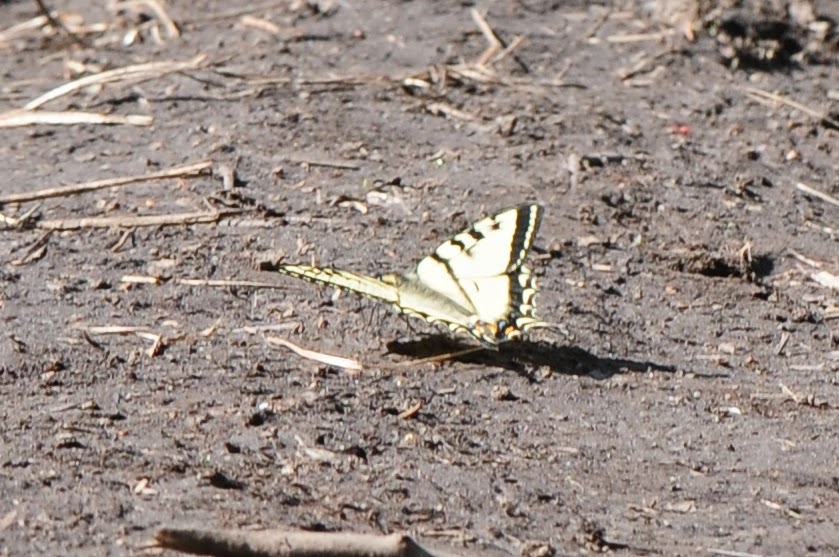
I also added two lifer swallowtails; a couple of fly-by OLD WORLD SWALLOWTAILS as well as my first CANADIAN TIGER SWALLOWTAIL:

Fast forward to the next morning when we returned to the airport in Anchorage.   After our cancelation the day before, I wasn’t convinced things were going to go as scheduled.  Turns out I was wrong; this time the plane was actually going to leave!  Were our checked bags going to leave with us?  We didn’t really know the answer to that but we got on the plane regardless.  Strapped in and ready to go, we took to the air.

14 May 2014

Alaska

Here follows the first of many blog posts not coming to you from California, but from Alaska instead where I'm happy to be back.  I was last here in 2006, a full 8 years ago, when I worked in Barrow with shorebirds.  I won't be returning to Barrow this time though.

Anyway, it wasn't long after arriving in Anchorage that it was obvious things were different.  I stopped at this local park (Westchester Lagoon) and the abundant ARCTIC TERNS were floating around everywhere.  The surrounding mountains were nice too:

The next day I started my way down towards Homer where I planned to spend a day or two birding and hopefully targeting some lifers.  Just outside of Anchorage is Potter Marsh, a scenic place even if it wasn't well-known for birds:

The snipe were winnowing, the Lincoln's Sparrows were ubiquitous, it was a nice cool morning.  Plus, the tame terns and gulls at the southern pull-out provided some eye-candy.  Here's a MEW GULL along with some nasty lens specks:

I imagine the tame ARCTIC TERNS at this pull-off have to be some of the most-photographed terns in the world:

Continuing south, the view along the Turnagain Arm of the Cook Inlet was much more... satisfying than a view in the Central Valley:

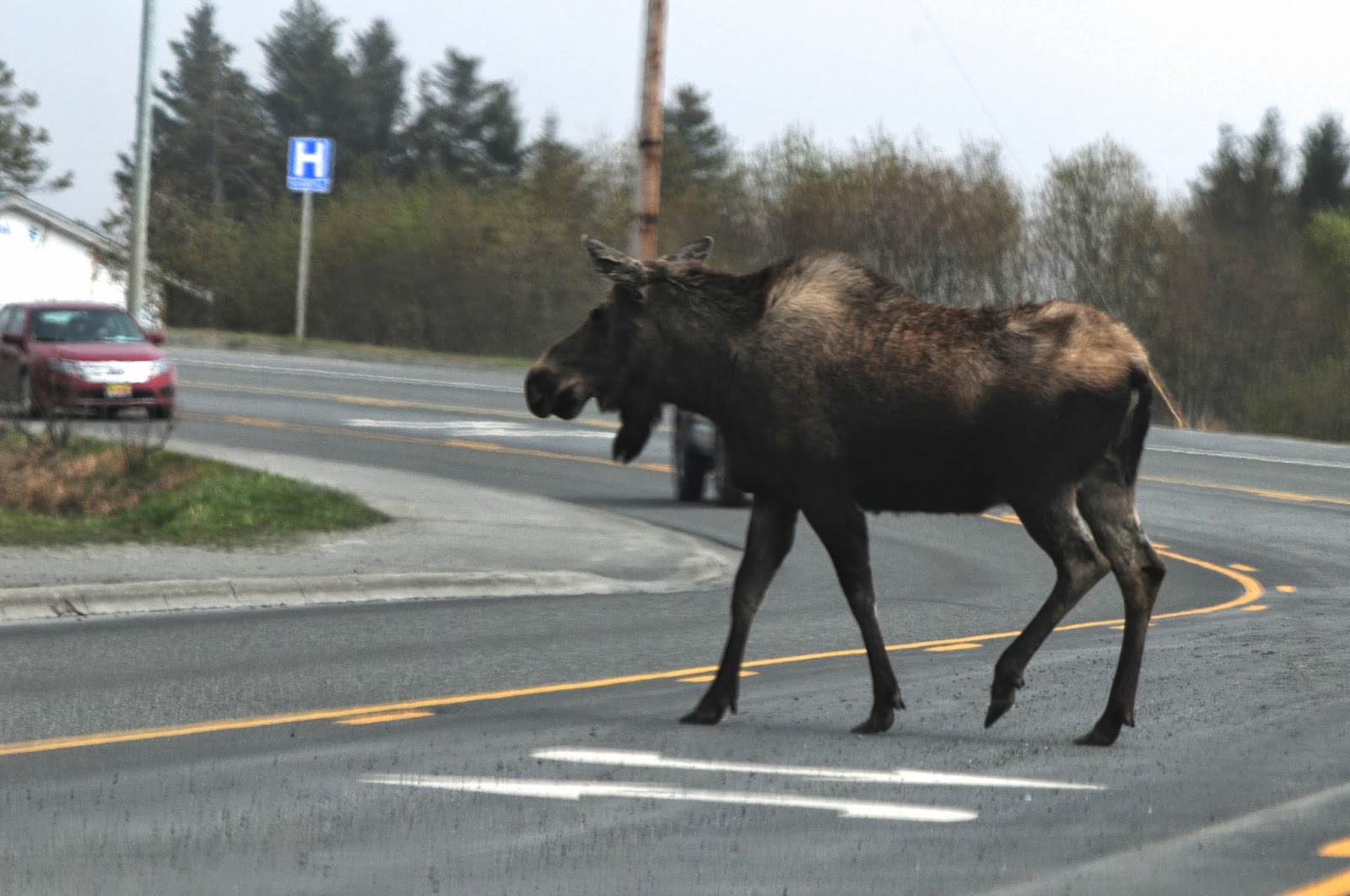
Once in Homer, it WAS obvious things were different when this MOOSE was strolling about town:

In the end, I saw 5 different MOOSE and a couple of CARIBOU during my brief visit.

The following day I went boating on Kachemak Bay (another arm of the Cook Inlet) with Karl S. to look for Kittlitz's Murrelets.  He is THE MAN for this job and I highly recommend his business.  Before I could even get to the marina, though, I stopped along the Homer Spit and got my lifer ALEUTIAN TERN.  Excellent.

Once on the boat with Karl, we motored north.  It was pretty foggy and so although the scenery was muted, the birds were still pretty cool.  For example, here's a bad picture of a FORK-TAILED STORM-PETREL that we bumped up.  This was the first FTSP eBirded in Alaska this year:

We arrived at Bear Cove and there were at least 200 MARBLED MURRELETS to sift through for the much-rarer Kittlitz's.  Bear Cove in itself was quite scenic, here's where it's at:

View Bear Cove in a larger map

The MARBLED MURRELETS were making a racket too:


There were plenty of other birds around too like COMMON MURRE:

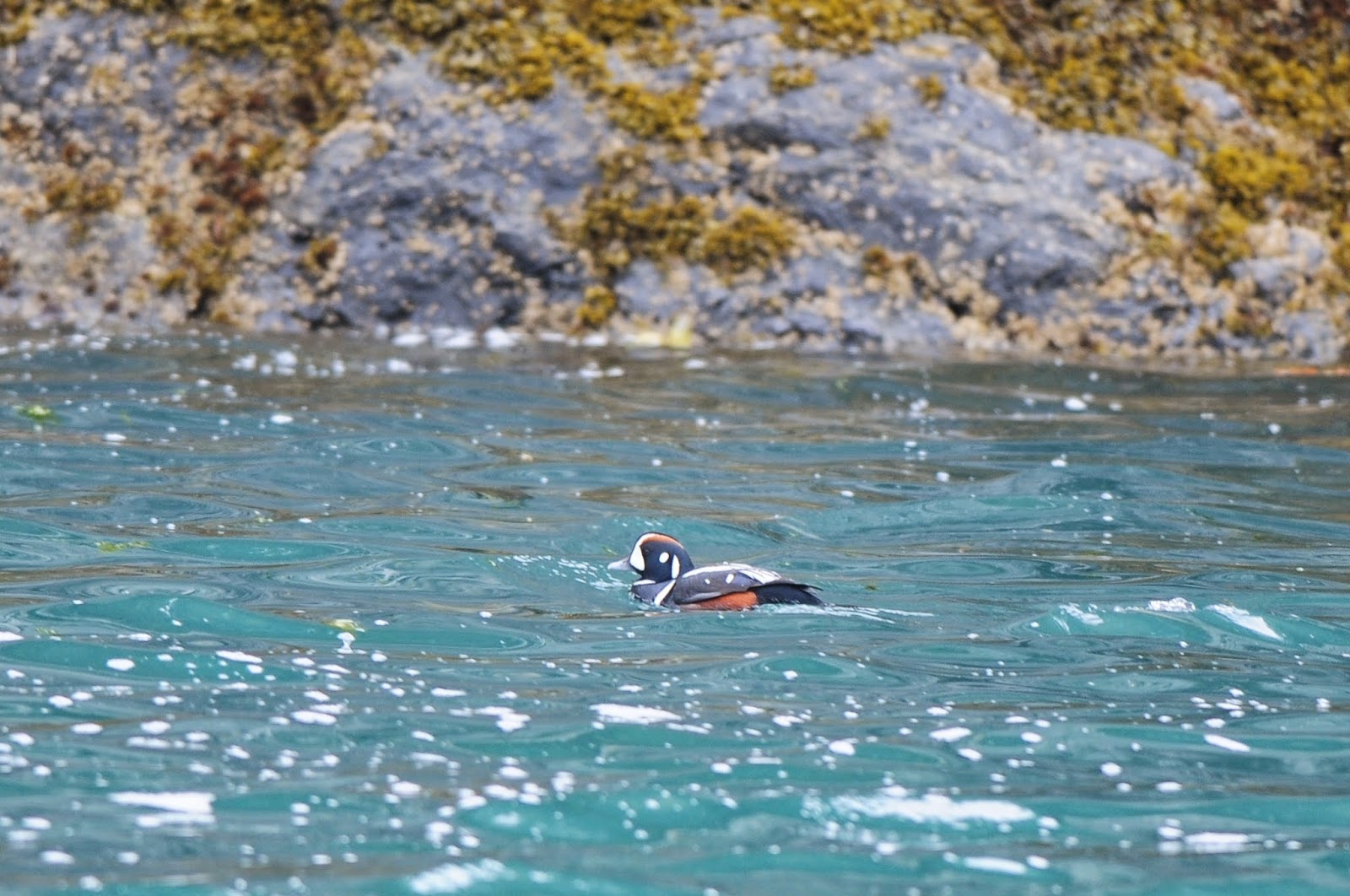
... and this male HARLEQUIN DUCK in some amazing turquoise-colored water:

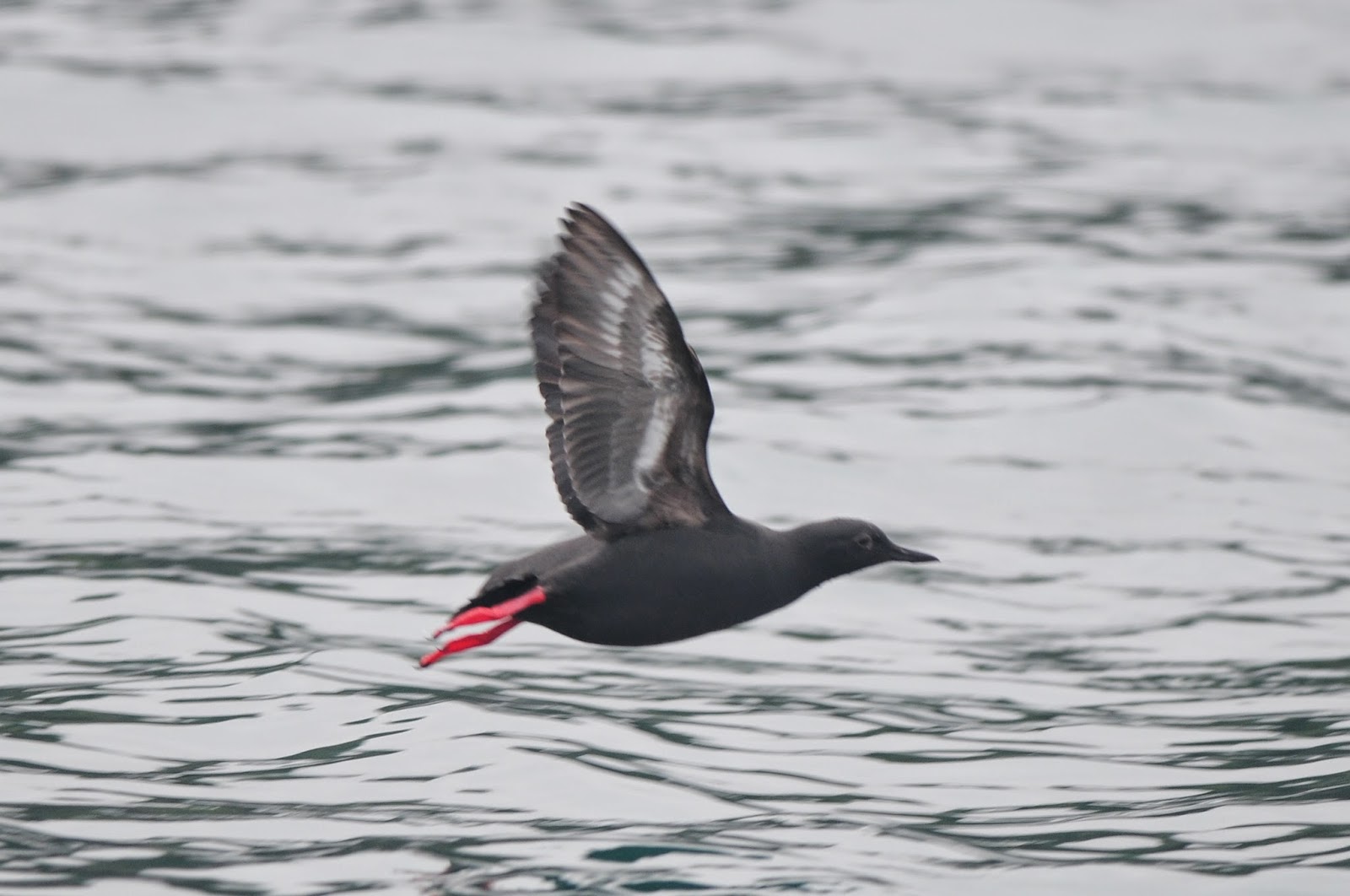
PIGEON GUILLEMOTS were also common:

Although we never did see a Kittlitz's in the 4 hours of searching, I was really happy I went.  It's not every day you get the share your morning with hundreds of murrelets and other seabirds.

Speaking of boats, if you've watched The Deadliest Catch on TV, you'll be familiar with this boat which was docked in Homer:

Back on the spit, two SONG SPARROWS found me and so I photographed them:

In truth, they really freaked me out; they're SO dark here.  I suppose they're probably of the Kenai subspecies Melospiza melodia kenaiensis.

I continued to bird along Homer Spit for the remainder of the day and was rewarded with things like a YELLOW-BILLED LOON and thousands more COMMON MURRES:

I worked shorebirds for some of the day and got to sift through things like 500+ SURFBIRDS, a few ROCK SANDPIPERS, hundreds of DUNLIN and WESTERN SANDPIPERS, as well as this big fatty WHIMBREL:

Once the clouds actually cleared, the view across the bay was fantastic:

It was time to head back north to Anchorage though and so I took my time stopping along the way, hoping for some new butterflies or dragonflies.  I first bumped into this blue:

Turns out, it's probably in the SPRING AZURE complex which blows my mind (if you're familiar with the azures, you'll know that most are much paler than this).

When the random roadsides look like this, I have a hard time not stopping and seeing what birds are around:

About every stop yielded abundant species like VARIED THRUSH, TOWNSEND'S AND YELLOW-RUMPED WARBLERS, RUBY-CROWNED KINGLET, and LINCOLN'S SPARROW.

I also saw my lifer ARCTIC WHITE at one of these pull-offs:

At one particular stop, I popped down to the streamside to have a look around and found a pair of HARLEQUIN DUCKS paddling about:


For all the hundreds of HADUs I've seen, I think these are the first I've seen actually in their river-dwelling breeding habitat.  Here's a pin showing the stream:

View Quartz Creek in a larger map

I bumped into this GREEN COMMA at a pull-off as well:

Interestingly, the range maps I've seen don't put this species on the Kenai Peninsula but who knows how accurate those maps are.  Or perhaps this sighting was noteworthy?  Either way, I'm not really sure.

Here's a pull-off I'd highly recommend.  It's by Tern Lake and yes, there were ~50 ARCTIC TERNS and many MEW GULLS breeding here:

Back near Anchorage, I stopped briefly again at Potter Marsh... you know, for terns and such.  Here's an ARCTIC:

Well, that's all for now.  The next post will come to you from a remote island in the Bering Sea.  Stay tuned...

08 May 2014

BRITAIN'S DRAGONFLIES

"Britain's Dragonflies: A Field Guide to the Damselflies and Dragonflies of Britain and Ireland (Third Edition)", by Dave Smallshire and Andy Swash, was published in 2014.  It's 224 pages, a paperback but comes in a clear plastic sheath for protection, and costs $25.95.

Once again, I feel rather sheepish for reviewing a book that covers things I'm so clueless about.  Although I've been increasingly interested in dragonflies and damselflies for the last 5 years, I've never even been to Britain... or anywhere in Europe for that matter.  So why review this book?  Because I honestly enjoy scanning through the many species I've never heard of before, learning how other authors organize their books, and... well... because I'm a low-level field guide hoarder!

Because I already find myself so fascinated with bird and butterfly identification, rarely does someone ask why I'm into dragonflies.  When they do, however, I'll totally flip to this page:

Unfortunately this was just an add-on image during an introduction piece BUT I like where they were going with it.

I mentioned the introduction though; I was more impressed with this introduction than any other I've seen in a dragonfly field guide.  For starters, the book covers many of the standard items such as this plate of key features of damselflies:

It's a bit obvious to put into words but one really should try to learn these parts so that when the guide mentions S7-S8, you won't be completely lost as to what they're talking about.

This introduction also has some plates focusing on identifying dragonflies in flight which is another item I rarely, if ever, see in a dragonfly field guide.  Here are two sample plates:

In an another attempt to help the reader identify what they're looking at, the authors include this "type guide"; match what you're seeing to the general type of bug and you're theoretically off and running:

One area where this book really does go beyond the minimum requirements is the many pages of charts that help simplify the identification process.  For example, here's a chart that shows life-size abdomen and thorax illustrations as well as notes on head and wings (males on the left, females on the right):

Now, why haven't any guides here in the US figured this out?  

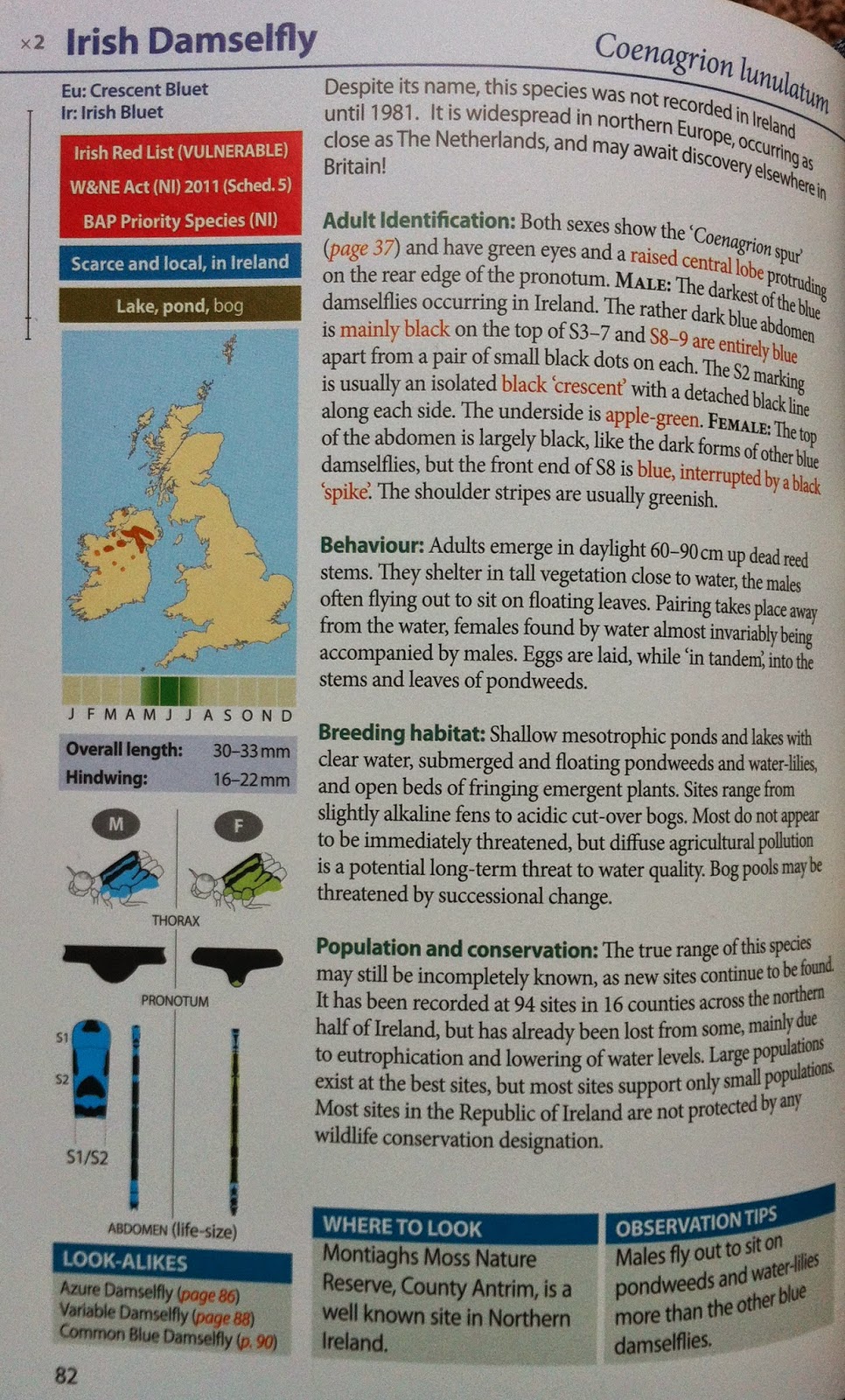
Once you get down to the actual species accounts, you'll see a spread like this:

Taking a closer look at the Small Spreadwing species account, I'll point out a few things:

First up, you'll see they cover alternate names below the common name.  This is always a good idea to keep aggravated novices from chucking their guide into a pond.

Secondly, you'll see a little "x2" next to the name.  That indicates that the photos on the opposite spread are twice the life size of the actual species.

Also, you might have missed it but look at the far left part of the page; you'll see a vertical line.  This shows the life-size length of the species.  You'll see a hash mark 2/3 down that line; that indicates the minimum length whereas the bottom mark indicates the maximum length.

Here's another species to look over:

Farther down the page they include this nice life-size illustration of male/female abdomens:

And of course, they include some photos on the opposite spread to even things out:

Here's another spread to glance at, this one for the Scarce Emerald Damselfly:

Under the distribution map, you'll notice a temporal seasonality chart.  For example, this species is most-likely to be encountered starting in June, then peaks in July, and then they start to dwindle by the end of August.

A lot of field guides that cover dragonflies and damselflies would just end there.  Of course, it's the colorful and flying insects that captures the attention of the most casual observer.  However, there is a whole other side to identifying these creatures and this field guide is the first one I've seen tackle this daunting task.

-- drum roll-

THE EGGS AND LARVAE

Seriously, I've never seen such a collection of data on identifying dragonfly eggs and larvae; it's really refreshing to see for once!  At the start of this section, which is at the back of the book, you'll see a table covering hatching time, larval micro-habitat, adult emergence, peak season, etc.  Take a look:

If that chart wasn't enough to get you nodding your head in agreement that you don't know the first thing about larvae, they have full illustrations, photographs, and close-ups on how to ID these aquatic denizens.  Here's an example page:

They also do this by family too; here you see some general examples of emeralds, chasers and skimmers, and darters:

I'll leave you with... this intensely detailed plate on larvae ID:

So overall, the authors probably have the luxury of not being pressed on space for this book.  Consider that the size of Britain and Ireland is only a fraction of the size of the US.  In fact, the state of Texas is more than 3x the area of Britain.  Anyway, my point is that they can afford to use more space covering new aspects of field ID.  Although I wish more of the field guides here in the US had this kind of material, I also see how enormous of a book that'd end up being.

In truth, I don't have much that's critical of this book; it's hard when I know so little about the dragonflies of Britain.  However, I really do like the layout as well as the amount of info that's packed into it.  I'd probably have skipped the clear plastic sheath that fits the book and instead just give it a thicker cover.  Then again, I hear it rains there. 

I've never been to Britain but I can guarantee that when I do, I'll be using this book to ID odes.


Disclaimer:
I received a complementary copy from the publisher for review purposes, 
but the viewpoint expressed in this article is entirely my own.