22 January 2015

Local yokel

It's been fairly quiet here in Sacramento County, at least for us.  Most of my birding lately has either been at Don Nottoli Park, a local patch of ours, or simply making checklists from the yard.

Although birding the local patch might seem rather dull, and it is at times, it's still possible to find neat things that we haven't seen there before.  For example, this MERLIN was the first record of that species from the park:
Although I've seen MERLIN from the yard 5x, they're pretty scare overall in the area.  In fact, I just checked my eBird records for Sacramento County and can say that I see 22 AMERICAN KESTRELS for every MERLIN.

Another first record from Don Nottoli park was this CACKLING GOOSE.  You can see the white collar on the smaller goose on the right:
This species definitely isn't that rare but they're usually so outnumbered by GREATER WHITE-FRONTED GEESE at the park that it's just a matter of sifting through enough geese (and I don't usually take my scope).

Looking at the picture of the geese, you can see a lot of grassland going on.  It's true, Stone Lakes NWR butts up directly next to Don Nottoli Park, and much of Elk Grove, in fact.  The expansive grazed grasslands are responsible for many of the cool rural birds we see so close to an urban setting.  A good example of that is this uncommon grassland raptor, the FERRUGINOUS HAWK:
 
Although they're generally uncommon around here, spend enough time around grasslands in the winter and you'll surely find some.

Same goes for this flycatcher:
That flycatcher, as you might know, is a SAY'S PHOEBE and is a common winter resident.  You can usually find a couple in just about any open grassland setting around here.  Drive I-5 south of where I live and you can usually find a couple even at 70 mph.

Although Don Nottoli Park sits next to the grassland, we owe the diversity here to the wooded pond that we walk around every visit.  I thought I'd take a few pictures so that you can see what I'm dealing with:


So yeah, it's nothing huge or impressive but next to the urban jungle, it acts as a migrant trap.  In different seasons, it's brought in birds such as YELLOW-BREASTED CHAT, MACGILLIVRAY'S WARBLER, OLIVE-SIDED FLYCATCHER, PACIFIC-SLOPE FLYCATCHER, BLUE GROSBEAK, WESTERN TANAGER, and even rare birds like BREWER'S SPARROW and GRAY FLYCATCHER.

Most of the time, however, it's not as gripping.  We often see things such as RED-SHOULDERED HAWKS, a very common species:
There are usually some COMMON GALLINULES skulking around somewhere too:
Although they're completely abundant, I snapped a picture of this particular NORTHERN MOCKINGBIRD anyway:
This local patch usually has a good number of sparrows, mostly GOLDEN-CROWNED, WHITE-CROWNED, and SAVANNAH.  However, we'll see SONG, FOX, and LINCOLN'S around too.  The rarest of the sparrows here are things like LARK, CHIPPING, BREWER'S, and DARK-EYED JUNCO.  Anyway, here's a fence full of GCSPs:
Speaking of sparrows, I was birding in extreme SW Sacramento County (down in the Delta), when I started looking at the WCSPs a little more carefully.  It started with this bird which I thought had a mighty yellow bill:
The question was simply "would I know if I were actually seeing pugetensis or nuttalli?"  Both of those races winter just an hour drive west of there.  Yes, gambelii is the most widespread and expected winter subspecies in the Central Valley but since all three of those races have pale lores, I started to wonder what I should be looking at.  Does the yellow bill of pugetensis and nuttalli stand out enough?  Because like I said, I kinda think the bill of the above bird looks pretty yellow and I'm betting it's still gambelii.

Anyway, here's another photo from the same spot
While we're talking about WCSPs, I may as well share this picture too, taken from my patio in Elk Grove:
It's always a bit of a treat when we see sparrows in the heavily manicured urban neighborhood I'm in.  In here, sparrows are pretty uncommon and things like wrens are downright rare.  You can imagine my surprise then when I found this HERMIT THRUSH in some leaf litter below the patio:
That was certainly a first record for the yard.

Anyway, that's all for now.....

13 January 2015

Alaska eBird map

I recently shared my eBird maps here on my blog and I stated that I couldn't get openheatmap.com to take my Alaskan numbers.  Well, thanks to a tip from SEFI, the key is to add the word "Borough" after the borough name to your spreadsheet.  That worked with most of them but I was still having issues... and then realized that some should be called "Census Area" instead and sure enough, that worked as well.

It's a shame that I don't have any checklists from 3-4 other boroughs/census areas that I've been to in Alaska but maybe someday I'll return.  Anyway, here is a peek:


10 January 2015

Fun to start fast

Even though we had birded both January 1 and 2, we weren't quite done with the long weekend yet.  We were, simply put, on a hunt for county year birds.  This post is devoted to our recent snags for the year list.  Less words, more pictures.  Go.

First up, we headed to Cosumnes to target things like GOLDEN-CROWNED KINGLET.  It took us a while but it worked out in the end:
And it's hard to ignore other non-year birds along the way like this AMERICAN KESTREL:
A male CINNAMON TEAL doesn't exactly blend in with coots all that well:
I visited the City Cemetery targeting BROWN CREEPER and RED-BREASTED NUTHATCH.  Managed to find both.  Here's the latter:
I birded William Land Park in Sacramento hoping to bump into the Hammond's Flycatcher that has been seen sporadically there this winter.  No luck with the flycatcher but I found my year TOWNSEND'S WARBLER and photographed the HOODED MERGANSERS there:
I hit up the Blue Heron Trail portion of Stone Lakes NWR; I had a hunch it was my best shot at AMERICAN WHITE PELICANS.  Apparently they agreed:
A spin to Camden Park didn't yield any Black-crowned Night-Herons, a species I still need for the year, but there was still a male BARROW'S GOLDENEYE on the lake.  Sharp looking dude:
There were also several PINE SISKINS there at the park.  Although it wasn't a year bird, I think it might have been the first record of that species for this local patch:
Also at Camden, there were two freaky ORANGE-CROWNED WARBLERS.  I'm not sure if anything is wrong with these birds but they don't look right to me!  Ruffled forehead feathers, messed up eyes, and a giant bill (or maybe just accentuated by the chewed-up forehead).  Strangly, BOTH birds looked like this:
A visit to the Folsom Rodeo Grounds was in store to target HUTTON'S VIREO and RUFOUS-CROWNED SPARROW.  I picked up a bonus WILD TURKEY along the way, managed to hear the RCSPs, and this HUVI was obliging:
Birders found a STELLER'S JAY on a CBC at a park I had never been to before.  Since it was a year bird, away to Lew Howard Park I went.  I actually found one before I even parked; it flew right over the road as I was arriving.  That's stupid.  Here's a documentation pic:
It was here that my attention was drawn to some interesting notes coming from the top of a tree.  For the life of me, I thought it sounded similar to a vireo singing!  Keen to find the culprit, I searched until this PURPLE FINCH popped into view.  What the crap?  Here's a picture of the bird:
Take a listen to this recording of a PUFI from Vancouver, see what I mean?  Now I know.


I ventured back to Nimbus Fish Hatchery to see if there were any odd gulls around.  I didn't see our ICGU from before so I instead took pictures of mixed goldeneye flocks.  Here are two male BARROW'S GOLDENEYE on the left and two male COMMON GOLDENEYE on the right:

Whew.  In the end, I reached 150 species in the county in the first week of the year.  All of a sudden, it hit me that I'm basically 3/4ths through the species I'll see in Sacramento County this year already!   I looked at my pace in 2014 and it took me 3 weeks to hit 150 so I guess I'm ahead of schedule.

So branching out a bit, we actually took a detour one day and headed up into Gates Canyon in Solano County.  I love this canyon.  We weren't very far in when we noticed BAND-TAILED PIGEONS freaking everywhere:


Yeeeeeah, we ended with nearly 300!  Again, this winter has brought BTPIs into lower elevations all over the place (so no, this wasn't all that unexpected).  What WAS unexpected was finding a TOWNSEND'S SOLITAIRE about 3.3 miles in:

This was a good find for us, there were only 4 other Solano County eBird records of this species.

Anyway, up through today, the 10th, we're happily perched at #1 and #2 in the county this year.  Of course, that doesn't really mean anything, it's just been fun to start fast.

09 January 2015

Glaucoides!

Day 1 of this year went splendidly; we ended the day with 101 species.  Sure, that was a good start, but we wanted to bird again the next day.  And, well, January 2 was even better!  Little did I know that a first county record was lurking.

We started off at Nimbus Fish Hatchery along the American River up in Sacramento.  With the ducks, gulls, and songbirds combined, it's possible to tally a respectable number of species in a short amount of time.  It's also a reliable place for PHAINOPEPLA, a then-needed year bird.

It was here that we chanced upon a truly great find, an ICELAND GULL:
Woah, right?!  This white-winged gull was loafing with HERG and CAGU about 0.75 miles downstream from the fish hatchery.  You can see that it has a) almost pure white wingtips, b) fairly long wings that stretch well beyond the tip of the tail, c) a pale eye, d) a quite short and thin bill, e) a smaller-headed look compared with the blocky-headed shape of HERG, f) overall smaller than the surrounding HERGs, and g) a slightly paler mantle than the surrounding HERGs.

It eventually it flapped its wings for a bit which showed the almost-pure white primary tips quite well:
If we were keeping track, and if this is an ICELAND GULL, this is the rarest bird we've ever found in Sacramento County (and probably the state too).  In fact, this would be a first county record (although I heard there was a young bird that was submitted as ICGU but was rejected by the CBRC).  Regardless, finding a first county record was an exciting treat!  Of course, sure, I should add that all of this obviously depends on whether it is accepted by the CBRC as an ICGU so who knows. 

What's kind of goofy is that I had actually connected with a putative glaucoides ICELAND GULL here in the Central Valley back in 2012 (you can see that checklist here).  Long story short, there was an adult glaucoides that was found at the landfill in Yolo County in 2012 and then again in 2013.  So, one has to wonder if this Sacramento bird, which could appear as a glaucoides unless you see the spread wing carefuly, is the same bird as seen in those years.  Besides, the Yolo landfill is only 23.8 miles away from Nimbus (as the gull flies).

As an aside, no one has relocated this bird as of yet.  In fact, I'm not sure how many people have even looked for it, it appears that very few people have.  I looked once more recently with no luck but hell, you'd think county listers would be all over that.

Anyway, so besides all that excitement, I might mention nuthatches really quickly.  We saw this WHITE-BREASTED NUTHATCH creeping around near Nimbus and thought I'd snap a picture of it:
I took a picture not because it's a WHITE-BREASTED NUTHATCH, a fairly familiar bird across the continent, but because the ones we have here are a different subspecies than the ones found across most of the country.  These are Sitta carolinensis aculeata and are sometimes placed in an arbitrary "Pacific Coast" group.  In fact, this subspecies is only found in Washington, Oregon, California, and far western Mexico.  However, if I drove up I-80 to the east, I'd find a different subspecies on the other side of the Sierra... but that story is for another time.

Anyway, you can see our complete checklist from Nimbus here.

After that, we headed to Michigan Bar Road to see if we could connect with any more county year birds.  We did.  For example, we found two different BALD EAGLES (which was flagged in eBird).  Here's an adult:
... and a youngster:
And continuing our great streak with MOUNTAIN BLUEBIRDS, we found one yet again.  It wasn't super close but there's only one thing that that sky blue beacon could really be:
Michigan Bar Road is a favorite spot of mine in Sacramento County.  If you navigate the sometimes-rough road to the top, it's a great spot to spy on FERRUGINOUS HAWKS, like this one:
Speaking of spying, I highly suspect this beastie:
Our final checklist for Michigan Bar can be seen here.

05 January 2015

Numbers and maps

With 2014 gone, it's time to focus on 2015.  But first, numbers and maps (you all know how much I love maps).

According to eBird (which I love and would suggest you trying), I made 680 checklists last year which was down from 953 in 2013).  How will this year compare? 

In terms of new ABA birds, last year was an exceptional year for me given my 5 months on St. Paul.  My time in Alaska delivered 35 new ABA birds and considering my initial target was 20, I'd say it treated me pretty well!  

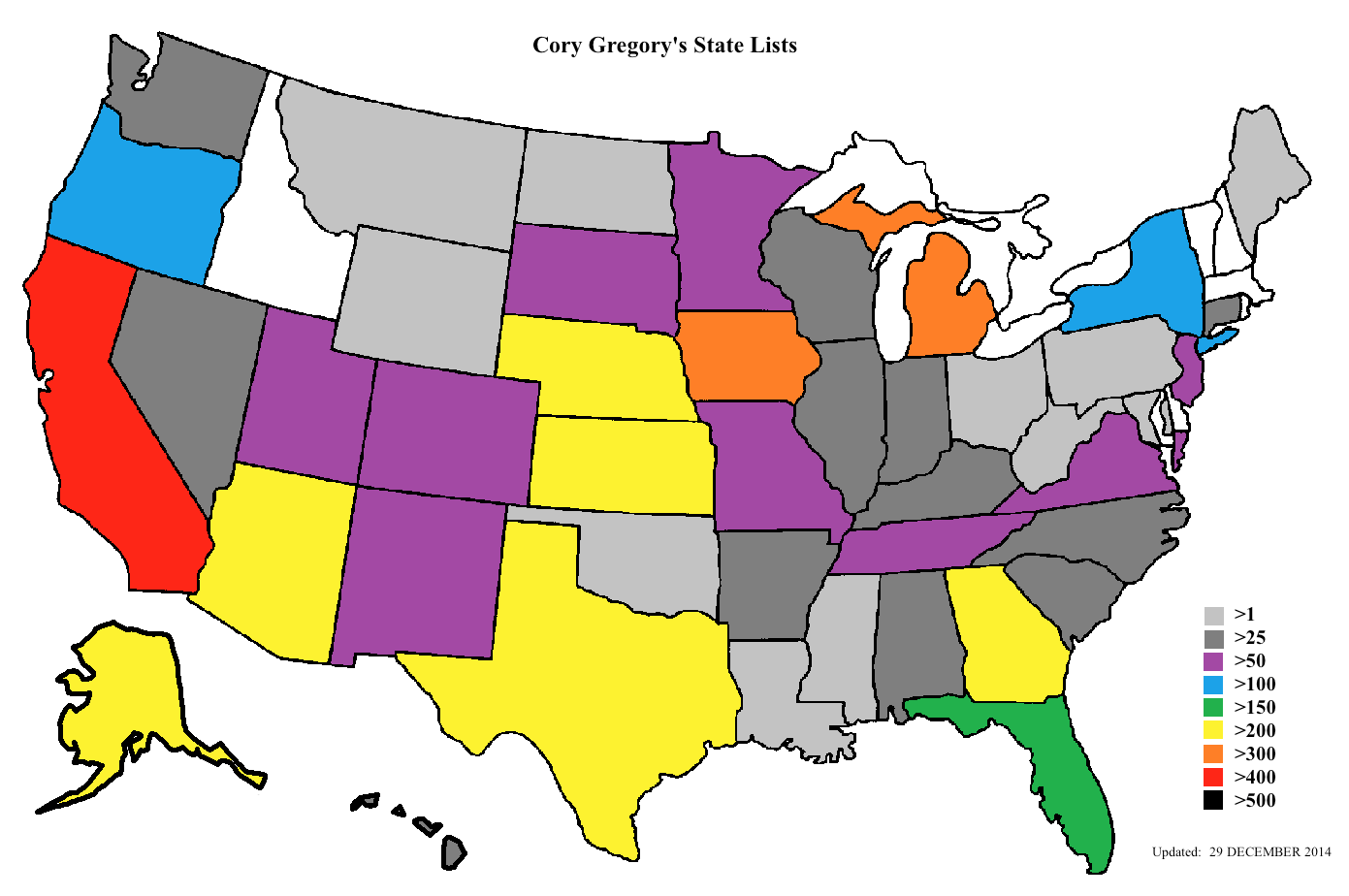
My time up north also pushed my Alaska list into the 200+ category.  As you can see below, I recently updated my US map which shows state list totals (CA and OR upped a color):
You can also see that I still lack state lists for Idaho, Rhode Island, Massachusetts, Vermont, and New Hampshire (even though I have been to those states before).  Oh well, someday.

Here's a different look at my Lower 48 tallies; this time by counties (sadly, Alaska and Hawaii don't work):
The other 7 months last year were spent around home in Sacramento County where I actively kept a county year list.  In eBird, I ended up in 4th place which probably isn't too bad considering me being gone for 5 months of the year.  I'm also really impressed that Ashley finished in 2nd place!  Oh, and don't let the eBird rankings here fool you in regards to her placement; most birders around here enter Egyptian Goose and Mute Swan into eBird which inflates their list by two species.  (I won't get into that topic here but yes, I see the value of entering those uncountable species.  As for us, though, we decided to only eBird species that are on the official California state list.  Otherwise, I may as well eBird the Budgie I saw at my local patch!!).

I really enjoy being able to visualize progress and being able to make my own maps is just icing on the cake.  It's free and easy to do via openeheatmap.com.  No need to send your numbers to a third party...

Anyway, here's a look at my county list totals in California.  You, as a reader, can't do much to this map (such as zoom in, see county totals, etc) because I didn't embed it but you get the gist of the idea:
 
Regarding the above map, I finally visited Trinity County (in the NW part of the state) which only leaves two counties without a county list: Inyo and Alpine.

But here we are at the start of another year.  Given the clean slate, January 1st rolled around and we took the chance to see if we could top 100 species that day.  

First stop was Sherman Island.  The best bird was an intermediate juvenile SWAINSON'S HAWK:
In eBird, this is only the 3rd January record of this species in Sacramento County.  Here is is again, more distantly, as it banked:
This SAY'S PHOEBE was right next to the road.  I just rolled up on it smooth and fired a few shots.  It didn't know what didn't hit him.
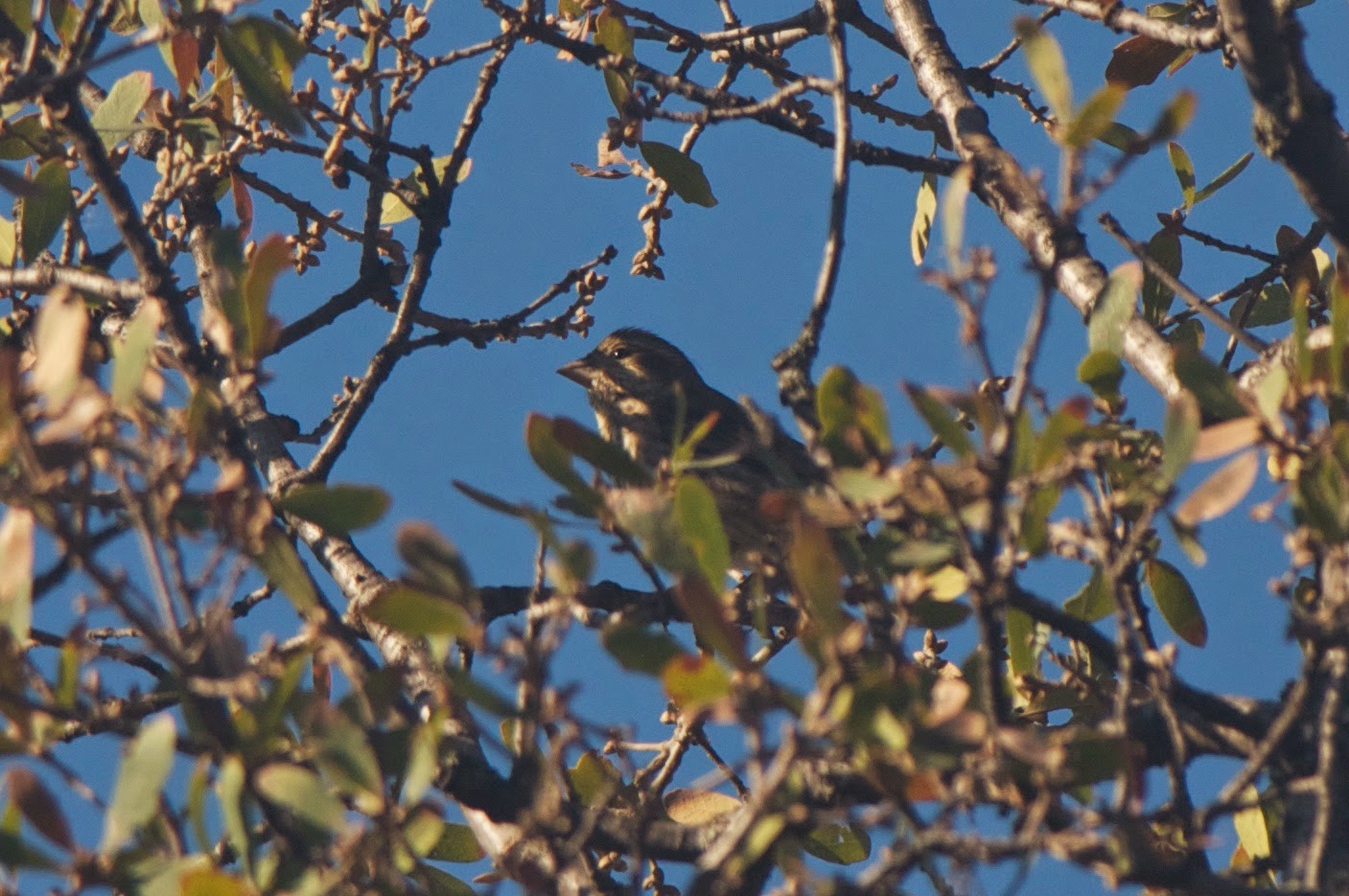
We also ventured to our local patch, Don Nottoli Park, where we stumbled on this PURPLE FINCH:
This is actually the first record of this species at this patch.  According to eBird, this was the 139th species seen there since we moved to the neighborhood and started birding it in 2011.

Anyway, we ended with 101 species that day in just this county.  Not a bad start to the new year!

With that, my 1st blog post of the year will come to a close.  As an aside, I ended with 111 blog posts last year which breaks my previous record of 98! 

Cheers.