17 February 2014

Don't gyr at me!

And here I am 6 days later, finally with some sightings actually worth blogging about (ok, mildly debatable).  I'm sure all 3 readers are ecstatic.

The biggest news revolves a big white bird.  "Oh cool, a Snowy Owl, right?"

A white-morph GYRFALCON was reported earlier this month in the Ferndale Bottoms area of Humboldt County, California.  Reports continued to come in and finally, when a KING EIDER showed up in the same county, it was time to utilize the long weekend for a quick stab to the north.  Although we didn't see the eider, we did manage to see this impressive bird at the Eel River Estuary Preserve:

As many of you already know, the white morph of this species is the least expected, especially here in California.  In fact, when the bird was initially seen earlier this month, it was passed off as a pale Prairie Falcon.  Whoops!  Either way, I was pleased to see my first white-morph Gyr.  I should add that I was impressed with the preserve (even though we had to make reservations to visit); check out their website here.  Here's a map of rough where the bird was during our visit:

View Gyrfalcon in a larger map

Back to local stuff, I finally ventured outside of Sacramento County last week and visited Staten Island (San Joaquin County) which is only 15 minutes south of here I live.  Although I didn't see any collared geese to scope through, the ubiquitous SANDHILL CRANES, including this banded bird, were obliging:

If I lived closer to the coast, this is the season that Allen's Hummingbirds migrate north.  However, I'm "stuck" in the Central Valley where we only have ANNA'S HUMMINGBIRDS for the time being.  Although if you catch the gorget in the right light, it's still an attractive experience:

This "slate-colored" DARK-EYED JUNCO was actually my first for California (loooong overdue).  And where did I stumble on this charcoal ground-denizen?  My local patch, of course:

At the same park I found this TOWNSEND'S WARBLER.  Although not exceedingly rare here in the winter, they're by no means common either.  This was the first time I had seen this species during the winter months at Elk Grove Regional Park:

Oh the woodpeckers.  Can't forget the woodpeckers!  The most abundant species around here at the moment is the well-known NORTHERN FLICKER.  Best pay attention to these because the different races have no decency whatsoever and hybrids are ransacking all local parks, lawns, and yards.  This male, however, is just a pure RED-SHAFTED:

The second-most abundant species of woodpecker around here is the NUTTALL'S WOODPECKER.  Nope, not Downy.  Here are two recent shots showing a hopefully-obvious difference between the genders:


I recently received Howell's latest book ("Rare Birds of North America") to review and I already know I'm in for a treat.  So good!  More on that later....

06 February 2014

Go local

And by that I mean, don't ignore the local parks if you're considering birding somewhere.  Lately I've been limiting myself to Sacramento County and I've already discovered more interesting places (and birds) are out there if I'm just willing to explore.

Keeping with the local patch theme that I've been on this year, here are a few sightings from the last week and all within Sacramento County.  First up is a DOUBLE-CRESTED CORMORANT at Mather Lake:

One of the main discoveries I've made this week is William Land Park.  Yes, it's a city park not even 15 minutes from here and yes, I know other people have birded it but I was blissfully ignorant of its existence until some recent reports came in of a WESTERN TANAGER.  They are common migrants here but winter records are quite hard to come by.  And considering I've been trying to stay atop of Sac sightings this year, I figured I'd check this place out.  Five minutes out of the car and...

Adding a slightly new flavor to the usual local-park-recipe were these HOODED MERGANSERS that were hanging out on a small pond (yes, complete with fountain): 

I also found a couple of VARIED THRUSHES at the park (which is known to be a reliable spot for them; lucky me).  Although they're not rare winter residents here, they're still somewhat local:

All in all, I was happy to find a new local patch.  You can see the checklist from that first day here.  It's actually a relatively big park as you can see here outlined in blue:

View William Land Park in a larger map

Anyway, remember Camden Park?  The local patch I've been birding at once in a while this winter?  A recent trip there yielded about 50 species including this SNOWY EGRET:

Yesterday I birded with a vagrant gypsy/former coworker, who I now call Jubo.  Our first stop was William Land Park to see if we could find some uncommon warblers or Varied Thrushes.  In the end we did manage to stir up one BLACK-THROATED GRAY WARBLER but no Western Tanagers.  One pseudo-stunning discovery was a flock of ~15 VARIED THRUSHES on the ground together... at once.  Neither of us had seen this many VATHs at one time in our lives.  Weird.

We looked up and spotted this NORTHERN FLICKER, complete with red nape crescent and [mostly] yellow shafts:


Cool, a "Yellow-shafted", right?  Well, how pure does this look to you?  The shafts certainly look a little bit orangish which gives me pause.  It's a little harder to tell because it's a female and females lack the mustachial stripes that males have.  Either way, it's certainly mostly a "Yellow-shafted" but at what point do you call a bird pure?

Anyway, we also rampaged through The Nimbus to see what was around (but mostly to gaze upon BARROW'S GOLDENEYES).  We certainly owned that desire; we ended with more than 30 of these uncommon diving ducks and only 4 shy of the all-time Sacramento County record.

Among the 6 gull species present were at least two MEW GULLS, perhaps the least common of the "common" gull species there:

There were at least 50 WHITE-THROATED SWIFTS rocketing back and forth along the American River.  At times they would come down a little bit lower than normal hence a photo of one:

We ended the day with nearly 80 species with 60 of those coming just from Nimbus... not too bad for being "in the middle of winter".  You can see our checklist for Nimbus here.

Oh, and we also had 17 LEWIS'S WOODPECKERS along Michigan Bar Road in eastern Sacramento County.  Hardly worth mentioning with how abundant they've been this winter...

28 January 2014

Finally a teal

So far this year I've limited 100% of my birding to two counties in California; Solano and Sacramento.

Even though there aren't life birds or mega rarities in these parts at the moment, it's been enjoyable keeping tabs on county birds this year and trying my best to stay on top of things.  Even though I reached 150 species in Sacramento County this past week, I've been keen to continue finding species that have escaped me so far.  At least for me, birding is at its most interesting when there are goals and targets involved.

One such target was HUTTON'S VIREO, an uncommon year-round resident in the Central Valley.  I finally tracked one down the other day at Cosumnes River Preserve (with such a distinctive song, it was straightforward to pick out).  To untrained eyes, this species can resemble RUBY-CROWNED KINGLET but note the thick bill among other things:

The vireo was in good company; we tallied 70+ species on that checklist.

Another species I was missing was BLUE-WINGED TEAL (no, they're NOT common here).  After quite a few checks at Cosumnes River Preserve, I finally found two males there this morning.  Here's one of them:

Here's a pintail from this morning as well:

So here are some other species I'm still hunting for this year in Sacramento County:

California Quail
Great Horned Owl
American Bittern
Brown Creeper
Blue-gray Gnatcatcher
Purple Finch
Lesser Yellowlegs

The first three are giving me a major headache....


23 January 2014

Nimbus

In the same vein as my other 2014 Sacramento County birding exploits, one could include my recent trips to Nimbus Fish Hatchery.

Although this well-known birding hotspot along the American River is at least 30 minutes from my house, I've made the trip several times this year already (remember, I'm pretending that I'm reluctant to leave this county; I'm still grounded).

Nimbus Fish Hatchery is along the American River which flows between Folsom Lake and its junction with the Sacramento River in... ta-da... Sacramento:

View Nimbus Fish Hatchery in a larger map

Parking at the Nimbus Fish Hatchery is free at the access off of Gold Country Road (which travels southwest off of Hazel Ave).

Although I never visit to actually watch the fish jump the ladder, this spot has been providing mitigation for habitat loss since 1958.  However, the annual fall migration of salmon and steelhead in the lower American River is still of interest to me... the birding here is great!

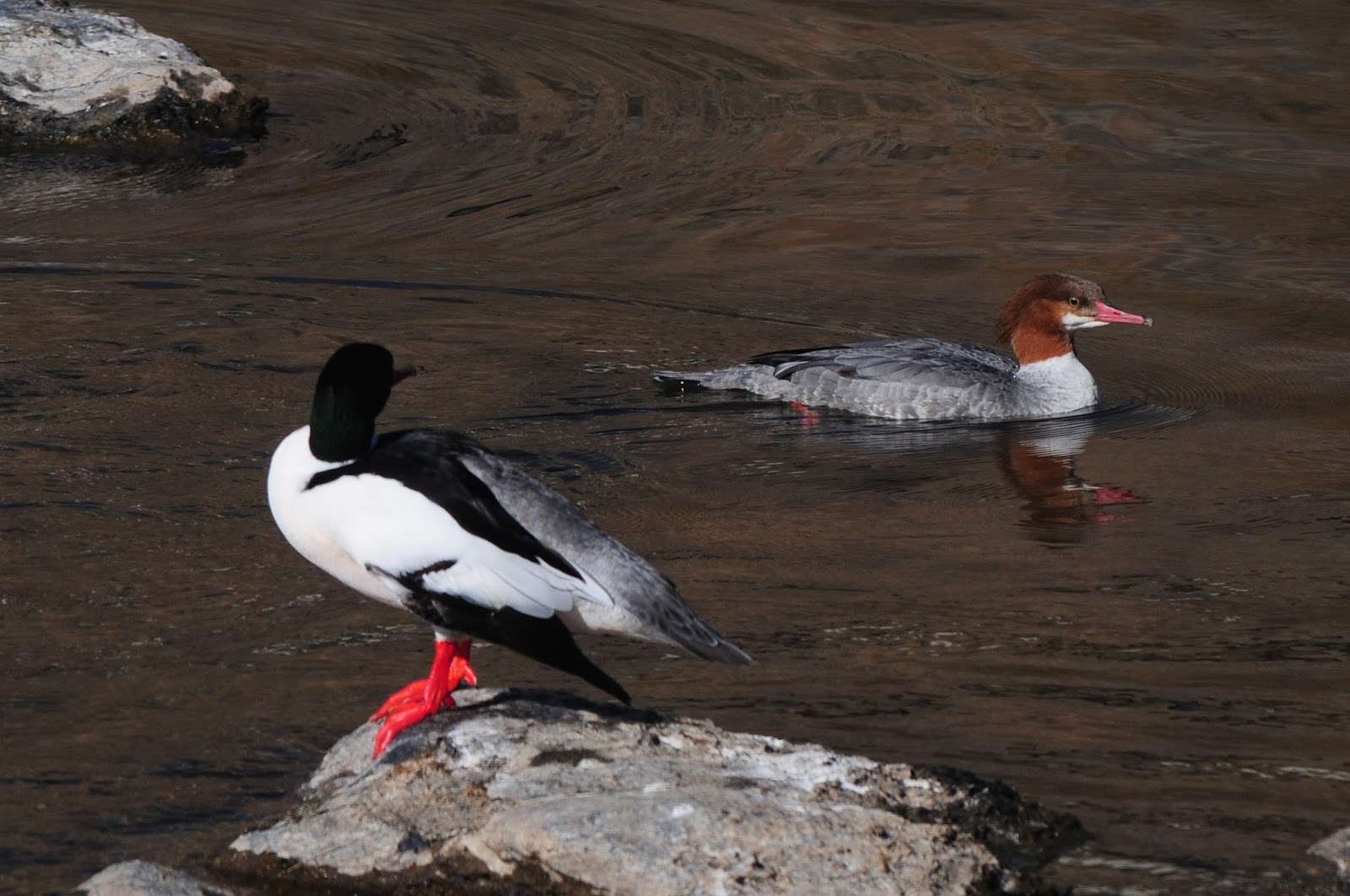
There are a couple of main attractions for birders; first might be the flocks of divers that congregate on the river near the fish ladders.  For example, the male COMMON MERGANSERS here practically glow when the light is at your back:


There are always females loafing around too.  These are separated from the much-rarer Red-breasted Merganser by the white chin and the much thicker bill:

-whistle-  Yes, she makes me turn my head too.

Usually more numerous than even the mergansers are the goldeneye that congregate here (I counted more than 80 goldeneye on my last visit).  Arriving in November and then wintering until April, both COMMON and BARROW'S GOLDENEYE are found here although Common is always more... common; the ratio as of late is about 1 Barrow's for every 12 Common.  Here are some Common Goldeneye of various sexes and ages:

The gleaming male in front is an adult whereas the two middle birds behind him are young males.  You can see that their flanks and scapulars aren't clean yet but the head pattern is mostly there already (although their heads still lack that fine, glossy finish).  The two outer birds, the shy ones that won't look at the camera, are females (note the darker gray flanks).

I mentioned BARROW'S GOLDENEYE so here is a sharp-looking female:

The main field mark to note is the screaming yellow bill; female Common Goldeneye will absolutely never show quite this much yellow.  You'll also note the angle of the forehead just above where it meets the bill.  Barrow's Goldeneye have a smaller, more triangular bill along with a different head shape.  Here is that same female with a male COMMON GOLDENEYE; note the different bill size: 

Some of the female BARROW'S GOLDENEYE aren't quite as obvious.  Here is a female (right) with two COMMON GOLDENEYE.  Note especially the angle of the forehead compared to the Commons:

To make matters worse, but more interesting, the two species of goldeneye DO hybridize from time to time, and guess what, I happened to find such a bird on my last visit (the first COGO X BAGO hybrid ever entered into eBird for Sacramento County).  Here's the male hybrid (right) along with a male HOODED MERGANSER (middle) and a male COMMON GOLDENEYE (left):

You'll notice a couple of interesting things about this bird.  First, the bill is smaller than the Common's and I'd say it looks fine for Barrow's.  Secondly, the forehead is steeper on the hybrid (again, I'd say it looks fine for Barrow's).  However, the facial crescent is intermediate in shape and maybe even a touch closer to Common than Barrow's.  Lastly, you'll see that the black on the scapulars is intermediate between the two species and the "black spur" is... kind of there but not as pronounced.

Moving on from ducks, Nimbus Fish Hatchery is also one of Sacramento County's finest spots for gull watching.  At least 10 species of gulls have been seen here through the years which makes it one of a few Central Valley locations that can boast those numbers.  Here's part of roosting flock during my last visit:

However, I've only seen 6 of those 10 species at Nimbus so far.  Here's my list in order of most common to least common (based on my opinion):

California Gull
Ring-billed Gull
Herring Gull
Glaucous-winged Gull
Thayer's Gull
Mew Gull

The GLAUCOUS-WINGED GULLS, which are winter-only residents, seem to be fairly pure here which is a nice change (they hybridize rampantly).  Here are two recent photos of these large, dark-eyed, smudgy-headed behemoths:


It's not a great shot but this is an adult THAYER'S GULL that flew over Nimbus the other day.  Note the extensive white on the underside of the primaries:

In addition to the ducks and gulls that will probably keep you busy for a bit, there are other various things to ponder.  One such wonder is this famous PEREGRINE FALCON which has mastered the art of catching the local WHITE-THROATED SWIFTS!

Yes, WHITE-THROATED SWIFTS are common here year-round; I had 30-40 during my last visit.  But hold on, this species of swift is suppose to be one of the fastest fliers on the planet (after all, their speeds have been estimated to reach 200 mph!).  How on earth would a falcon deal with that?  Well, by being THE fastest flier on the planet.  So here's a swift sorry to the sorry swift.

Much less common at this particular location is ROCK WREN.  I found this bird feeding on the rocks along the fish ladder (yes, on the other side of a chain-linked fence, as you can see)

Turns out, this is only my 3rd sighting of ROCK WREN(S) for Sacramento County and the first away from Folsom Lake (which is the main, reliable location).


19 January 2014

"THE CROSSLEY ID GUIDE: RAPTORS"

Here we are again, this time reviewing another Crossley book.  "The Crossley ID Guide: Raptors", by Richard Crossley, Jerry Liguori, and Brian Sullivan, was published in 2013 by Princeton University Press.  It is 286 pages long and costs $29.95.

I'm glad I don't have to beat around the bush for very long to start this out.  In fact, the very first 9 words in the preface of this book are "The Crossley ID Guide: Raptors is for beginning birders...".  So there you have it.  I don't really consider myself a beginner anymore which will explain why I generally find The Crossley Guides a waste of my time.  If you want a review from a beginner who thinks this is a glowing gift from heaven, look elsewhere.  Granted, I will try my best to find some saving grace of this book but after that, it's going on the shelf.

Generally speaking, the first 173 pages are photos of our North American raptors whereas the remaining pages are all text, range maps, etc.  You're probably aware by now of how these photographs are laid out; they're edited and superimposed on a natural background.  You can expect to see some of the birds up close whereas others are distant, some perched and some flying.  And for this, "The Crossley ID Guide... has turned the traditional field guide on its ear", or so says The Wall Street Journal.  I just don't buy it.

So for example, the Bald Eagle images begin on page 26 whereas the species account begins on page 183.  And yeah, don't get me wrong, the background photos are great, stunning, sure.  But the beginning birder deserves more, in my opinion.  Here's the first spread included for Bald Eagle:

Because the emphasis appears to be on the photos, you'll see how all the text is crammed in at the bottom.  I'm not a huge fan of this but then again, I'm not sure how one can have any text if your emphasis is on the photos.  Here's the spread for ZONE-TAILED HAWK:

Here's another spread, this time of SWAINSON'S HAWKS:

 Things get a tad bit more interesting when the authors start giving you spreads of quiz birds:


Generally speaking, I AM a fan of the text in the back of the book.  I think it's here that the author that knows most about hawks, Jerry Liguori, flexes his muscles and saves the book's butt.  Liguori, who has authored books such as "Hawks at a Distance" and "Hawks at Every Angle", knows his stuff and you can rest assured that his contribution is solid.  Each species account gets a color range map and 2-6 pages of text which include headers such as:

Overview
Flight Style
Size and shape
Plumage
Geographic Variation
Molt
Similar Species
Hybrids
Status and Distribution
Migration
Vocalizations

And for all the quick and critical talk, I will say that birders could learn a good bit of information if they scour the material in the back and give all the quizzes a try.  That's an honest answer.

However, I wouldn't have imagined that authors intent on claiming this book as "innovative" would include text such as this:
It's been a good summer.  Easy living... just relaxing in the nest while Mom and Dad brought squirrels, woodpeckers, jays, and anything else they could find to keep me from begging.  But now I'm an outcast, first pushed out of the nest, and now out of their territory.  
I certainly don't find this tidbit from the Northern Goshawk species account innovative.  I'll move on.

This book does manage to do some new things though.  For example, they include entire spreads of quiz birds that are "Going Away" or "Into the sun" or "Sunrise on the East Coast" or "Black and white" or "Topsides" or.. well, you get the idea.  I'd say that's a good thing for a beginner to look at once or twice because, yes, lighting can change everything.  Kudos to them for including those scenarios that many field guides don't.

On the inside flap it says this book is "the first raptor guide using Richard Crossley's acclaimed, innovate composite images that show birds as they actually appear in the field."  I'm not sure about you but when I see birds as they actually appear in the field... they're moving.  Sounds silly, sure, but I think instead of spending your days inside combing over the quizzes, you should get outside and see how hawks behave, how they move.  After all, it's experience that makes you.. well... experienced.

If I boiled down all my thoughts about this book and put them into a short list, it would go like this:

1) There's no denying that the photos are great.  I'm jealous of his camera gear, whatever it is.
2) The saving grace of this book is the text in the back by Liguori.
3) The quizzes are interesting and potentially helpful; thanks, guys, for putting those in.
4) The sections on "raptors going away", "backlit raptors",  etc make for new field guide material.

So although I find myself being quite critical of this style of guide (at least for my purposes), at least I can comfort myself in knowing that I don't have any other Crossley books to review just qu.... oh wait... I have another one right here!  On the plus side, this next one I have seems more interesting so that's a start!
Disclaimer:
I received a complementary copy from the publisher for review purposes, 
but the viewpoint expressed in this article is entirely my own.