28 February 2013

New Jersey chases

After hearing about the hundreds of birders out east going and twitching the NORTHERN LAPWINGS and PINK-FOOTED GEESE this winter, it was finally time for me to get in on that action.  Off to New Jersey I went.  It's only... what, across the country?

First stop was the NORTHERN LAPWING field.  I pulled up, saw a distant lapwing in the field, and breathed a sigh of relief.  I didn't fly out here for nothing!  I eventually pulled out the scope and tried to take some distant pics of the three continuing birds (which is hard to do when the wind is blowing 30 mph):


For those who don't know, lapwings are a type of plover and this species belongs in Europe, NOT here in North America.  Think Killdeer but then give it a green back, a big black breast band, and a giant crest.  Woah!  Anyway, here is a map of where the lapwings have been seen:

View Northern Lapwings in a larger map

Well, that's cool.  On to my second target.  Where was I going to find this one?  Well... Marshalls:

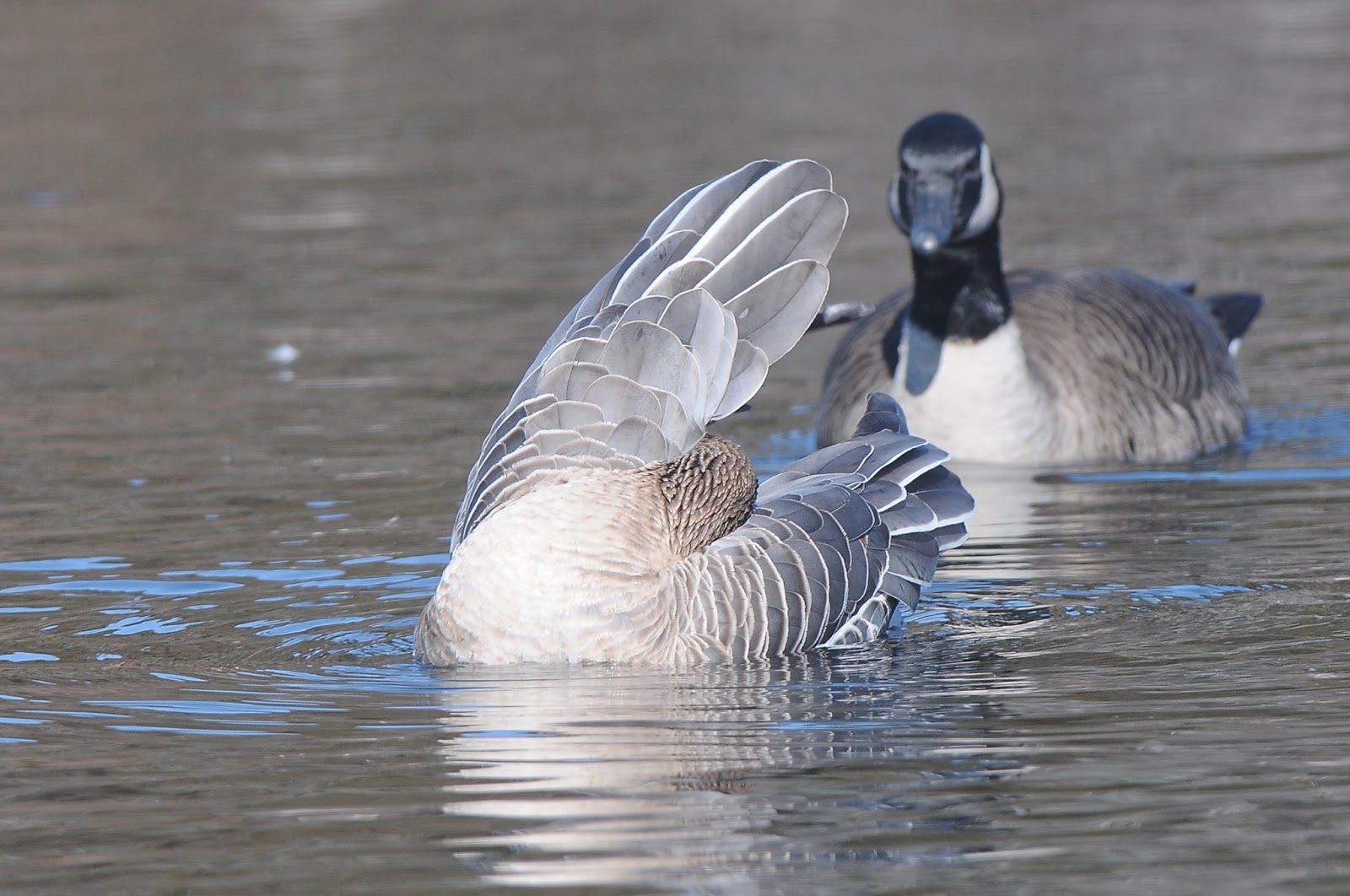
Ta dah.  Yeah, pretty sexy to see a rare bird from a parking lot but hey, I flew across the country for this so I wasn't complaining.  In a pond NEXT to a Marshalls in Toms River, New Jersey, the goose flock was still present.  Immediately the PINK-FOOTED GOOSE stood out.  It happened to be relatively tame too:

Doing the New Jersey Itch simply impressed the guy in the background.  It had never seen such a fine Icelandic rear: 
Here's a map for the goose spot:
View Pink-footed Goose in a larger map

So I gave myself 2.5 days to find these birds and I managed to get both within a couple of hours of each other.  Now what?!

The next day I met up with a Bosler and we looked around for random things including a recently-reported Barnacle Goose.  We dipped on that goose but alas, we found another PINK-FOOTED GOOSE.  This particular bird had been present several weeks before at that location but it hadn't been seen since.  Then we came along.  Now that's just silliness:

Oh yeah, remember how I'm from California these days?  I couldn't help myself, I found myself taking pictures of EASTERN BLUEBIRDS:

Before I knew it, it was time to leave the rude people of New Jersey (ok, only most of them were rude).  Next up, off to Seattle to do some chasing on the other coast.  Stay tuned....

19 February 2013

Four pictures

I don't have much to share today other than a few photos from the last couple of days.

Being the weekend, Ash and I went up to Michigan Bar Road in eastern Sacramento County.  We weren't looking for anything in particular but you never know, maybe we'd stumble on some Mountain Bluebirds or out-of-season Lawrence's Goldfinches.  Neither of those things happened but we did see a few raptors including this distant, light-morph ROUGH-LEGGED HAWK:

We were chatting about "how uncommon" RLHA is for the county and I think we came to the conclusion that there are definitely fewer of them compared to Ferruginous Hawks.  We looked out the window.  Yeah.  FERRUGINOUS HAWK:

At our local patch, here is a GREAT HORNED OWL trying to blend in:

Closer to home... more like... home, this NORTHERN MOCKINGBIRD pic was taken from the patio in late afternoon light:

I'm flying east tomorrow to chase some rarities.  Stay tuned....

17 February 2013

British Columbia - Part 2

So did I get SKY LARKS at the Victoria Airport?  Although it was getting dark and the wind was rather gusty, I eventually heard a SKY LARK singing at least twice.  However, I didn't actually see it (or photograph it).  Not to worry, I had another morning here on Vancouver Island.  I trusted I would have more luck in the AM.

Woke up and immediately went to a reliable field along Central Saanich Road.  It didn't take long to hear several SKY LARKS singing but again, I couldn't actually spot them up in the air singing.  Eventually I flushed a couple along the path and they flew a short distance away; perfect for getting nice scope views of them:

It was then that I realized that they were singing from the ground.  I didn't really know they did this but it made me feel better that I wasn't missing them up in the air:

As you probably know SKY LARKS prefer more of an agricultural setting than some birds.  Take a look below at the field the birds were perched in and flying around in.  Pretty special looking?

After the success with the larks, I decided to see if I could see an additional BRAMBLING on my trip (although I had seen a different one the day before).  One had been previously reported at a residence down in Victoria.  However, after 40 minutes of watching the feeder, I called it quits and drove back towards the ferry terminal.

The ferry from Swartz Bay back to Tsawwassen was pretty uneventful as well.

A laughable picture, this was my only HARLEQUIN DUCK of the trip:

Also from the ferry, we passed by some buoys; this one had both PELAGIC and BRANDT'S CORMORANTS on it:

Speaking of BRANDT'S CORMORANTS, here is one in flight showing the delicate white feathers down the mantle:

There were dozens of PIGEON GUILLEMOTS on the boat ride back to mainland:

I also enjoyed the hundreds of LONG-TAILED DUCKS that were around on the trip back.  Here's part of one flock:


Here's a sharp-looking adult winter male:

RHINOCEROS AUKLETS were fairly common on the trip back:

Last but not least, there were dozens of RED-BREASTED MERGANSERS around as well:

After that, it was a simple matter of driving the 18 hours home to Sacramento.

16 February 2013

British Columbia - Part 1

I had been itching to get to the Vancouver area for some time now.  New ABA birds were waiting for me, what was I supposed to do?

I decided the time was right and started driving north.  Before I saw anything of interest, I first had to drive 18 hours and that included passing Mount Shasta:

Once I arrived in Vancouver, I met up with Keith and Wendy (friends from Whitefish Point Bird Observatory) and we started by going to Queens Park for the RED-FLANKED BLUETAIL that was found a month ago.  Even though it was misting and really dreary, it didn't take long to spot the little guy hopping around on the ground:


Also known as the Orange-flanked Bush-Robin, this species does NOT belong in North America.  Instead, it is usually found in northern Asia, northeastern Europe, from Finland east across Siberia to Kamchatka.

This is the first record of RED-FLANKED BLUETAIL for Canada and only the second record from mainland North America.  What a great find!  For those of you who are curious, Queens Park looks like this from the air:

View Queens Park in a larger map

Next stop for us was at 868 W. 17th Avenue in Vancouver.  We wandered down the small lane leading behind the house and within a minute or two we saw the long-staying BRAMBLING.  It was rainy more heavily now so I didn't take very many photos:

Not to jinx ourselves but everything was really easy thus far!  Here's a map of the spot we had the BRAMBLING:

View BRAMBLING in a larger map

I had a little time to spare before my ferry left for Vancouver Island so the three of us wandered down to Boundary Bay.  I honestly hadn't even heard of the place until the day before!  However, it wasn't long before we started seeing the main attraction, multiple SNOWY OWLS... everywhere.

Here's one on a house.  I can just see that conversation now:

"Honey, what's that looking down at us through the sky light?  Oh, it's just the Snowy Owl again."

Here are three SNOWY OWLS in one view:


Overall, I was rather impressed, I think we ended with 11 different SNOWY OWLS.  I'm not sure if I'd seen 8 SNOWY OWLS in one scan before despite my time in northern Alaska.  If you're in the area, here's where to go:

View Boundary Bay in a larger map

As you can see above, you can park at the end of 64th Street or 72nd Street.  Then just walk along the levee/path towards the other road and I doubt you can miss the owls.  They were perched on houses, water towers, farm buildings, driftwood, etc.

After Boundary Bay it was time for me to go wait in line for the ferry.  While sitting there I figured I'd snap a picture of the abundant NORTHWESTERN CROW:

I was reluctant to get on a boat because of my famed affinity for heaving stomach contents into large bodies of water... but I simply HAD to.  Luckily, seas were calm, the ferry was large, and I was able to walk around and look for seabirds.

As a whole, though, I was a little disappointed by the diversity; I never saw any murrelets or procellariiformes.  Not to worry, here are some COMMON MURRES:

"Oh... there's a MEW GULL... and a couple more... oh... um..."

For some reason the MEW GULLS didn't decide to stay on the water and get plowed over by the 8-story-high ferry.  Instead they opted to fly away.  Such big babies:

There were some loons around including this PACFIC LOON flying parallel to us:

Even though I wasn't looking at Long-billed Murrelets and strange shearwaters, the view on the water wasn't half bad:

In short, I made it to Vancouver Island with some daylight left so off to the Victoria Airport I went.  I had taken the ferry over for one bird, the introduced-but-countable population of SKY LARKS.

My first stop was at Mills Road which runs along the north side of the airport.  It was there that I was greeted by this young NORTHERN SHRIKE:


But did I get SKY LARKS here?  The light was fading quickly and it was rather breezy.  Stay tuned for part 2 coming soon....

08 February 2013

Flickr Flicker

With my last post talking about flickers, how could I not follow up with this photo?

I took it today at our local patch, Don Nottoli Park, here in Elk Grove.

What is it?  Well, a screaming intergrade NOFL of course:

Maybe this is stupid... but I'm curious why all the intergrades I see here look mostly like Red-shafted.  Sure, Red-shafteds are abundant BUT I don't recall seeing intergrades out east that looked mostly like Yellow-shafted.  Anyone?  Are these F2 or F3 hybrids with mostly Red-shafted lineage?  Ok, I'd like to see more hybrids that look more like Yellow-shafted... there, I said it.