14 January 2016

First Florida

I think it's fair to say that I've fallen epically behind in my blog posts so far this year.  There goes turning a new leaf (leaves are under snow anyway).

Ash and I have been all over the place in the last month or two.  One of those places is Florida.  We decided to swing down that direction from New York.  It's kinda close, right?

Probably our foremost target was a bird that has been reliable at Markham Park:

The bird, of course, is the long-staying WESTERN SPINDALIS (formerly known as Stripe-headed Tanager).  This Code 3 vagrant belongs in the Bahamas, Cuba, Cayman Islands, etc.  However, they show up in Florida with some regularity and have even bred there.

So we arrived and were primed to see this bird right away... except it didn't happen that way.  First, we enjoyed a SHORT-TAILED HAWK that frequented the airspace overhead:
But still no spindalis.  Fine, we'll walk around some more.  We stumbled on another raptor, this tame RED-SHOULDERED HAWK:
But STILL no spindalis.  Were we going to miss this thing?  I got distracted by this dragonfly.  Although I don't remember the name of this one off the top of my head, it should be easy to ID once I'm around my dragonfly book again:
Then, finally, after a couple of hours, we spotted the spindalis quietly drinking deep within the woods!  Once we both got on it, we enjoyed the views through the scope.  I pulled out the Kowa digiscoping case for my iPhone 6:
The bird moved around a little bit but, unlike other reports, it was solitary and not with the roaming hoard of Spot-breasted Orioles it was supposed to be with.  Here it is again a little higher up in the trees:
So that was a relief!  This was a new ABA bird for Ashley but I had been lucky to see one in 2013 near Key West.  However, this was my first male and I can safely say that they are quite stunning!

Another stop, embarrassing as it is, was for the now-countable EGYPTIAN GOOSE.  We opted to go to Brian Piccolo Park:

Seeing this established exotic didn't register high on our excitement meter BUT it had to be done:
Probably more exciting was watching this MERLIN chasing after Mourning Doves nearby:
We also spent some time at Loxahatchee NWR hoping for a Smooth-billed Ani.  The anis, which nested there last year, were nowhere to be seen.  Clearly this wasn't the right season for reliable anis.  Oh well, maybe next time?

There were lots of other birds like COMMON GALLINULES:
The exceptionally vociferous RED-SHOULDERED HAWKS were hard to ignore:
One of our last stops was at Jonathan Dickinson State Park in Martin County (again, to hope for anis):

Like before, still no anis to be seen.  Instead, we busied ourselves with things like FLORIDA SCRUB-JAYS.  Here's one on a snag (left) with a Loggerhead Shrike (right):
You can see with the above jay that it's wearing color bands put on the legs by researchers.  Anyway, turns out, this was only my 5th time seeing FLSJs!

As one would expect, FISH CROWS were abundant around the park.  Here's one obeying the sign it's on:
The diminutive COMMON GROUND-DOVE can also be found in the area.  This one flew by right in front of us and sat up in a palm for a minute:
Here's a bird with no feathers.  Maybe sick?  On second thought, I'll have to do some research to ensure that it's even a bird.  Roight, I've confirmed with myself that this is in fact NOT a bird:
 Jon Dick SP had some cool habitat though!  When you see habitat like this...
... you know these aren't too far behind:
It is a PINE WARBLER, and one of the brighter ones we saw.  Here's a comparison shot of one that's considerably more drab:
We tried to find some Bachman's Sparrows in this habitat but came up empty:
With that, we headed back north towards New York.  Of course, I had to get off I-95 when I passed Darien, Georgia because it's where I worked for a bit in 2013!  In fact, we visited the historic old plantation I lived in:
Ok, so that was Florida visit #1.  More to come!  (Because, yes, like sane people, we drove BACK to Florida shortly thereafter).

01 January 2016

R.I.P. 2015

In this inaugural post of 2016, I'll start with a quick look back at 2015.  It looks like 2015 wasn't anything for the year list record books.  Although I ended up with 446 in the ABA area, 9 of those were new ABA lifers for me:

Common Scoter - Feb., California (1st ABA record)
Common Greenshank - May, Alaska
Eyebrowed Thrush - May, Alaska
European Golden-Plover - Jun., Alaska
White-throated Needletail - Jun., Alaska
Little Stint - Aug., Alaska
Pallas's Rosefinch - Sep., Alaska (1st ABA record)
Pallas's Bunting - Oct., Alaska
Egyptian Goose - Dec., Florida

Ashley and I started 2015 in California but certainly didn't end the year there!  We both managed to surpass 200 year birds in Sacramento County in 2015 before we moved in April.  As it turns out, both of us managed to stay in the Top 5 for the year!

But back to a more recent reality.  It's been more than two weeks since Ashley and I ventured up along the St. Lawrence River, into Canada, and spent a day looking for the previously reported SMEW.  The Smew, a species of diving duck, doesn't belong on this side of the Atlantic (or Pacific) and so we were eager to try for this Eurasian vagrant.  However, the bird wasn't seen during our visit.  Boo!  The trip wasn't a waste though, we had another target to key in on.  The story, like most others, starts at a sod farm near a landfill.  We were there to look for the PINK-FOOTED GOOSE that had been seen lately mixed in with a Snow Goose flock.

We pulled up and saw lots of birds out on the sod... but they weren't geese:
Instead, they were gulls.  HERRING GULLS were the most numerous with fewer GREAT BLACK-BACKED GULLS and singletons of ICELAND and GLAUCOUS (adult; seen in above photo).

As for the geese though, we started to be concerned when the only goose we could find was this lone SNOW GOOSE milling around, looking very lost:
We waited around for a while (other cars full of birders were parked there too, many of them napping) but we eventually gave up and headed back down to the river to look for the Smew some more.  

On the drive back down to the river, Ashley spotted this RUFFED GROUSE perched in a tree along the highway.  Kudos to her for picking this out as we drove by at 60 mph!
Once we arrived at the river, we checked the listserv on my phone and found that someone had just reported the big goose flock from near where we just had left!  So... doing what had to be done, we turned around and drove back.  Once we arrived at the road they mentioned, however, it was void of geese!  We had just missed them.

Because we were near the landfill again, we swung by to see if maybe some of the geese had landed there.  Some had... like 10,000 of them:
Once or twice they flushed and, let me tell you, it was eye-opening to witness that many large birds spinning through the air right in front of you:
Think you could pick out a Pink-footed in this mess?
Thankfully, the birds settled down and we started sifting through the many thousands of geese looking for the one, dark-headed oddball.  Of all the birders present, it was Ashley who first spotted it.  Tucked way in the back, she had relocated the Pink-footed Goose, a lifer for her.  These digiscoped pictures barely do the job (but I think they do):
So although we never did see the Smew, we left Canada having at least gotten her a quality ABA bird.

Back around western NY, we continue to bird some of the local areas like Wellsville and Cuba Lake.  On one of our ventures around Cuba Lake, we played around with one of the common winter residents, a BROWN CREEPER.  Here's a photo showing how good the camouflage can be:
Although they're probably the most common winter bird in these parts, it's still fun to see BLACK-CAPPED CHICKADEES up close and personal.  This one was feeding on a deer carcass on the side of the road (similar to how many feeder birds eat suet):
Perhaps the most widespread winter sparrow on the country roads around here is AMERICAN TREE SPARROW.  Pulling up to scrubby areas in the somewhat open valley floors often will produce a flock.  Here's one that stayed still amongst the falling snow:
One of the rarer finds on our local expeditions was this GOLDEN EAGLE soaring high above the hills near the Wellsville airport.  This is the first eBird record of this species in Allegany County:
Another highlight happened later that day.  I saw a bird perched on a snag and, with my mind instantly clicking, I pulled over expecting it was a NORTHERN SHRIKE.  But it wasn't.  It was an obvious Blue Jay.  :-(  So I start driving again and not more than a couple hundred meters later, Ashley informed me that there was a shrike on the power lines behind us!  In disbelief, I pulled over and, sure enough, a NORTHERN SHRIKE was on the power lines!
Ha, what are the odds of it happening that way?  Anyway, this was the 6th Allegany County record in eBird.

Oh, we've also done a quick trip to Florida lately!  More on that in my next post.

17 December 2015

Western NY

Not a ton has happened since we've returned from Ecuador (besides driving halfway across the country, flying halfway across the country, etc).  One of the main reasons for the lack of posts here on SYAS is, well, the lack of birding.

I've been hanging out mostly in Allegany County, New York.  If you're not familiar with it, you're not alone; Allegany must be one of the least birded counties in the state.  It sits in the western part of the state where Pennsylvania borders its southern edge, it's a couple of hours from Lake Erie and slightly less to Lake Ontario.  Buffalo is to the NW and Rochester to the N.  Here's the outline of where it is:
It's a somewhat tough county to bird, in my experience, mostly because of a rather homogeneous landscape (or you could just say it *kinda* lacks in habitat diversity).  The hilly terrain dominates this part of the state and the hillsides are wooded, the hilltops can sometimes be open farmland/fields, and the valleys have streams.  However, the more time I spend getting to know these spots, the more potential I've been seeing.

A perk to birding this county is that just about anything you eBird will fill a hole.  I've always thought that birding is much more rewarding when you get to explore and find your own birds (and hotspots) instead of following people to mega-spots that are saturated with birders (although there are benefits to that too).  And besides, just getting out and birding a lot almost always delivers some surprises, it doesn't matter where you are!

One such surprise came when Ashley and I were birding some hilltops around Wellsville, the town in which I was born.  We spotted a very high hawk circling and photos revealed it was an adult NORTHERN GOSHAWK.  Very cool!  My photos, on the other hand, are crap:

Later that day, we drove around the Wellsville airport perimeter to look for Snowy Owls (although they've never been seen there as far as I know).   It had some nice habitat though and I thought it would be worth returning at dusk to look for owls.  We did just that... we swung by at dusk and immediately found a SHORT-EARED OWL!  Here's a super-grainy photo showing it perched on the ground:
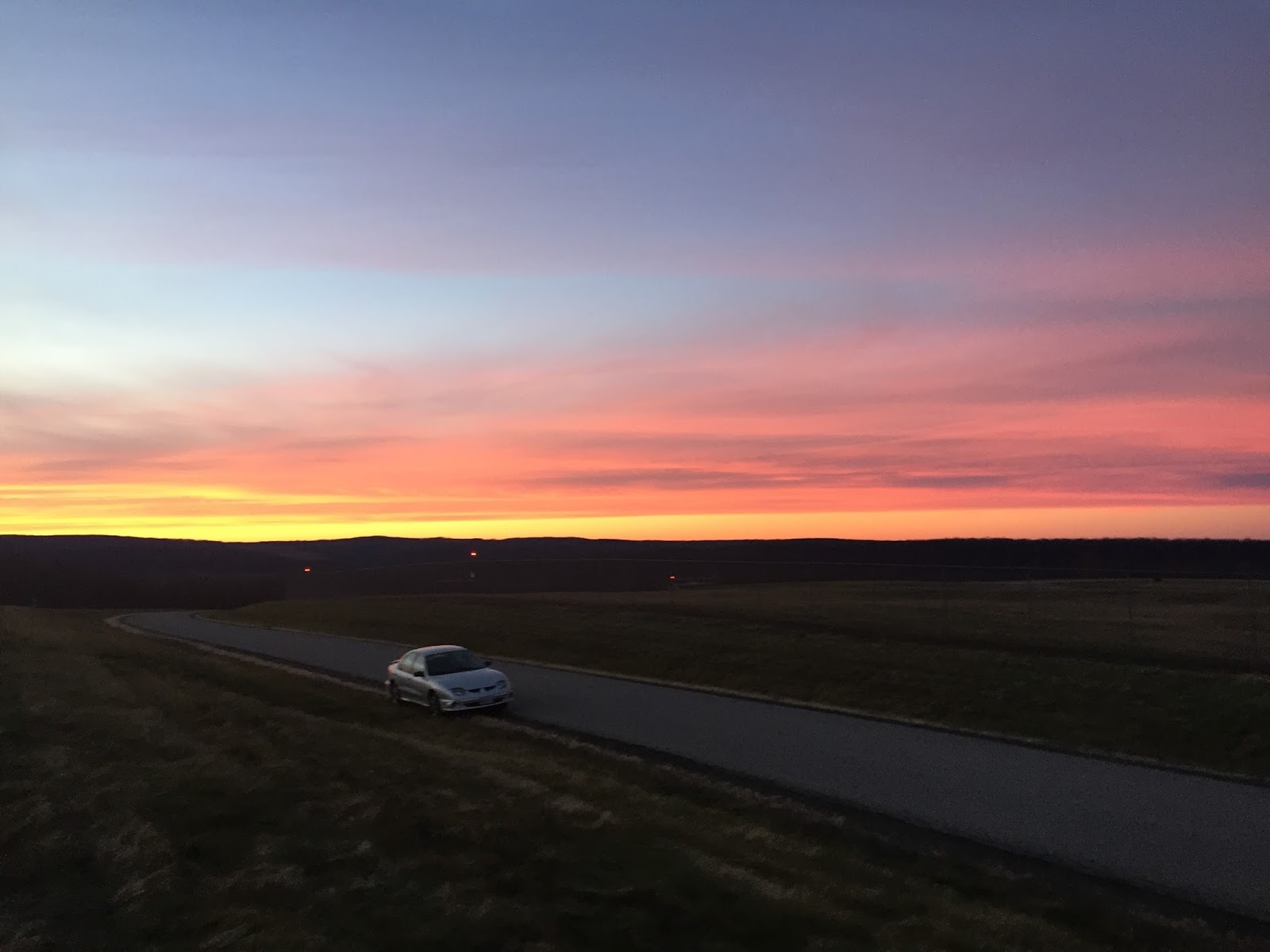
This is the first time this species has been eBirded in Allegany County but I suspect they occur more frequently.  After all, this is a species that one has to target during the right time of day, in the right season, in the right habitat.  It's no wonder that the relative lack of coverage around here hasn't yielded SEOWs before.  Oh, and the sunset from the airport was a colorful one too!
Ashley and I have been trying to explore some of the backroads around here which involves a lot of checklists of BCCH, DEJU, BLJA, and AMCR.  However, we found a nice field or two that was hosting this dark-morph ROUGH-LEGGED HAWK, only my third in the county:
Although I'm sure there are a few around in Allegany County, I certainly wouldn't call it a common species.  This NORTHERN HARRIER also wafted by while we were in the same area:
It might surprise you that this NOHA was the first December eBird record for Allegany County!

Ok, by now in this post you might have noticed a theme... all the birds have talons. Talons. You know... like..
But not all of the highlights have been owls and hawks (or chickens) though.  Probably the best example is this CHIPPING SPARROW that Ashley and I found and photographed just to the south of Wellsville:
Although they breed here during the summer months, they should be well to the south by now and having one in this area is very uncommon.  In fact, here's a screen-capture showing how many December records there are for CHSP so far this month (hint: ours is the only one so far):
I find Allegany County interesting for its water... or lack thereof.  There's a very limited number of large bodies of water in this county.  But, perhaps, the ones that do exist would act a bit as migrant traps?  Just to east of Wellsville is a pond I grew up calling Browns Pond.  Turns out, the birding there can be productive if you time it right.  Although things were quiet on the balmy evening we visited it, the scene wasn't too bland:
However, the main attraction in Allegany County is probably Cuba Lake.  It sits right on the western edge of the county (and so is a 40 min drive from here) but it's probably the best spot in the county to check for rare birds.  The pin marks the spot:
It's not a huge lake, it's about 445 acres or about 0.8 square miles (compare that to Lake Red Rock in Iowa that is 109 square miles!).  Despite the small size, it has an interesting history.  This man-made lake was completed in 1858 and, get this, it was the largest man-made lake in the world at that time!  Who knew?

Here's a panoramic view from the it's-really-not-THAT-impressive dam:
Fair warning though, it can be frustrating to look for access points to bird this lake.  There are a couple of spots though including this one:
Despite the gray skies, you can see a good chunk of the lake from here (which is along the north shore).  You also can see a lot of mud in this photo which is a result of the lake management draining the lake 6-8 feet every winter (it's easier on docks and things when it freezes up completely).

We've seen about 65 species here at the lake which consists mostly of waterfowl.  During our 10 visits to the lake, we've seen things like:

Tundra Swan
Common Loon
Horned & Pied-billed grebes
All 3 merganser species including some day totals of ~200 Hoodeds
5 gull species so far (including Iceland, Lesser Black-backed, Bonaparte's, etc)
5 species of Aythya ducks (LESC, GRSC, RNDU, REDH, and CANV)

In looking at past records on eBird, the lake has had other goodies such as Red Phalarope, all 3 scoters, 9 gull species including Franklin's, Northern Shrike, etc.

In truth, I haven't been taking many photos of the birds there.  Of the few, here's a RED-BREASTED MERGANSER I digiscoped with my phone/scope one day:
I'll end the post with a venture away from Allegany County.  One such visit was to the town of Canandaigua which sits at the northern tip of Canandaigua Lake (the 4th largest of the Finger Lakes).   The name is actually derived from Seneca (which I'm an enrolled member of) meaning "the chosen spot".  I didn't see a ton, honestly, besides some GREAT BLACK-BACKED GULLS and 4 continuing SNOW GEESE:
As an FYI tidbit, did you know that Kristen Wiig was born in Canandaigua?!  That's right, one of my favorite actresses came "all the way from the Finger Lakes".  Remind you of anything?

25 November 2015

Ecuador - Part 3 (misc.)

I figure I may as well throw another post together, this one covering some of the miscellaneous things we saw while visiting the Tandayapa Bird Lodge in Ecuador.  And by miscellaneous, I mean things that AREN'T birds.  Yes yes, I'll slip slightly into the world of insects, mammals, and scenery.

Straightaway, we noticed a LOT of butterflies.  Some families were familiar to us, like this satyr...
Although it's probably a different species from the ones we see here in North America, it didn't exactly blow my mind.  Oh, and no, I don't actually know the species names of these things.... I'm lacking in any book for identifying Ecuadorian bugs!

This guy was pretty vibrant... but I'm still not sure of the family.  Maybe a metalmark or something similar?
I didn't see many skippers but the one I did see was ENORMOUS.  I don't know the species but it rivaled the giant-skippers we have here in the US... at least in size:
This butterfly was also pretty distinctive.  Maybe it's related to the blues or hairstreaks?  These would swarm the moist mud in the road just below the lodge:
In terms of butterflies, nothing there (that I saw) rivaled the number or sheer coolness of the clearwings.  Yes, these butterflies have wings you can see through!
I'm not sure if they're seasonal or what but when we were there, there were hundreds or maybe thousands of these just about everywhere.  Anyone know the species?
On one of the hikes, I saw a couple of damselflies (again, I'm nowhere close to being able to identify these):
 This particular one looks like some kind of rubyspot (at least that's what we call them up here):
Some insects were straight-up pretty large (and identifying them is beyond me):
Not all of the creatures we saw were winged though.  Ashley and I stumbled on this moving lump of leaves... just to realize it wasn't a lump of leaves!
It is, of course, some kind of porcupine! Although I'm not sure if it's an Andean Porcupine (Coendou quichua), a Bicolored Spine Porcupine (Coendou bicolor), or some other species... either way, it was a big deal; all the lodge staff said that this was the first porcupine ever seen on the Tandayapa Lodge grounds. Cool stuff.

I really enjoyed the scenery even though it was dominated by a blanket of green. It started right there from the back patio where you could see through the trees into an expansive valley surrounded by tall, tree-covered mountains:
The lodge sits at about 5700 feet which is higher than the "mile-high" city of Denver.  Even still, the incredibly steep mountains rose above the lodge with an enormous presence.  Often they would "end" where the clouds began:
Sometimes I would just point my camera at a tree on a distant ridge... this one is about to be engulfed by the clouds behind it:
A walk down to the Lower Deck gave another vantage point:
Although I never saw much from this location during our short stay, I'm sure a feeding flock would liven it up immensely:
I found it interesting that Quito, the capital city of Ecuador, sits at 9350 feet in elevation which makes it the highest official capital city in the world.  So confusing as it was, traveling from the city to the lodge was actually all downhill!  After we made the return trip to the airport (all uphill), I snapped a quick picture from the airport entrance.  It was a scenic farewell evening despite the nauseating exhaust pollution:
So that's a wrap.  My next update will be in regards to birding western NY a tad... and I'm guessing it'll have less tropical greens in it!