14 April 2015

State bird (and county nemesis)

Here I am, 5 days after my previous blog post and already sitting only 2 away from 200 in Sacramento County this year.  That means that there's been a fair bit of birding since my last update.  Let's get to it....

Probably most exciting is that Ashley and I finally connected with a county nemesis of ours, LEAST BITTERN.  Turns out it was a state bird for me too (you can tell how little chasing I do).  The kicker is is that this bittern was at Stone Lakes NWR, probably only a couple of miles from where I live.  Of course, we only got to hear it which is often typical of that cryptic species... but we were happy with that.

On the same visit, we connected with another nice species, this one a county year bird (which get harder to come by as you approach 200).  This one has been hanging out in the palms by the HQ building for a couple of weeks now:
HOODED ORIOLES do breed here in Sacramento County but they're fairly uncommon and certainly harder to find around the southern portions of Sacramento County (away from the American River corridor).  Late in the fall, however, I've had HOOR at least twice from my yard.

Marshes around here are still teeming with the raucous RED-WINGED BLACKBIRDS.  No surprise there.
We swung through Cosumnes the other day and had 3 SEMIPALMATED PLOVERS.  They were flagged in eBird (for being early) so I snapped a crappy picture of one of them:
We also had 2 pairs of BLUE-WINGED TEAL which was also flagged.  This species is essentially never common around here.  Here's a male with some goop:
Back at home, check out what showed up at our hummingbird feeder one day:
CALLIOPE HUMMINGBIRDS are flagged any time of year here in Sacramento County but are annual in the spring.  Despite them being rare, I've had great luck with this species at our feeder; I think this was my 8th record from the yard in 3 springs.

A few minutes after the male showed up in my yard, I went to my local patch and one of the first birds I stumbled on there?  Well, have a look:
It's ANOTHER male CALLIOPE.  Things are getting ridiculous.  Luckily I managed to get some proof of him despite him not being at a feeder.

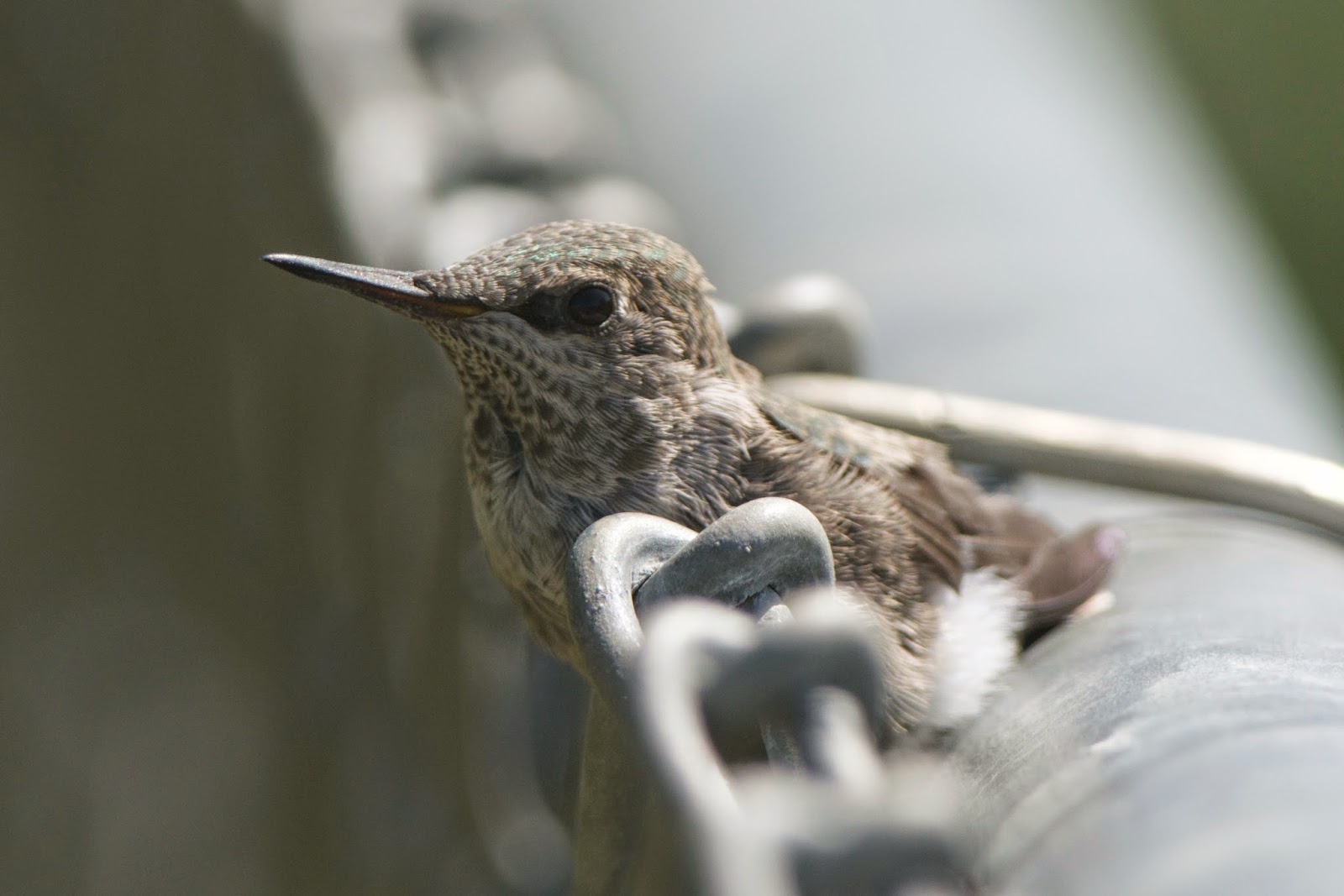
While we're on the topic of hummingbirds, I may as well share this close-up of a young ANNA'S HUMMINGBIRD:
Younger yet was this ANNA'S HUMMINGBIRD that was flying around while still quite downy on its flanks:
I'll throw in a random butterfly picture now.  It's a PAINTED LADY, an abundant species through much of the Lower 48:
Back to birds, a different day found us at Cosumnes River Preserve, this time walking the woods hoping for new migrants.  Although we missed Ash-throated Flycatcher (which had been reported by that point), we were more pleased to find this empid feeding rather high up in the trees:

Any ideas?  The most expected empid right now is Pacific-slope but this bird doesn't have a long bill with a completely pale lower mandible.  In fact, doesn't even have a long bill.  You'll also notice it has fairly long primary projection, at least longer than what you'd expect on a Pac-slope.  Alas, it's a HAMMOND'S FLYCATCHER and it was one of the earliest arrival dates ever for the county (not counting a few winter records).

Oh, the GOLDEN-CROWNED SPARROWS are certainly still around although I can tell some have started to move out.  They're looking pretty sharp these days too:
This male LESSER GOLDFINCH was feeding on the fiddleneck flowers near my local patch here in town.  Goldfinches love this stuff:
Speaking of goldfinches on fiddleneck, we ventured up to Latrobe Road this past weekend with a couple of species in mind, specifically county year birds.  These LAWRENCE'S GOLDFINCHES fit the bill perfectly: 
They weren't overly tame but just standing in the warm, oak foothills on a spring morning and listening to them in full song was a treat.  Here's a picture of a male without the distraction of all the fiddleneck they were feeding on:
Oh, and yes, we finally tracked down some ASH-THROATED FLYCATCHERS.  In fact, they went from nonexistent to abundant in just a few days.  Here's one at the local patch in town yesterday:
Remember the madness with all the CALLIOPE HUMMINGBIRDS?  Yeah, it has continued!  Here's yet another male CALLIOPE feeding on a flowering tree just yesterday:
This was only about 0.5 miles from the male I saw 4 days ago so perhaps it's the same bird?  Either way, I'm starting to think I might be good luck for these!
I had another piece of good fortune yesterday when I happened to find a singing CASSIN'S VIREO in the urban neighborhood right near where I live.  Although they're regular migrants through the valley, it was one of a few migrants that I still needed for the year.  On top of that, I've certainly never had one in such an urban environment around here.  It was clearly a migrant that had dropped in (this was shortly after dawn) and was trying to find some better habitat.  Hopefully it did.

So with that, I'm just about at 200 for the year in Sac County.  What goal can I come up with next?

09 April 2015

April at the LOPA

You know the routine by now; yes, I've birded the local patch and yes, I've seen some stuff from my yard as well.  This post won't break the trend...

I found a COOPER'S HAWK nest between here and the park.  I glance up every time I'm around and most often see a hawk in the area peering back at me:
Cliff Swallows are the most numerous swallow I see on a daily basis around here followed closely by Tree and Barn swallows.  Bank Swallow is the rarest, I've yet to see this species in the county.  Purple Martins nest very locally in the county and I do manage to see them at least once a year.  Notice anything missing?  Yes, we do have NORTHERN ROUGH-WINGED SWALLOWS around too, they're not that uncommon either:
This NORTHERN MOCKINGBIRD allowed some incredible photo ops.  It's probably my best shot of a mockingbird head to date... if I were keeping track:
This time of year has quite a few large shorebirds moving around the valley.  For example, the Long-billed Curlews are migrating out, Whimbrel are migrating through, and BLACK-BELLIED PLOVERS are leaving their wintering grounds and migrating north as well.  Here's a part of a flock of 10 that zoomed north overhead yesterday morning:
CEDAR WAXWINGS tend to stick around.  They don't breed around here but they do spend 10 of the 12 months here so by the time you notice they're gone... they're back.  Here's one at the park:
I usually spend a couple of hours at the local park birding and, as of late, have been reaching about 50 species.  This last visit was my highest total yet of the season (checklist seen here).

Back at home, daily checklists from the yard produce largely the same species.  I have had my first WHIMBREL of the spring though; they'll be coming through in earnest soon and it won't be uncommon to see and hear them from the apartment.  Hummingbirds continue to be frantic at the feeder; I watched a swarm of ~10 the other evening before dusk.  This female RUFOUS HUMMINGBIRD has been a reliable staple the last couple of days as well:
This grainy photo shows another recent arrival, a male BLACK-CHINNED HUMMINGBIRD.  This species will breed in the neighborhood although I've yet to see a female this spring.
Speaking of hummingbirds though, not all of the nests made by ANNA'S HUMMINGBIRDS do a good job at staying where it belongs.  This empty nest had fallen out of a tree by some recent storms:

06 April 2015

Sprung

Indeed, spring has done just that.  The warm days that border on hot, the fully-leafed-out woods, it's a really pleasant time to bird the Central Valley.
 
As one would expect, I've continued to bird local patches of mine, at least ones I can walk to.  Front and center on that short list is Don Nottoli Park just to my south.  

It goes without saying that if you're out and about these days, you'll see that Say's Phoebes have moved out and WESTERN KINGBIRDS are ubiquitous once more:
Although I've fully grown accustomed to these yellow-and-gray kingbirds, I still wonder if deep down my default is still their black-and-white counterparts of the east.  No matter, no matter; these will do for now:
In the summer, it's not uncommon to see 5-7 different species of herons around here.  One of those is certainly the familiar GREAT BLUE HERON, especially considering there is a nesting rookery about a mile away:
Less obvious is the often overlooked GREEN HERON.  This smaller cousin of the above bird posed nicely in some morning light at a nearby lake:
It's not a stellar picture but CACKLING GEESE are now flagged in eBird; it's high time for them to be north of here by now.  I found these two lingering in a grazed portion of Stone Lakes NWR:
A common bird that is NOT flagged is the COMMON YELLOWTHROAT, a familiar denizen of marshes through much of the US.  Although, yes, it has a yellow throat, the distinctive male dons a black face mask.  It's a wonder this species wasn't named Masked Marsh Warbler or something:
On a recent visit to my LOPA, I also stumbled on my first empid of the spring, this PACIFIC-SLOPE FLYCATCHER:
Fieldmarks include fairly yellowish below, greenish above, tear-drop shaped eyering, completely yellow lower mandible, fairly short primary projection, somewhat crested appearance, etc.  The PSFL is also the most-expected empid to be seen at this local patch and especially early in the season like this.  Later in the spring we might get empids like HAMMOND'S, WILLOW, or even a GRAY FLYCATCHER.  Time will tell.

I was birding an open (and generally not birdy) part of the park the other day when I heard a TRICOLORED BLACKBIRD singing somewhere.  I definitely wanted to track the source down, I had only seen TRBL once at this park before and that was mixed in with a large blackbird flock way out in the grasslands.  But this time it sounded like it was coming from one of the baseball diamonds!  I tracked it down to this guy sitting up in a solo tree, not even close to a marsh:
Sure enough, it looks like a young male.  You can see some white starting to emerge on the median coverts.  From a different angle, you can see the oober-slender and sharp bill:
Anyway, with the weekend here and with new year birds waiting for us at various spots across the county, we ventured out several times and ended up tapping into some fortuitous luck.   We first headed out to Meiss Road on Friday night to take a look around.  We got there with an hour or two of remaining light so we ventured to the east end where GRASSHOPPER SPARROWS breed.  Sure enough, about 1.6 miles west from Ione Road, we had this bird north of the road:
As we ventured farther to the west as the light faded, we came upon a pair of BURROWING OWLS out on their porch enjoying the sunset (one would have to assume).  We paused to receive some evil stink-eye from one of them:
The real treat came at sunset when the LESSER NIGHTHAWKS started wafting through the fading light.  This is probably the most reliable spot in Sacramento County to see this uncommon species although we were the first to see them there this spring.  We counted 8 at once which was flagged in eBird; most sightings include 1-5 birds.  Here's two of the closer ones:
The following day we returned to the foothills and managed to keep our good luck rolling.  On Latrobe Road we found a flock of 5 (!) CHIPPING SPARROWS; the most either one of us had ever seen in the county.  Although even one of these would be flagged here, we must have tapped into a bit of a migrating flock.  Here's one that perched up:
We kept our eyes open for another rare but annual sparrow, Brewer's.  No luck, just loads of SAVANNAH SPARROWS such as this one:
Another species that we had in mind was Lawrence's Goldfinch... but we could only find their favorite food source, not the bird itself.  This is Fiddleneck (genus Amsinckia):
We visited our main local patch, Don Nottoli Park, again in hopes of maybe relocating the Pacific-slope Flycatcher.  Instead, a "creamy" smooth warbling song caught my attention.  Then it called... no doubt, we had a grosbeak singing somewhere in the broadleaf trees.  We eventually tracked down this very early BLACK-HEADED GROSBEAK:
I believe that BHGR is the 2nd earliest record ever for Sacramento County (at least in eBird).  While on the topic of early passerines, we also found this flagged WILSON'S WARBLER at Cosumnes yesterday.  It's not a great picture, for sure, but I strive to document every flagged sighting I can:
Even birding from the apartment has been fruitful as of late.  Besides the now-common SWAINSON'S HAWKS that filter north on spring winds just about every day, the hummingbird feeder has seen a level of activity that usually borders on frantic.  I've been surprised to see them consume about a cup of sugar water every day which is far more than other times of the year here.  The main culprits in this act of welcomed feeder thievery are the year-round ANNA'S HUMMINGBIRDS, such as this male that peeked around the feeder one morning:
However, the last week has yielded 4 different species which is another sure sign of spring.  They were:

Anna's Hummingbird
Rufous Hummingbird
Black-chinned Hummingbird
Calliope Hummingbird

The BLACK-CHINNED just arrived yesterday but that species will breed locally and I expect they'll be normal visitors from here on out.  The CALLIOPE was a brief visit by a male but this species has proven to be annual at my feeders during the spring.  The RUFOUS HUMMINGBIRDS are almost daily visitors and will be around through sometime in May when they finally will trickle northward out of the valley.

With that, I'm now sitting in the 190s for the county this year.  I'll be happy if I can make it to 200 before we depart for good.  Cheers.

01 April 2015

Shrike shrieking

I've been back home in California for about a week now and it didn't take long for that to sink in.  Perhaps it was the temperatures in the mid-80s.  This season really is a pleasant time to be in the Central Valley though; the trees have leafed out and newly arrived migrants can be found at your local birding patches.

However, I'd be remiss if I didn't start out with some rarity talk.  While I was in NY, a Code 4 BROWN SHRIKE was found and reported back here in California.  It has stuck around for several weeks which is really not surprisingly considering it probably has spent the past winter there despite being found only recently.  When I returned from NY, Ashley and I ventured up to have a look:
The more interesting aspect with this bird is now the identity is in limbo.  Although it was reported as a BROWN SHRIKE, there are many birders that believe this is actually a RED-BACKED SHRIKE which would be a first record for North America.  Needless to say, the identity isn't clear-cut at this point and as the bird continues to molt its tail, hopefully it'll morph into something we can ID with certainty.

As we watched the shrike from across the ravine, people weren't too interested to see THIS shrike right in front of us.  I assume it's a second BROWN SHRIKE... I mean, it's brown and has a slightly hooked-bill.  That's all you need to know, right?  SCORE.  I'm such a good birder.
Back around home where finding rarities apparently isn't a worry I need to dwell on, I've instead focused on birding a local patch and have been trying to enjoy the common things... like this WESTERN SCRUB-JAY that was rummaging around at close range:
The local RED-WINGED BLACKBIRDS are ubiquitous as ever:

This is the season for BLACK-BELLIED PLOVERS to be on the move; I've seen a flock fly over the house as well as this flock down at Cosumnes River Preserve:
Sometimes you find birds that you're certain are in the process of migrating.  For example, I was walking along a levee trail near home when I found this MARSH WREN on the edge of a grazed pasture.  It eventually hopped up and flew across the trail to a fence line bordering urban apartments.  This isn't even close to the habitat that these guys are looking for.  Regardless, I hope it righted itself the following night when it probably took flight, gained elevation, and migrated north some more.
I found these CACKLING GEESE mixed in with the normal GREATER WHITE-FRONTED GOOSE flock at a local patch.  Surprisingly, this is only the second record of this species at this particular hotspot:
Some birds are already in the thick of chick-rearing; the local ANNA'S HUMMINGBIRDS in my neighborhood have already fledged a brood (and it's not uncommon to see 6 different hummingbirds at my feeders in a given day).  In fact, the family rolls in and does a good job at draining my hummingbird feeder in short order.  The local geese and ducks have hatched chicks as well such as this "mostly" MALLARD:
I'll end with another update to my county map.  (As an aside, I recently reached a milestone in terms of county listing, I reached 500 counties/parishes/census areas/etc).  Anyway, if you look at the shading in western New York, you can see where I did some county listing on my recent trip: