08 January 2014

"PETRELS, ALBATROSSES & STORM-PETRELS OF NORTH AMERICA"

"Petrels, Albatrosses & Storm-Petrels of North America; A Photographic Guide" by Steve N. G. Howell", was published by Princeton University Press in 2012.  It is 483 pages and costs $45.00.


I hope I'm not stepping on anybody's toes by saying this... but if you're a serious birder, you probably own Dunn and Howell's reference guide to gulls of the Americas.  You know the one, the one that's not really a field guide but might be living in a corner of your trunk on road trips and vacations?  THE gull book.  Anyway, this review would be a lot easier if you know that book because, as it so happens, this book is very similar in many ways.

It seems like nearly every book I review has an introduction of some kind or another.  The introduction for this book though is something that actually needs mentioning.  Howell, over the course of 50 pages, lays out a very valuable resource, a very complete overview about these oceanic birds.  Here are a few categories he covers in depth, just to get you started:

What are tubenoses?
Ocean Habits
Current Systems
Thermoclines, Upwelling, and Fronts
Habitat Associations
Phylogeny, Biogeography, and Vagrancy
Taxonomy and an Identification Framework
Field Identification of Tubenoses
Flight Manner
Environmental Factors
Appearance and Topography
Plumage Patterns
Bill Structure and Color
Leg and Foot Color
Molts, Plumages, and Aging
How to See Tubenoses
Conservation
Seabirds as Indicators

The introduction is dotted with photos, interesting graphics, and even extensive tables that compare wingspan and mass of some species (includes average, range, sample size, etc).  Here's an example of a graphic he includes in the introduction on flight manner:

Once you turn to a specific species account later in the book, you can expect several things.  In the case of the Audubon's Shearwater, it is 7 pages long, has a color range map, and 15 photographs spanning 3 pages.  Each species account has measurements such as length, wingspan, tail (including graduation measurements), and bill.  Other categories include taxonomy, background about the names, status and distribution, field identification, habitat and behavior, description, and molt.  Also included is an identification summary, a nice, one paragraph succinct summary of the species, where it's found, flight style, and roughly how to ID it.  Here's a look at one of the range maps, this one for Buller's Shearwater (the numbers refer to the months of the year): 

The setup of the photos is pretty much the same as in the gull book so if you're familiar with that, this will be pretty easy.  The photographs of each species are placed at the end of each species account.    Here is a rough look at some photos from the Pink-footed Shearwater account:

I really enjoyed looking through some species accounts for species I'm not familiar with at all.  For example, have you spent much time with Markham's Storm-Petrels or Chatham Albatrosses?  Probably not.

Some of you are probably wondering why on earth I'm reviewing a book about seabirds in the first place.  Those who know me well probably also know that I get wickedly seasick on just about every body of water imaginable.  It's true, if you've seen me on a pelagic birding trip, you probably saw me wrapped around the back rail with near-suicidal tendencies.  And although I might be one of the least likely people to gain years of experience out on the ocean... that doesn't stop me from seawatching from shore!

It's a rare treat to be reviewing a book like this.  As you've probably seen before, I don't mind ranting about books that I don't like.  I try to be honest, isn't that what a review should be?  But how could I be critical of this book?  I mean, I have so little field experience with so many of these species, it seems silly for me to be critical of anything here.  But like I said, it's a rare treat to be reviewing something like this, something that is actually packed with knowledge (did I mention it's nearly 500 pages long?).  In most bird-related books you pick up these days, that's not the case.  So no complaints from me!

For better or worse, I have come to expect any book by Howell to be of this quality.  And although it's easy for me to fling around summaries here on the web, you really should pick this book up off the shelf (if that's even an option) and flip through it.  It really is a wealth of knowledge and will surely be referenced for decades to come.

So, were you happy with the gull book that Howell and Dunn put out?  Just try to imagine that very valuable resource and translate it to petrels, albatrosses, and storm-petrels.  And although I'm no veteran seabird guide, I believe this book really is the best resource for these species here in North America.  It goes without saying that I'm very excited to have this book in my library and I imagine you might be as well.


Disclaimer:
I received a complementary copy from the publisher for review purposes, 
but the viewpoint expressed in this article is entirely my own.

The Sizable Year at a close

Although it is now a week into the new year, I never formally concluded my Sizable Year here on my blog.

Before I get to the numbers, highlights, and big misses, I figure I may as well mention my last year bird of 2013.  I was visiting Morro Bay in San Luis Obispo County, California... and my timing couldn't have been better.  There was a "King Tide" in the works and I wanted to be on the boardwalk for hopefully a glimpse of the wintering NELSON'S SPARROW.  Although I would see this species each fall when I lived in Iowa, I did not see any this year during my time in Michigan.  And as an added bonus, it would be a new state bird for me here in California.  

I found myself there at dawn, surrounded by the clamorous flocks of BRANT:

Even some CASPIAN TERNS got in on some of the action:

However, people weren't seeing the NELSON'S SPARROW in the usual bush.  I started to wander to other spots in order to sift through all the sparrows as they were being pushed closer and closer to us by the incoming tide.  Before I knew it, there it was, an awesome orange sparrow skulking around not more than 20 feet away!  What luck.  Not everyone got to see the bird and so I consider myself very lucky indeed.

So, the year was finally at a close and I could rest easier knowing I wouldn't be tempted to chase nearby year birds.  It was a fun year for birding, I can't lie.  I had been lucky to do quite a bit of traveling back and forth across the country, managed to do some long-distance chasing, and even managed to see a bunch of birds.  :-)

About halfway through the year, once I realized I was going to target year birds a little, I figured that breaking my previous year list was my initial target (593 species set in 2011).  So that was my goal... at first.  Once I reached that goal, I next took aim at 600 species.  Although, sure, seeing 600 species of birds was nothing compared to the awesome effort into an actual Big Year by Neil Hayward, I was merely a bird bum, a biologist that happened to be doing a lot of traveling.  I'm happy to say that I reached 600 species this year.  In the end, I tallied 611.

The American Birding Association gives a ranking (1-6) to each species on its checklist; 1 for the easiest/commonest species and 5 for the hardest/rarest (code 6 are extinct).  So, I'll give some highlights of code 3 and 4 birds that I was lucky to see in 2013:

Code 3 in plain lowercase, Code 4 in bold, and * for ABA lifer:

* Pink-footed Goose
* White-cheeked Pintail
Tufted Duck
* Masked Booby
* Blue-footed Booby
* Brown Booby
* Northern Lapwing
* Lesser Sand-Plover
* Spotted Redshank
* Black-tailed Godwit
* Black Noddy
*Buff-collared Nightjar
White-eared Hummingbird
* Thick-billed Vireo
* Yellow-green Vireo
* Sky Lark
* Red-flanked Bluetail
Clay-colored Thrush
Rufous-capped Warbler
* Western Spindalis
White-collared Seedeater
* Little Bunting
* Shiny Cowbird
* Brambling

In total, I added 26 new ABA birds to my life list in 2013, much greater than anything I would have imagined at the start of the year.  In fact, this was my most productive year for life birds since 2004, nearly 10 years ago!

Personally, I think it would be more interesting to hear what I missed instead of what I actually saw.  Of course I missed many things that I never tried for (for example, I never visited Alaska, I didn't do any pelagic birding, and I didn't visit the north Atlantic coast).  Still, some species that slipped through really stand out to me:

King Eider
Little Gull
Ruff
Yellow Rail
Whooping Crane
Greater and Lesser prairie-chicken
Greater and Gunnison sage-grouse
Flammulated Owl
Northern Hawk Owl
Boreal Owl
Amazon Kingfisher
Black-billed Cuckoo
Citrine Wagtail
Sinaloa Wren
Connecticut Warbler
Baird's Sparrow
Common Redpoll
Hoary Redpoll

So with that, I'd like to thank all of the birders that helped me out as I chased a few birds here and there.

Here's to 2014...

29 December 2013

Sizable slowing

As the "Sizable Year" is coming to a close, I've had half a mind to focus on chasing year birds whereas the more logical half just stays local.  

The part that whispers rotten things in my ears, like "Go to Bodega Bay, maybe you can find an Ancient Murrelet or Short-tailed Shearwater" got the best of me last week.  Neither of those year birds materialized in my optics so I had to take pictures of more common species.  First up, a standard WHITE-CROWNED SPARROW:

The number of BRANT was pretty decent (~1500), as one would expect, including some that weren't way out in the middle of the bay:

The wintering flock of MARBLED GODWITS and WILLETS were reliable as ever at Porto Bodega:

Birders who have been birding for a long time notice when other birders mispronounce names.  It just happens.  An example I've heard a lot through the years is calling a scoter a "scooter".  Well, here's the boat version of this FAIL:

I really do like Bodega Bay although THE BIRDS never seem to mob me for some strange reason.  Here's a view of the jetties on this clear winter day:

I also took a quick trip down to Morro Bay in San Luis Obispo County.  Although I didn't see any year birds, I did find these three ROSS'S GEESE roosting with a flock of gulls!  This sighting was apparently quite uncommon for this location; the last time 3+ had been seen was back in 2007:

I think I'll be back to Morro Bay soon; it's a really species-rich area with a lot of potential (yes, I'm only realizing this after living in CA for 2-3 years).  

But like I said above, some of my birding has just been local.  For instance, I drove south 15 minutes to Staten Island which is a great place to sift through waterfowl.  In jotting down a few neck collar codes on "Aleutian" Cackling Geese, I stumbled on this weirdo.  It looks to be a CANADA X GREATER WHITE-FRONTED GOOSE hybrid:


I do have some more plans to chase year birds in this last week so stay tuned...

20 December 2013

Bunt

Getting news like this was difficult... difficult because I had just left California for Missouri.  You see, the news came in of a LITTLE BUNTING in Humboldt County, California.  I knew I'd chase it as soon as I got back to CA on Sunday but that's only if the bird stuck around.  Would it?

The Little Bunting doesn't belong in this part of the world and I had never seen one before... anywhere.  Although there are many records from western Alaska, they're even harder to come by down here in California.  In fact, this particular bunting was the 4th for California and only the 5th for the Lower 48 states.

Day after day passed and the bird thankfully was seen each and every day.  In fact, I saw one report saying "nobody has missed it".  Hmm, sounded promising!

After we returned from the Midwest, I headed up to Humboldt County without much hesitation.  I arrived at the cow pasture with only an hour left of daylight:

View Little Bunting in a larger map

Thankfully, birders were still present and had the bird primed and ready.  Hanging out with SAVANNAH SPARROWS, you can see the LITTLE BUNTING in front with the chestnut ear-patch:

I was pleased!  So much so that I figured I'd return the next day to enjoy the bird some more.  When I arrived, even more people were present:

It doesn't look like much but this portion of the field is home to a Little Bunting, a code 4 rarity from Asia:

Birders said it was present in this patch of grass.  Do you see it?

No wonder LITTLE BUNTINGS aren't found more often, it blends in quite well when it has its head down feeding.  But wait until it pops up, now it's not so subtle:

I snapped a few more photos before I moved on, this time digiscoping (holding a point-and-shoot digital camera up to my spotting scope):


My next destination was the north jetty there in Humboldt County.  I wouldn't mind snagging ROCK SANDPIPER and maybe some murrelets for my year list.  I found some shorebirds without much trouble but the sandpiper I wanted wasn't with them.  Here's a photo showing SURFBIRDS and BLACK TURNSTONES.  The Surfbirds are grayer with a pale base to a more-blunt bill.  The turnstones have a thinner, mostly-black bill:

Here's a SURFBIRD a bit closer:

... and likewise with this BLACK TURNSTONE:

I did see several MARBLED MURRELETS off of the jetty (year bird) but didn't see any other alcids or phalaropes.  I had some other targets but I headed home instead.  I'll be back up here in a week and I'll worry more about those targets later.

11 December 2013

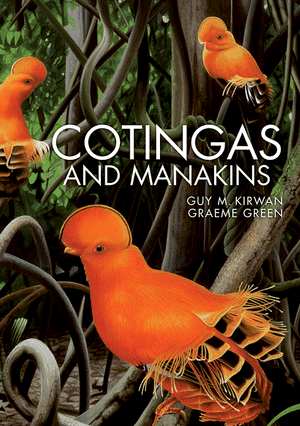
"COTINGAS AND MANAKINS"

"COTINGAS AND MANAKINS", by Guy M. Kirwan and Graeme Green, was published by Princeton University Press in 2011.  It is 624 pages and costs $55.00.


Ahh, what a refreshing change from my last book review!  Here is a book that is both useful and completely astounding.  I won't waste time either... if you want the best resource on cotingas and manakins, go buy this book!

Many of you are probably familiar with "the gull book" by Howell and Dunn, right?  Well, this book follows much of the same format but obviously focuses on the cotingas and manakins of the world (more than 130 species).  Oh, and it makes the gull book look like child's play!  And by that.... I mean this book is a beast of research.  Let's take a quick random peek inside before I go any further:

Exactly.  That's just a portion of the account for a single species.  In truth, this book seems like a culmination of every piece of knowledge ever published on these exclusively tropical New World families.  Yes, this is very much a reference guide but one that you'll probably pull out from time to time even if you AREN'T planning a trip to South America.

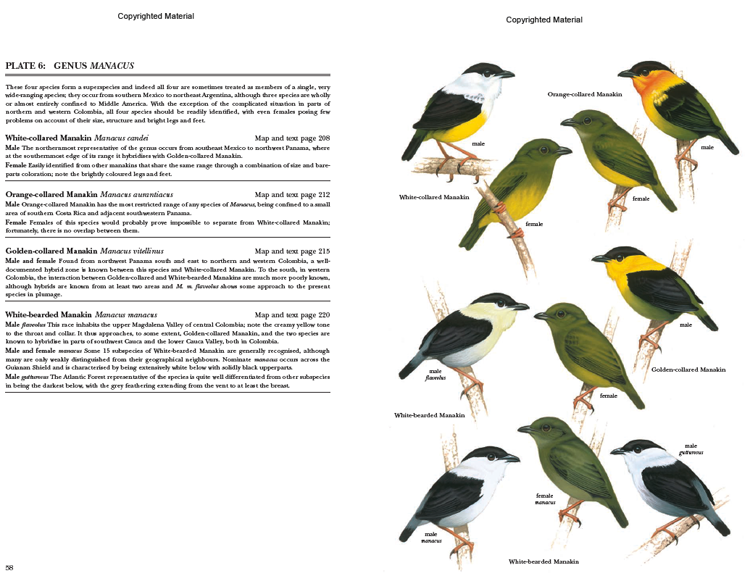
One of the reasons this book blew me away was simply the art (by Eustace Barnes).  Other books often have all the manakins jammed onto 2-3 plates which makes it colorful... but maybe not all that easy to navigate between A and B.  The plates in this book though are big, spacious, and detailed.  Here are some samples:


The species accounts are incredibly in-depth, more so than probably any other single source on these families.   Here are the subheadings found with most accounts:

Identification
Distribution
Movements
Habitat
Description
Measurements
Geographical Variation
Voice
Natural History
Food and Feeding
Display
Breeding
Status
References

With those categories, followed by a culmination of literature on each, you can imagine reading about some of these strange species.  For example, the Chestnut-capped Piha, which was discovered only in 1999, is limited to a narrow belt of ultra-humid premontane 'cloud forest', at 1,500-1,820m in Colombia.  It was actually discovered in an area that was politically unstable but still largely ornithologically unexplored.  Reading about such species, it really makes me wonder how many other species might be lurking around, completely undiscovered.

There are very detailed range maps accompanying these species accounts (including all the known subspecies); here's a quick sample of the map for Sharpbill (Oxyruncus cristatus): 

As you're probably aware, there are many genera in these two families, some that you might not be aware existed there.  Besides species with the actual "manakin" and "cotinga" in the name, here are some examples of included genera:

Mourner
Purpletuft
Fruiteater
Piha
Fruitcrow
Bellbird
Umbrellabird
Cock-of-the-Rock
Plantcutter
Piprites

All in all, I found this book not only to rose to exceedingly high standards with the plethora of information and research, but I also found it visually stunning with amazing art and detailed map layouts.  Although I, personally, haven't had the good fortune of spending time with many of these species, I can't imagine another more-detailed resource for these species exists.  In truth, this book was almost capable of causing me depression... depression from not having spent more time around these fascinating and still relatively unknown tropical species.

Disclaimer:
I received a complementary copy from the publisher for review purposes, 
but the viewpoint expressed in this article is entirely my own.