12 March 2014

THE SIBLEY GUIDE TO BIRDS, 2ND EDITION

There's a lot of buzz regarding the new Sibley Guide to Birds that was released yesterday.  This post won't be so much of a formal review as just a collection of photos I took with my phone this morning.

A lot of the hype has been about the darkness of the reds.  Here's a comparison with the new edition on the left and the old edition on the right:

Thoughts?  Is the new one too dark?  Or is the 1st edition too washed out?  Or both?  Most people agree that many of the plates are much too dark.

The Nature Travel Network review, by Brooke McDonald, can be seen here.  In response to this complaint, Sibley responded with:
"There is a fairly dramatic contrast between the colors of the first and second editions.  I would describe the new printing as rich, deep colors and excellent detail, on bright white paper, and the first edition actually looks washed-out in comparison.  It's possible that some will find the new colors too dark, or it may just take some getting-used-to after using the first editions for years."
So there you have it... just get used to it.  Anyway, you'll also notice he changed the font and removed the little guide-lines (like the ones pointing to the gray bill and brilliant red).

Most of the artwork is the same, just slightly enlarged.  However, he has reworked many spreads including the bluebirds:

And to be honest, I feel like the blues on the Eastern & Western are noticeably too dark here, ESPECIALLY on the Western Bluebird (which is hard to see in this picture).

I was fairly impressed with his reworked spread of finches.  I like the improvements here:

One MEGA difference is that Sibley added a BUNCH of rare species to this edition:


Yay for Humboldt County birders:

Rare swifts now have a page; here Common Swift on the left and Fork-tailed Swift on the right:

However, many of the new additions are noticeably lacking in fine detail (I'm not an artist and so I apologize for not knowing all the different styles and terminology).  For example, I found the illustration of the Redwing (lower right) to be visibly... sketchy:

I found some insight though.  In an interview with Birdwatching Daily (which you can read here), he was asked what was the hardest thing about revising the book.  He responded:
"Trying to blend the new work with the old. The original paintings were done in one marathon session about five years long. There’s a difference between the earliest and latest work in that time, but my style, the colors I used, and the flow of the work were unified. 
It’s been almost 15 years since I finished those paintings. My painting style has changed, the colors on my palette have changed, my eyesight has changed, and so much more, but I was still trying to create new paintings that would blend with the old ones, and I was doing a relatively small number of new paintings in small batches, not the continuous stream of work week after week that I did for the first guide. 
It was an impossible task: I couldn’t really match the old paintings. When the new ones didn’t quite match, I was faced with a choice — revise the old ones to try to bring them closer to the new, revise the new ones, or just let them be different. I think I chose each of these options at different times, and, hopefully, the contrast of styles won’t be a distraction to readers."
But yeah, I think it's noticeable.  For example, this Fork-tailed Swift just lacks the super fine details:

Here are some mixes of rare species (on the ABA checklist) together with some NOT on the checklist:


Hey, now that the book is slightly bigger in dimensions, you notice the blank white space a lot more.  I just scribbled all around in it to calm my nerves and make it feel more busy:

Speaking of blank space, why is the Nutmeg Mannikin illustration so small?  I mean, it could be twice as big:

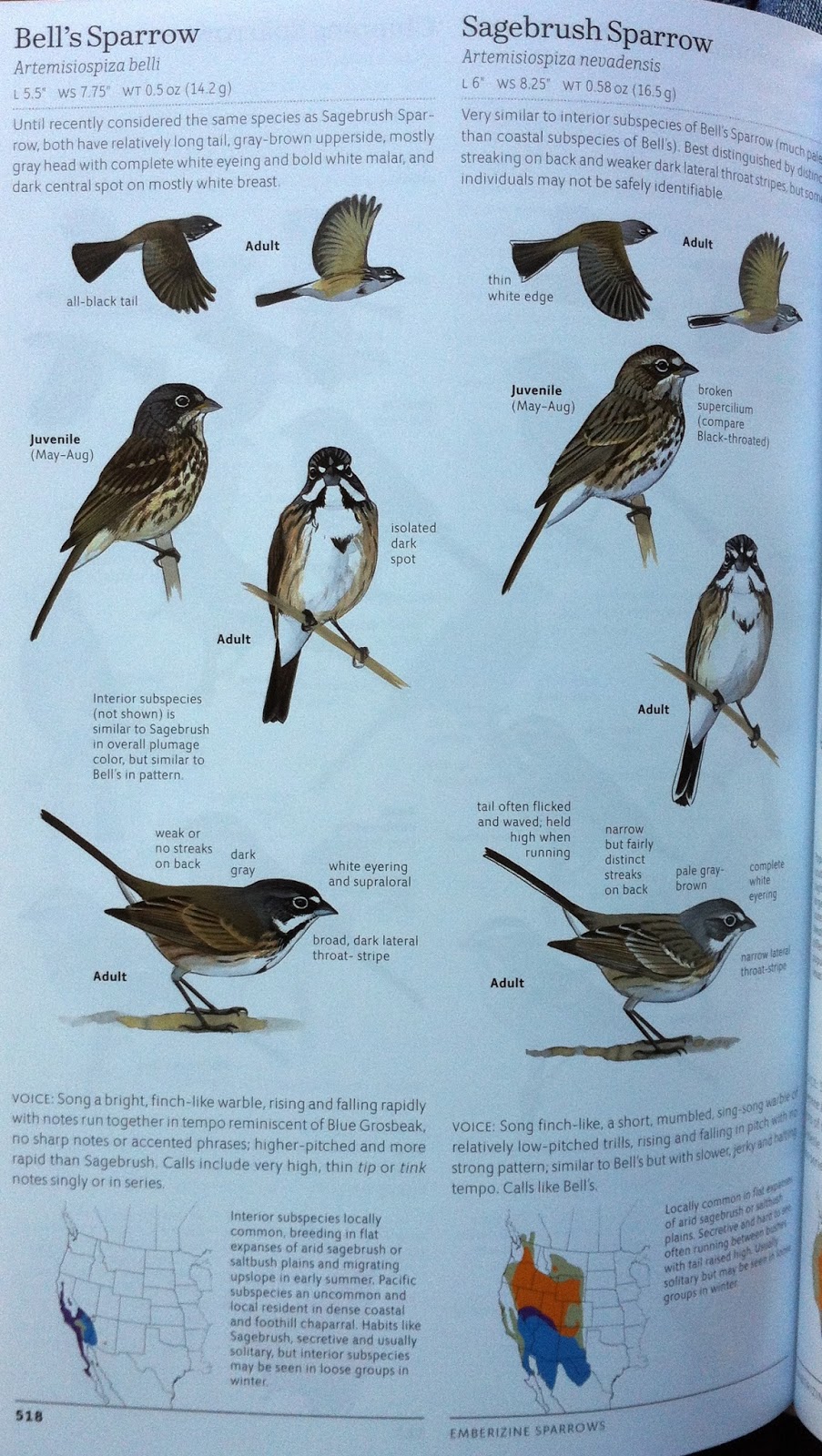
One perk is having a book that is relatively up-to-date with taxonomy.  For example, we now have a book where "Bell's Sparrow" is split out from "Sagebrush Sparrow":

... and the miracle whips:

It's been a while since these have been split and renamed:
 

Probably the biggest disappointment for me, besides the darkness issue, is that Sibley continues to leave out the scientific names of subspecies.  Instead he just calls them generic things like "Red" or "Sooty" and sometimes he just makes up his own names.  At least he included separate maps for some of the obvious subspecies:


For some random species, he added little illustrations at the top of flying flocks:

Speaking about the tops of pages, he included some new "flying-away" illustrations:

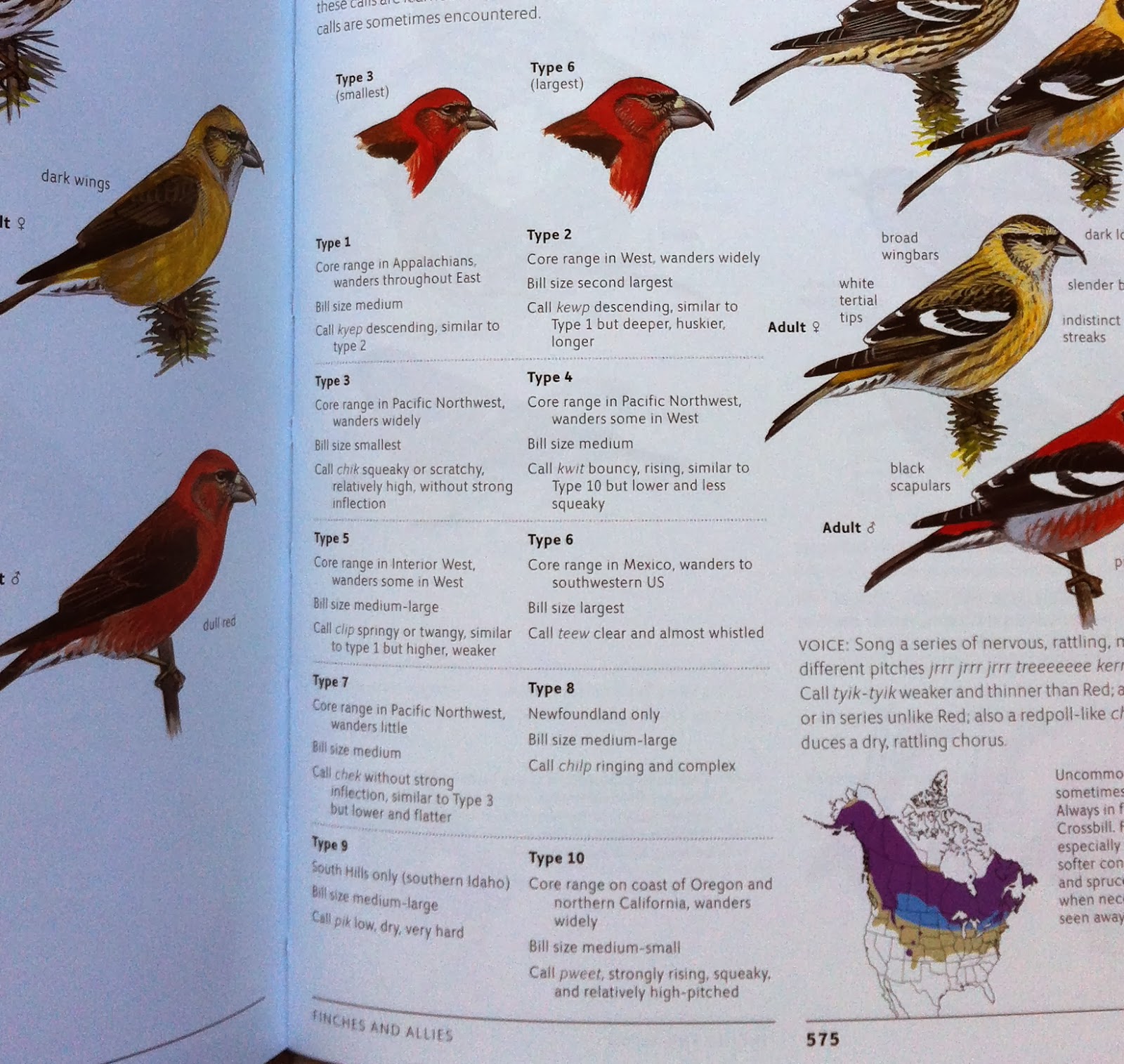
Red Crossbills get a little more coverage but what I'd really like to see are separate range maps of crossbill types:
If you're a beginner and enjoy checking boxes, the checklist in the back of the book should tickle your innards:

Range maps, which were done by Paul Lehman, are more zoomed-in to a regional level.... sometimes (he could afford to zoom in more on things like Baird's Sparrows).  Here's the map for the Purple Swamphen:

Check out the super sweet range map of Cackling Goose though!

Oh wait, that's the map from the newest National Geographic book, NOT the newest Sibley.  Here's the Cackling Goose map from the newest Sibley:

Now tell me, which map would you rather look at?  I might add that the Sibley map is 1.5" from lower left to upper right... whereas the Nat. Geo. map is 5.5"!

You'll also notice, NO GREEN DOTS in any of the Sibley range maps anymore.  I understand it would be quite an undertaking to include accurate dots of records... BUT I WANT THAT, NOT THIS:

Some of the spreads are not very neatly organized (understandable when you're combining multiple races of one species, multiple types of hybrids, a domestic, along with the heads of 2 other rare species):

You'll notice some new additions here and there like this illustration of tern bills:

But man, some of the illustrations don't impress me.... like this Least Tern:

Pigeons, oh, pigeons:

Yuck pigeon!  And I mean the detail of this artwork, not the actual pigeon:

Sibley adds some new details about owling, as you can see below:

Um... the correct spacing is "Le Conte's Sparrow", not "LeConte's Sparrow".  I know, I know, it's not a big deal to most of you, I understand, but I immediately noticed the error on page 522.

Personally, I'd axe the below text and add more hummingbird hybrid illustrations... namely Costa's X Lucifer:

Anyway, if you want some truly *amazing* artwork, check out the Rare Birds book I reviewed lately.  If that's the standard I judge by from now on, I'm going to live a very unhappy life.


10 March 2014

Simmer down

With the modern birding world still reeling from my infamously witty and acidic previous post, read by thousands of hardcore birders (or 68 bored people), I decided to take it up a notch and elevate this post to something pertinent... more local birding.

Ok, so maybe not so pertinent to many of you but alas, it's just a brief update.  So, one thing the Central Valley has plenty of in the winter are geese.  Nope, no shortage here, they winter here by the thousands (actually, it's thought the Central Valley hosts 3/4 of a million).  You can expect all the normal inland species in the Sacramento Valley (head 2 hours west if you want Brant).  Around here, the list from most expected to least expected species (for me, at least) goes like:

Greater White-fronted Geese
Canada Geese
Cackling Geese
Snow Geese
Ross's Geese

One local area I've been visiting lately is Staten Island in San Joaquin County.  It's here that one can sift through thousands of the "Aleutian" subspecies of Cackling Goose.  Here's a typical view with an oddball mixed in (and no prize for picking the oddball out):

Once you zoom in a bit you start to notice things.  For example, here's a minima Cackling Goose with a yellow neck collar:

For me, that's a pretty big deal.  See, I've been recording the combos on neck collars on-and-off for three winters and this is the first yellow one I've ever seen.  I suspect it bred in western Alaska but I haven't heard back from any officials yet.  If you look behind and to the right of that bird, you'll notice a typical blue collar on a leucopareia Cackler.  Here's another look at the yellow collar:

Elsewhere in Sacramento County, I stumbled on this hybrid goose showing traits of Canada Goose and Greater White-fronted Goose.  In fact, this is the third hybrid of that pairing that I've seen since I've lived here.  It really jumps out in a flock of GWFG too:

Or if a standard Canada Goose does much for you, we have those too:

There's one particularly uncommon wintering shorebird species in the Central Valley that still really interests me; the Mountain Plover.  Around here, the best location is near Hwy 113 south of Dixon and northwest of Rio Vista (this is in Solano County).  They can be tricky little devils to find when you want because there is a LOT of open habitat out there and they can blend in perfectly if they so choose.  I swung by the fields the other day and was happy to find 109+ of them in this particular field off Robinson Road.  Did I mention how distant they were?  Look at the distant blobs and try to use your imagination:

There is another neat shorebird species that winters here... and it's slightly bigger.  In fact, it's the biggest shorebird in North America and around here, Long-billed Curlews can form large flocks (500+).  I actually studied this species in western Nebraska from 2008-2011 for my Masters Degree.   Around here, though, I figured the birds were oblivious to me and my history of terrorizing their kind.  So when this flock got up and started flying away, I was somewhat relieved:

... just to see them turn and aim right for me!  Thankfully, they pulled back and swung wide around me:

Just today I visited the nearest local patch of mine, Don Nottoli Park in Elk Grove.  I ended with ~45 species including this Black-crowned Night-Heron which is only the third record for this hotspot:

However, what do you get when a night-heron is flying around in the territory of a grumpy Cooper's Hawk?  Well, this photo shows the start of the chase:

Through much squawking and shrieking from the night-heron, the Cooper's eventually drove off the heron.  Thanks a lot, no wonder I almost never see night-herons there.

Lastly, the Killdeer in the park are paired up and staking out the apparently prime habitat of woodchips.  Whatever you say, silly plovers:

06 March 2014

Facebook stadium banter

The big day is finally here.  You're amped because, well, you'll be under the same roof as the best birders in the world.  Not only that, but this will be the largest gathering of birders under one roof... EVER.  Let's say the state-of-the-art conference, sponsored by the American Birding Association, will be held in this stadium:

Once you arrive and find your seat (Section 307, Row, 9, seat 3, btw), you're amazed at how many people are showing up... at least a thousand, and then another thousand.  Birders continue to pour in and fill the stadium, many donning their "outdoor approved" tan vests with a myriad of pockets just bursting at the seams with the latest birding gadget or Crossley Guide.  By the start, there are nearly 5000 people jammed under this roof.  The dull roar of thousands of people talking to their neighbors is almost deafening.  No doubt many are clamoring about the newest edition of the Sibley Guide that is going to be released in less than a week.

Pretty soon the crowd hushes as a birder walks up to the mic with some interesting news, a Barnacle Goose was just found... and it was only 5 blocks away.  You sit there and think to yourself "You know, I'm really happy they mentioned that rarity sighting!".   You start to notice a small smattering of birders getting up from their seats and heading out, presumably to go try to relocate the goose.  However, one of them makes their way to the stage.  It's someone you've never heard of or met before but maybe they have something useful to add?

They boldly walk up to the mic and proclaim "wow".  But... that was it.  They turned around and climbed off stage!

You sit there dumbfounded... did someone really just do that?  Did someone truly get up out of their seat, wander down 30 rows, walk up onto the stage.... just to say "wow" into the microphone?  Before you can fully comprehend what just happened, you see another person making their way to the mic.  You think "Oh thank god, hopefully it's an organizer who can bring us back on topic".  They tap the microphone thrice, clear their throat, and gurgle "I hope it waits for me to see it!" before stepping down and heading back to their seat.  You start to see people rolling their eyes.  "Who WOULDN'T want it to wait for them?" one birder asks another.  It's a good point... does that birder actually know how completely unhelpful that comment was for the rest of us?  I mean, you hate to be cruel but seriously...

Shocked, you continue to sit there as person after person, making a fool of themselves (in your opinion), stand there in front of thousands of birders just to say things like:

"Nice!"
"Awesome."
"Wow"
"Yikes!"
"Wow, amazing!  Never would think it would be down there."
"Sweet!"

One guy even proclaimed to the world "Great bird.  You are building quite a list - but I'm still ahead of you in warblers."  Um.... what?  Who is this guy talking to?  And... WHY WOULD YOU TELL THAT TO THOUSANDS OF PEOPLE?  You shake your head... this just doesn't make sense AND it's wasting your time.  You'd leave the stadium but you don't want to miss any pertinent information that might come through so, in essence, you're trapped there.

So, have you made the connection yet?  Of course, there was no conference, it's just a comparison to the Facebook groups that are made for sharing rare bird reports.  See, Facebook is now a major player in spreading the word of rarities via various groups (such as the ABA Rare Birds group).  However, when people report rare birds now, there is always a surge of useless banter.  When I used to see that a new comment had been posted, I'd look at the group immediately expecting either a follow-up post or something useful.  Now, sadly, I expect crap.

"I think we are leaving Sunday AM if it's still there Saturday."

Thank you.  Now would you please keep your daily diaries to yourself?  I don't think you'd be amused if I logged on and proclaimed to everybody "Hey everyone!  I'm Cory Gregory and I sure do like how longspurs look".

So yes, all those above lines, those are actual quotes I pulled from some recent Facebook groups.  In my opinion, they a) are completely useless to all of us, b) should not be allowed, and c) are diluting valuable information.  If you want to show everyone that you're impressed or that you like the post, that's what clicking this is for!

The problem is just the cyberspace disconnect these days; it's too easy for people to type something in 3 seconds and push enter.  In other words, it's easier for everyone to comment which means more comments which sadly seems to indicate more idiotic comments as well.

Don't believe me?  Let's look at the two most-recent threads on the ABA Rare Birds group.  First up is this very interesting report/photo of a Redwing in British Columbia that was found in December 2013:

Check out the second comment.  He (a local birder, actually) asks a question when the answer is RIGHT THERE.  Please, people, READ before you ask!

Secondly, here's a legitimate post about a Smith's Longspur in NJ:


But what about the two comments?  Are either of those helpful to absolutely anyone?  If not, why post them in front of ~5000 people?!  I'm assuming, maybe wrongly, that these commenters understand that we all have to look at it?

There is no doubt that Facebook groups have revolutionized how birders spread word about rare birds, and in truth, I'm a huge fan of the idea of spreading word quickly but there's a dark underbelly to these groups that is indeed ugly.  There is a slippery slope between usefulness and uselessness that some Facebook groups just can not find traction on.  By allowing birders to leave these steaming piles of digital... litter, the useful information it slowly but surely being drowned out.  I would be overjoyed if a moderator with a bit more online presence and a heavier hand started laying out some rules (that were enforced) for posting to these groups.  How about starting with:

Post only if it's useful.

I would strongly encourage every birder out there who uses these groups to step back and THINK first before you go blabbering to the rest of us.  Why not treat these threads more like a listserve post and less like a wandering thought?  Surely you'd never send an email out to 5,000 listserve subscribers just to say "Yikes!", riiighhtt?

I'd say there is still hope for cleaning up these groups but, well, I highly doubt it'll happen.  It's a slippery slope... and it doesn't look like it's drying out anytime soon.

03 March 2014

TriMerlined Gull

It's hard for me to believe that it's been more than a week since my last blog post.  You know how the adage goes: "Time flies when you're... not doing anything."

First up is a relatively tame MERLIN on Staten Island in San Joaquin County:

For some reason, this species has been decidedly tricky for me to find in Sacramento County this year; I have only one sighting so far.

This past weekend we spent a few hours in Solano County before the rain hit.  We stumbled into a flock of TRICOLORED BLACKBIRDS numbering ~400 birds.  Here are a few shots:

It's interesting how the closed wing of a perched TRBL shows very little color peeking out on the shoulder; the abundant RED-WINGED BLACKBIRDS almost always show more.  Either way, I especially like this picture of a spread-winged TRICOLORED:

Moving up on the "Stank-o-Meter", the nearby dump attracts a multitude of gulls to sift through.  Our best find was this first-cycle GLAUCOUS GULL (you can see it peeking out from behind the HERRING GULL in front):

Although this particular picture doesn't show it, the bird was very pale with completely pure white wingtips as one would expect on Glaucous Gull.

That's all for now but I promise to all three of you that I'll post again in the next few days....

25 February 2014

Cory Gregory's photostream

California Quail (Callipepla californica)Mountain Bluebird (Sialia currucoides)Mountain Bluebird (Sialia currucoides)Vesper Sparrow (Pooecetes gramineus)Vesper Sparrow (Pooecetes gramineus)Eurasian Wigeon (Anas penelope)
Prairie Falcon (Falco mexicanus)Gyrfalcon (Falco rusticolus)Nuttall's Woodpecker (Picoides nuttallii)"Slate-colored" Dark-eyed Junco (Junco hyemalis hyemalis)Townsend's Warbler (Setophaga townsendi)"Red-shafted" Northern Flicker (Colaptes auratus cafer)
Anna's Hummingbird (Calypte anna)Whimbrel (front; Numenius phaeopus) and Pacific Golden-Plover (back; Pluvialis fulva)White-throated Swift (Aeronautes saxatalis)"Yellow-shafted" Northern Flicker (Colaptes auratus auratus)"Yellow-shafted" Northern Flicker (Colaptes auratus auratus)Hooded Mergansers (Lophodytes cucullatus)
Western Tanager (Piranga ludoviciana)Varied Thrush (Ixoreus naevius)Double-crested Cormorant (Phalacrocorax auritus)Blue-winged Teal (Anas discors)Northern Pintail (Anas acuta)Red-breasted Sapsucker (Sphyrapicus ruber daggetti)

If you're after more pictures of mine, consider visiting my Flickr page. I have nearly 5000 posted so that should keep you busy for a while. :-)