04 August 2014

Tatts for tots

We FINALLY have a break in the weather happening which hopefully pushes in some interesting birds in the coming days.  The winds first started coming out of the northwest but never got that strong, maybe 20 mph.  However, they were apparently strong enough to bring in a bunch of adult tattlers; I had 10 WANDERING and 2 GRAY-TAILED between two stops the other morning.  Here is one of the latter behind its darker-backed relative:
Here's a different WANDERING TATTLER from yesterday, an ultra dark and barred individual, but notice how my digiscoping phone makes the grays look more like browns.  Oh well, the scope view was fantastic!
Birds don't arrive on St. Paul via this aircraft... but you would if you chose to visit: 
(I figured I'd take a pic since I was birding at Tonki Point and saw the plane coming right by).

Kittiwakes are doing interesting things these days.  First, here's a RED-LEGGED KITTIWAKE on the very-convenient Ridge Wall cliff which was the first time I had seen them perched there:
Some of the RLKIs are showing signs of basic (winter) plumage too; notice the black dot on the cheek:
But still, most are their usual, attractive self:
I also saw my first local fledged juvenile BLACK-LEGGED KITTIWAKE flying around Reef Point yesterday.  Such boldly-marked creatures!  Also at Reef Point, the evening puffin show continues to impress.  Here are a few of the clown-like HORNED PUFFINS debating rock perches:
Speaking of HORNED PUFFIN, here's another digiscoped photo I took with my phone yesterday:
It's early-August and we're already noticing that some species of auklets are getting harder to find.  We still see them if we go to their favorite spots but they're definitely less noticeable than earlier in the season.  Perhaps the one I see least often now is Least Auklet.  However, the PARAKEET AUKLETS, like the one below, are still on the cliffs in full force:
Anyway, hopefully my next update will bring news of uncommon arrivals.  Cheers.

01 August 2014

1/2 down, 1/2 to go

It’s August and that means that my season on St. Paul Island is now half over.  I’ve been here for about 78 days and have about 76 days left.  It’s hard to say if the time has gone by quickly or slowly… but it’s definitely gone.  Looking ahead, simply put, I hope the fall is jammed with stunning rarities.

For the time being, though, it’s been dreadfully slow birding and actually very warm.  The temperature reached the mid-60s yesterday which was flirting with the all-time record high of 68 degrees.  That means a couple of things; first, you can actually walk around in a t-shirt if you feel so inclined (although I seem to basically live in my fleece regardless) and secondly, these seals look HOT:
 
You can see how one female is pointing up to cool down but the other is bent backwards.  While I’m not sure what the function of bending that far back is (or did she just fall asleep?), it’s a pretty common thing to see when the temperatures creep upward.

Perched actually on the seal blind we were on, this GRAY-CROWNED ROSY-FINCH didn’t seem to notice the heat (or me) that much:
 
I’ve spent a few hours guiding at Reef Point lately which is typical due to the very close nesting seabirds there.  I glanced down though to see this guy sitting below me on the rocks.  It’s a not-quite-adult SLATY-BACKED GULL, the 4th largest gull species in the world:
 
Us birders continue to check wetlands on a daily basis in hopes of finding different and/or rare shorebirds.  Although we haven’t had many rarities lately, it’s been fun tracking the progress of the nesting birds (and the drying up wetlands).  Problem is, when a young RED-NECKED PHALAROPE spots you nearby, this is the view you typically have of it:
 
Speaking of phalaropes though, there’s been a fairly large flock of RED PHALAROPES off the north coast of the island lately.  Yesterday from Marunich I saw swarms, probably about 8000.

The highlight at Marunich though was a banded RUDDY TURNSTONE.  Although I’m still trying to track down who did the banding, it’s possible that this is the first banded RUDDY TURNSTONE ever seen on this island.  Although I didn’t manage to get photos, it had a blue flag (with “89” or “B9” written in white) above a white flag on its lower left leg.  The lower right leg only had a metal band.  I’ll keep you posted if I learn anything more about it.

Perhaps the second-most interesting thing about that visit to Marunich, and what I’ll leave you with, was the stunning view of the Bering Sea on that calm morning:

29 July 2014

Don't touch the bumblebee's house!

Finally, I have other things to blame for not getting a timely blog post written!  Usually it’s just my indolence but this time I get to point to our internet problems (half the town lost their internet for a while) and the fact that I’ve actually been working.  Yes, when one of these anchors offshore, better brace yourself:
 
So yes, we occasionally get cruise ships that unload 100-300 people on our shores leaving us to transport them, show them the bird cliffs, the church, etc.  Sometimes they speak English, sometimes they don’t.  I’ve grown accustomed to standing next to my scope with my finger pointing to my open Sibley Guide while Germans line up to see their first puffin.   Good times!  Oh yeah, puffins, here’s one:
 
While we’re on the subject of boats though, this pollock processor ship pulled next to shore for a few minutes the other morning:
Apparently they were unloading an injured worker before heading back out to sea.  In the meantime, they were dumping offal which was attracting a crapload of NORTHERN FULMARS… as in thousands.  We scanned for an albatross or anything else goofy but the best I could do were a couple of SHORT-TAILED SHEARWATERS and my first (and long overdue) island POMARINE JAEGER.  Here are a few fulmars though (pretty much every bird you see is a fulmar):
 
I would be remiss if I didn’t mention that I… drum roll… got to shave again already!  Yes, I managed to snag another new ABA bird just a few days ago.  I found myself at Southwest Point and although it was completely socked in with fog, we had a northwest wind at about 15 mph.  I patiently waited and sure enough, the fog started to recede for a bit.  There was a light stream of NORTHERN FULMARS passing by north to south, perhaps about 1000… and that’s when the MOTTLED PETREL flew by.  After scanning through so many fulmars and shearwaters during the past 2-3 months, a bold pterodroma petrel flying by was nothing short of a refreshing slap to the face.  It was a truly striking bird and one that I’d desperately hoped for during my gig here.  I seawatched for another couple of hours hoping for more… and although I was granted one more Mottled, that was about it. 

Lots of the visitors spend time watching the NORTHERN FUR SEALS from the seal blinds that we have on the island.  Although the colonies are usually pretty noisy, sometimes the seals look completely dead.  For example, here’s a male (left), female (lower right), and pup (middle) that look entirely exhausted:
 
Sometimes the seals are somewhat close to the blind.  As in….
 
The weather has remained quite lethargic lately; we've had no storms and certainly no strong winds to speak of.  However, we still have seen a few migrant shorebirds coming/going.  One such bird was yet another adult RED-NECKED STINT on Pumphouse Lake that stayed for 2 days.  This is already our 4th adult RNST of the year and we haven’t even hit the season for the more-numerous juveniles.
 
Tis the time for tattlers too.  Having not spent a ton of time around Gray-tailed, I’ve been studying various field marks on Wanderings.  For example, this photo is plenty good enough to clinch an ID of WANDERING TATTLER if you know what you’re looking at (for starters, focus on where the eyelines meet; maybe someday I’ll be able to post a helpful comparison which will then give meaning to what I'm showing):
 
Many species are starting to molt out of their high-breeding plumages (I’ve seen basic-plumaged Tufted Puffins and molting Pigeon Guillemots already).  Even the gaudy RED-FACED CORMORANTS aren’t as jaw-dropping anymore.  Here’s an adult but you’ll notice the reduced white on the flanks and the lack of the two tufts on the head:
 
Some cormorants were never that gaudy to begin with this year.  Here’s a youngster which, although reduced in color, is still striking when you can see the blue coming in under the bill:
 
I’ll close with a remarkable flower; MONKSHOOD:
Currently, this flower is one of the most noticeable blooming plants on the island.  As you can see, their deep purple color goes quite nicely with the deep greens.  But hold up... there are other names for this flower such as Wolf's Bane, Leopard's Bane, and Devil's Helmet.  You see, this flower is deadly poisonous.  Historically, the toxins extracted from this plant were used to kill wolves, hence the name Wolf's Bane.  In fact, people all around the world have used these plants for centuries for the potent poison; tribes poisoned their arrows and spears for hunting animals (ibex, tigers, foxes, bears, etc).  The Chinese, well, they even used it in warfare to poison an enemies' water supply.  Witches smeared Monkshood on their broomsticks and bodies, drank a dram of the herb belladonna and went "flying".

The native Aleuts here in western Alaska knew of this poison too and called this plant Anisnaadam Ulax (or "Bumblebee's House").  To ensure children would stay away from it, mothers would warn the children that if they touched the flower, a bumblebee would come out and sting them.  The native Aleuts would also tip their lances with Monkshood for whale hunting.  Typically, one hunter in a kayak would stalk the whale and once lanced, the whale would become paralyzed and would drown.

You should wear gloves to touch any part of the plant (whoops).  If you take in large doses, they say death is almost instantaneous.  On that note, I'll leave you with some cut-and-pasted cultural references from Wikipedia:

  • In Greek mythologyMedea attempted to poison Theseus with a cup of wine poisoned with wolfsbane. However Aegeus, his father, interceded when he discerned his identity.[19]
  • Shakespeare, in Henry IV Part II Act 4 Scene 4 refers to aconite, alongside rash gunpowder, working as strongly as the "venom of suggestion" to break up close relationships.
  • Wolfsbane is mentioned in one of the verses of the Wiccan Rede.
  • The 1941 film The Wolf Man suggests people can become werewolves when Wolfbane blooms.
  • In The Vampire Diaries, wolfsbane is the counterpart of vervain, which affects vampires, to debilitate werewolves and hybrids.
  • Wolfsbane in the Harry Potter series of Fantasy novels is a toxic plant that can be used as an ingredient in the Wolfsbane Potion, a potion werewolves use to maintain their rationality and conscience when transformed into a wolf.
  • In the 1931 classic horror film, "Dracula" starring Bela Lugosi as Count Dracula and Helen Chandler as Mina Seward, reference is made in regards to wolfbane (aconitum). Towards the end of the film, "Van Helsing holds up a sprig of wolfbane". Van Helsing educates the nurse protecting Mina from Count Dracula to place sprigs of wolfbane around Mina's neck for protection. Furthermore, he instructs that wolfane is a plant that grows in central Europe. There the natives use it to protect themselves against vampires. As long as the wolfbane is present in Mina's bedroom, she will be safe from Count Dracula. During the night, Count Dracula desires to visit Mina. He appears outside her window in the form of a flying bat. He causes the nurse to become drowsy and when she awakes from his spell, she removes the sprigs of wolfbane placing it in a hallway chest of drawers. With the removal of the wolfbane from Mina's room, Count Dracula mysteriously appears and transport Mina to the dungeon of the castle.[20]
  • In the NBC series Grimm, wolfsbane is rubbed on the person's skin to prevent a Blutbad (a wolf-like Wesen, or creature that a Grimm can differentiate from normal human beings) from detecting their scent.
  • In the TV series Dexter (Season 7), the character Hannah McKay uses aconite to poison some of her victims.
  • In the television series Midsomer Murders, season 4, episode 1 ("Garden of Death"), aconite is used as a murder weapon, mixed into fettucine with pesto to mask the taste.[21]
  • In Episode 9 of the TV Series American Horror Story: Coven, the resurrected Myrtle Snow poisons former fellow Witches council members with Monkshood laced Melonballs at a private dinner party hosted by Snow herself.

25 July 2014

LSAP remaineth

As we enter the last week of July, I’m looking forward to August and hoping some stray stints or odd shorebirds get blown in.  But before you accuse me of being ungrateful, I AM happy the LESSER SAND-PLOVER is still present.  Here are some more recent photos of it:


At this point in the season we get to search through juvenile shorebirds including the local breeders.  If you flip open your trusty bird book and look at juvenile LEAST SANDPIPER, you’ll notice it can look quite similar to LONG-TOED STINT.  Yesterday was the first, bright juvenile LEAST SANDPIPER I’ve seen; time to start being more careful!  Of course, you can still see odd feathering, some remnant down, on the back of the head which is an obvious clue:
 
Another species we're seeing plenty of juveniles of is RED-NECKED PHALAROPE.  They’re quite distinct with bright orange braces on an otherwise dark mantle:
 
Speaking of youngsters, this bleached-out photo shows a young NORTHERN FULMAR next to a preening parent:
 
Much less angelic is this gull up at the Webster Seawatch.  Best I can tell, it’s a 1st-summer going into 2nd-winter AMERICAN (smithsonianus) HERRING GULL:
I'll leave you with a stunner, the crowd-favorite TUFTED PUFFIN:

22 July 2014

Attack of the gastropods!

As I write this, a dreary day with frequent misty squalls is passing by outside.  The wind is out of the west but a measly 15 mph isn’t quite the power we hope for (crank it up to 50+, fine by us).

Weather notwithstanding, I did venture out for a bit but the dense fog at Southwest Point instantly indicated that bringing my scope was far too optimistic of me.  Instead I stumbled around the lava field for a while hoping for anything to pop up from the soaked vegetation.  The only thing that popped was an idea into my head; get the heck out of here and head to Pumphouse Lake to scan shorebirds.

As I headed back east, I stopped briefly at Antone Slough to check on the shorebird habitat.  It appears as if the LEAST SANDPIPERS that bred there have now departed the slough.  However, a distinctive call caught my attention through the pitter-patter of the rain, it was a PACIFIC GOLDEN-PLOVER.  Unzipping my coat and pulling out my camera, I only managed a picture of it flying away:
 
This is the third PAGP I’ve had this fall despite July being on the early side for this species.

I was checking Zapadni Ravine when I found this.  Gadzooks, it’s a mollusk!  A terrestrial gastropod!  Ok, fine, call it a slug if you must.  Regardless, it's the first I’ve seen on the island:
 
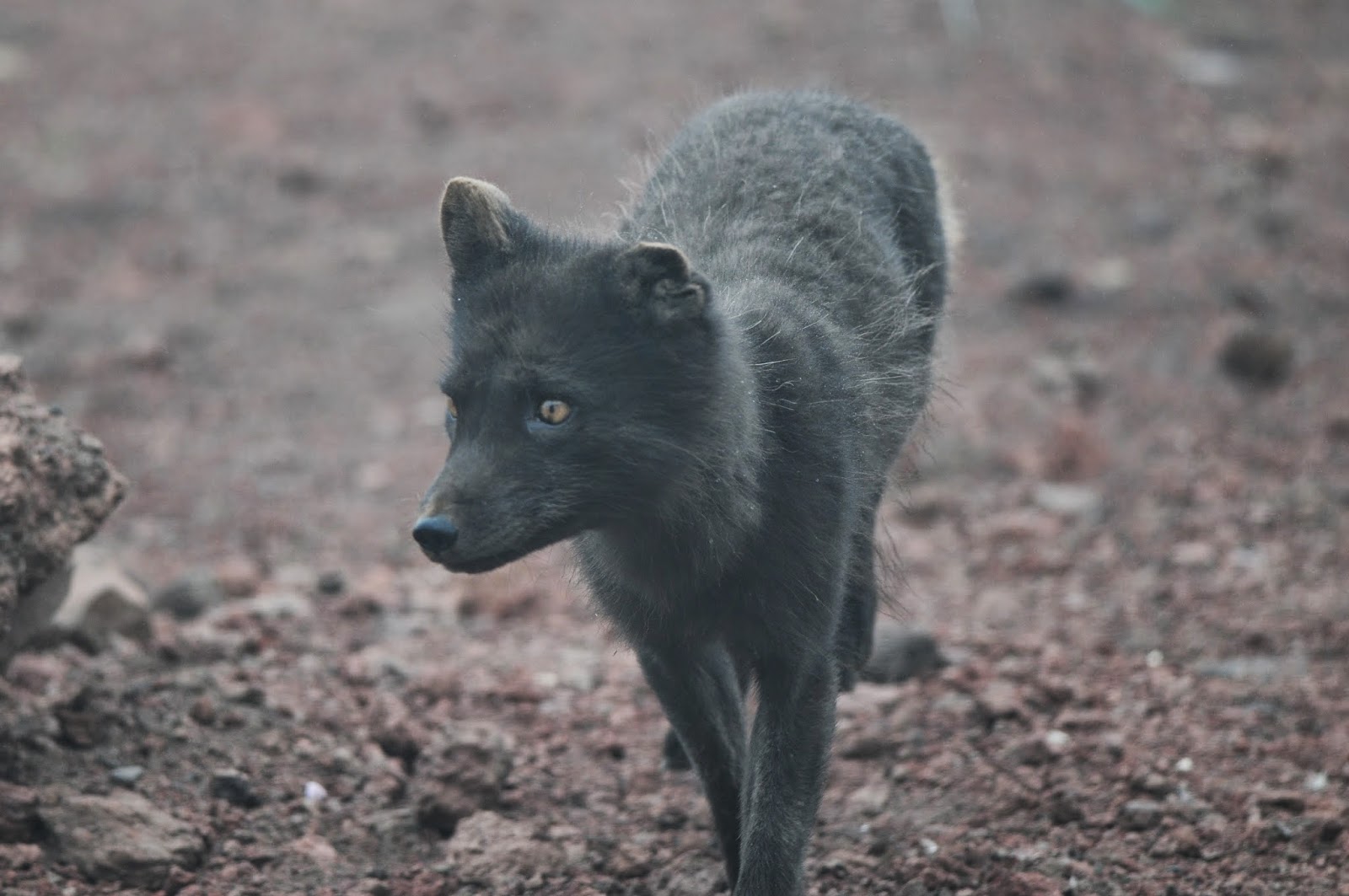
Sometimes I don’t have to leave my room to see interesting wildlife.  Just out my bedroom window, this ARCTIC FOX was intent on scavenging some spilled Pringles potato chips and rushing them off to its kits.  Nothing like healthy diet of sour cream Pringles to raise a youngster:
 
I’m not sure if any other guides/birders that have worked on St. Paul have tried to do this… but I figured I’d try to snap a picture of as many of the bird species here as I can.  A photo list, if you will.  Who knows, maybe I’ll leave with the record of bird species photographed in a year on St. Paul??  Anyway, what that translates to is a lot of crappy photos.  Case and point, this distant RED-BREASTED MERGANSER on a rainy day:
 
I may as well mention that Pumphouse Lake continues to host many shorebirds.  The LESSER SAND-PLOVER continued at least through today.  There was also a WESTERN SANDPIPER, 20+ PECTORAL SANDPIPERS, and 3 LONG-BILLED DOWITCHERS present.  This lake has already produced RED-NECKED STINT, SHARP-TAILED SANDPIPER, and RUFF this year... it's not far fetched to predict that this lake will strike again.

Yesterday evening I ventured up to Northeast Point to have a look around.  One of the highlights was finding a flock of 19 KING EIDERS swimming offshore.  After seeing 1-2 almost on a daily basis most of this summer, seeing a flock like this was quite refreshing:
 
Lastly, as I was driving back, I crested a hill and had to swerve at the last second to avoid hitting two ROCK SANDPIPER chicks in the road.  I stopped, hopped out, and ventured back to make sure I missed them.   Thankfully I did.  Cute little guy, eh?  No wonder I’ve worked with shorebirds for so long!