03 December 2013

Texas Troubles

The guy on The Weather Channel was freaking out: "Take a look at this footage taken in Oklahoma City!".  Cars were sliding off the road, trucks were rolling down the side of the highway.  I thought "Wow, that looks terrible" and then remembered "Crraaapp", I was IN Oklahoma City... stuck in a hotel.  -sigh-  I suppose I was lucky to make it to a hotel at all without ramping myself and my Golf over some precarious overpass... but I wasn't happy about being stuck and losing time.

See, there's no denying it; south Texas IS great for birding, even if you're not a fan of anything else down there.  I was lucky that my "sizable year" had me driving through this behemoth of a state multiple times en route to other places and jobs (do you see how I blame my year list for these extra miles and not myself?).  This time, I was heading back through the state after finishing my fall job in Michigan.

However, there were a couple of snags that were making this trip a bit more difficult than usual.  First, I was late in leaving the UP of Michigan due to an ice storm and losing our power.  Next, well, you saw what I found in Oklahoma (that's twice now that I've been stranded in OK by ice storms, btw).  It looked as if I wouldn't have more than 2 days to spend in south Texas.  Hopefully that would be enough time to see the rare Amazon Kingfisher... hopefully... maybe.

I'll get to the point... I DID end up missing the Amazon Kingfisher.  That ice storm I mentioned translated into a cold front there in south Texas and I found myself downright cold... and looking for a kingfisher that never showed.  I stood there on the side of Highway 100 in the wind and drizzle for nearly two days hoping for this bird to resurface and it NEVER DID.  Ok, I get it... Texas is going to play difficult this time around.

I was itching to take pictures of at least something so I started with this SORA that came out of the reeds:

Although not rare, this COUCH'S KINGBIRD is a species of flycatcher that is only found in south Texas within the US.  They are difficult to tell apart from Tropical Kingbird, which is also found in south Texas, but this particular one was vocalizing which is the easiest way to tell them apart:

Another common species at the "kingfisher spot" was ROSEATE SPOONBILL.  Pretty... but not a kingfisher:

Because I had so little time before I needed to drive to Arizona, I decided I'd like to leave with SOMETHING to show from this detour, perhaps a few year birds at least.  I spun over to Estero Llano Grande State Park to do some target year birding.  Because I had left the cursed Hwy 100 roadside, of course everything fell into place wonderfully.  First on my list was GREEN KINGFISHER, a species I had somehow missed on previous trips.  This time, I didn't even have to stop and look for one; this male (note the orange on the breast which females lack) was perched right along the trail I was walking:

This aforementioned trail was leading me to perhaps the most reliable roost for COMMON PAURAQUE known to birders in the US.  These nightjars roost only an arm's length from the trail day after day.  In fact, I was too close; I had to take a few steps back in order to even focus on the bird:

So those two year birds were all too easy.  There was a third that I curious about; EASTERN SCREECH-OWL.  Believe it or not, I had made it to late November without seeing this common eastern species and this was my last chance.  Estero Llano Grande just so happens to have a reliable one that uses a nestbox near the pauraque roost spot.  Once I got a glimpse of the box, there was no mistaking what was sticking out of it:

I should add that the screech-owls down in south Texas are actually of a different subspecies than the ones to the north and east.  Known as the "McCall's" Eastern Screech-Owl, this subspecies only comes in the gray color morph, it has a more limited vocal repertoire, and is limited by range.  Although it's not all that likely that this will be split into a different species anytime soon, it pays to take note of sightings.

With three easy year birds snagged, it was time to head back to the dreaded Amazon Kingfisher highway.  Two photogenic PLAIN CHACHALACAS along the trail on my way out whispered "good luck"... or maybe they were whispering about wanting to gobble up my toes, I can't be sure.

The Amazon Kingfisher eluded me again and before long, it was time for me to put that place in my rear-view mirror PRONTO.  I headed north into farming/ranching land on my way out for just one more target; SPRAGUE'S PIPIT.  I hadn't driven through the breeding range of this somewhat secretive species earlier in this year which relegated me to look for it on the wintering ground.  A quick search of recent eBird sightings told me where to go; Road 375 north of 1018 in Willacy County.  You got it.  Here's a map of where to spank some Sprague's:

Not more than a couple hundred meters up the road, a bird with white outer-tail feathers flushed from the shoulder and landed out on the bare field.  It was a very easy snag of SPRAGUE'S PIPIT.

I continued down the road and ended up seeing half a dozen of these!  With another year bird down, it was time to aim my headlights west.  Arizona, here I come.

27 November 2013

The "Sizable Year"

I don't think I've ever addressed the "Sizable Year" in my blog so this seems as good of a time as any.  Yes, strap yourself in, I'm going to be bragging about birds in this post.  See, my birding this year has evolved dramatically.  I started the year out stuck in California where my bird-related job put me outdoors nearly every day.  Ok, cool, right?  Lots of birds.  But... I also was eyeing some rarities that I wanted to chase... so I ended up doing that too.  Red-flanked Bluetail, Sky Lark, and Brambling in British Columbia, Pink-footed Goose and Northern Lapwings in New Jersey, etc.  Sure, quality ticks.  But then I realized that I was going to do a little traveling this year.  Hmm...

Then came a job in coastal Georgia where I worked with shorebirds every day.  But first I had to get there from California.  Well, as any crazed birder would have, I chased stuff along the way.  Additional quality ticks occurred such as Spotted Redshank in Indiana, Thick-billed Vireo and Western Spindalis in Florida, Black-tailed Godwit in Virginia, etc.  Working in Georgia helped me clean up a different corner of the country too.  For example, Swainson's Warblers bred just inland from where I was!  Easy peasy.  After that job finished, I was off to Florida again after some more life birds.  Ash and I snagged things like Black and Brown noddy, Brown and Masked booby, Sooty Tern, etc.

It was about this point that I realized what I was heading for... a decent ABA year list.  Now, this isn't a Big Year, as people often called it (if you're interested though, you should check out Neil Hayward's blog as he's getting close to the record).  But anyway, no, I wasn't hopping a flight to chase single birds, I wasn't driving 30 hours just to tick a year bird.  More importantly, I wasn't going to Alaska or taking any pelagic trips.  Besides, I'm just a poor boy, traveling and doing bird work around the country.  However, I WAS putting some effort into snagging birds along the way.    So... the "Sizable Year" began.

After Georgia and Florida, it was a prime time to head up to New York to visit family and snag a bunch more year birds (Bicknell's Thrush was a prime target, for example).  Then driving back via Michigan, I caught up to Henslow's Sparrow, etc.  One by one, these targets started being achieved.  It was time for south Texas... AGAIN.  Yellow-green Vireos were there and waiting... so that happened.  White-collared Seedeaters were easy; overall, another solid visit to south Texas.  Ash and I birded Arizona a bit and picked up more things like Rosy-faced Lovebirds, Buff-collared Nightjar, Lucifer Hummingbird, etc.

Back home in California, I couldn't rid myself of the bug; I chased some more year birds like Lesser Sand-Plover and California Gnatcatcher in San Diego and Spotted Dove in LA.  There was no turning back now... year birds were on my mind.  I never set out to break any records other than my own; I really wanted to reach 600 in a year, something I had never done before.

The next step came when I decided to work in the Upper Peninsula of Michigan for the fall.  This would be a great way to catch up with some more northerly species that I had missed so far.  But just like all my other field jobs... I had to drive there first.  This time I had a set list of targets as I drove from California to Michigan.  I didn't get them all, of course, but did manage to snag Black Rosy-Finch, Himalayan Snowcock, Pinyon Jay, White-tailed Ptarmigan, Chukar, American Three-toed Woodpecker, Brown-capped Rosy-Finch, etc.  The mountains were good to me... but how about the prairies?  I was running out of time to find breeding species there.  And yes, I missed some gettable birds.  But I also managed to stir up Lark Buntings, Chestnut-collared and McCown's longspurs, and late Upland Sandpipers.  Just before I got to Michigan, I very luckily snagged Golden-winged Warbler and Eastern Whip-poor-will in Wisconsin; it would be silly to miss those!

After reaching Michigan, year birds came fast and furious.  I ended up tallying 28 different year birds during the fall waterbird count there.  I was closing in on 600... but I needed a few more.  I know, I needed another trip to Texas and Arizona!

So, that was the background.  Now that you're up to speed, it's time for me to leave Michigan and head back home to California.... via the loooonnnggg way home.

Leaving Whitefish Point was more difficult than I wanted it to be; we had a blizzard that knocked out power for a day and coated the roads with ice.  Lovely!  I wanted to bird my way down to south Texas and this wasn't the start I had hoped for.  I finally did escape though and this lonely COMMON MERGANSER at the river mouth was one of the only birds to see me off:

Elsewhere in the UP, I had these 5 Tundra/Trumpeter swans fly over.  Sadly, they were going the wrong way and I didn't get a great look at them:

Once out of the UP, I also saw a phoebe in Iowa.  Rather, my niece Phoebe!  I had returned to Iowa for a brief visit and enjoyed seeing family and my former home.  In fact, I drove through Ames and briefly stopped by my old apartment.  The trail out back didn't look all that different from when I left in 2011:

After Iowa, I headed straight for Kansas where I had a few year birds targeted.  First up, Smith's Longspur at Lyon State Fishing Lake near Emporia.  This was a species I had obviously wanted to find in Michigan but it just never happened for me.  But Lyon SFL was my go-to spot in previous years so I had hopes of finding them there again.  Although no one had eBirded any from there this fall, I took to strolling the fields and a few minutes later, boom, 4 SMITH'S LONGSPURS flushed right in front of me.  Excellent.

Another target for me in Kansas, albeit quite easy, was HARRIS'S SPARROW.  This species can be fairly easy in the UP of Michigan but it was another species that just didn't occur at Whitefish Point this fall.  I stopped at a few bushy thickets along some Kansan roadsides and it wasn't long before a hoard of 30 popped up.  Here's one of them:

I had hoped for GREATER PRAIRIE-CHICKEN but, along with many of the grassland chickens, I just wasn't at the right place at the right time this year.  Oh well.  I am quite partial to Kansas though.  Anyone have a bird-related job there for me????

So, I had finished in Kansas snagging 2 of the 3 targets I was after.  Not bad considering my pressed time schedule.  Now it was a straight shot down to southern Texas were a slew of year birds were waiting for me.  With a little luck, I might also see the continuing Amazon Kingfisher and Rose-throated Becard that had been seen earlier.  Of course, it's never that easy.  Stay tuned...

16 November 2013

3 MONTHS IN MICH

It's been months since I've updated my own personal blog but hopefully you've been following along at the Whitefish Point Bird Observatory waterbird blog.  If you're in desperate need to know what I saw every day, you can always go back and find my daily blog entries at:

http://www.wpbo.org/blog/5

However, the fall waterbird season has wrapped up here as winter seems to have an ever-tightening grip on the north woods.  I'll be heading out of Michigan soon and will be birding my way back to California (snagging year birds along the way, hopefully).

But before I leave, I thought I'd share a few photos from my stint here at Whitefish Point....

My job here centered around the waterbird count.  Simply put, I would start at dawn every day and count all the migrants for 8 hours, rain or shine.  The fall season here extends from mid-August to mid-November and has been run every fall for 25 years.  

More specifically, I was counting all the different waterbirds; things like loons, ducks, grebes, geese, and shorebirds.  The COMMON LOONS seem to be one of the most popular migrants that pass by here.  And for good reason; sometimes they'll fly directly overhead:

Perhaps less exciting, I also tallied several thousand CANADA GEESE:

Not all the geese that migrate past here are common though.  For example, this fall we had a rare ROSS'S GOOSE and several different bunches of SNOW GEESE.  Here's one that flew directly overhead:

Although most of the duck species that migrate past here aren't super rare, once in a while we'll get a treat such as this HARLEQUIN DUCK that passed by back in September:

Being surrounded by water, it's no surprise that we had lots of terns around including CASPIAN TERNS:

... and COMMON TERNS which sometimes migrate past by the hundreds:

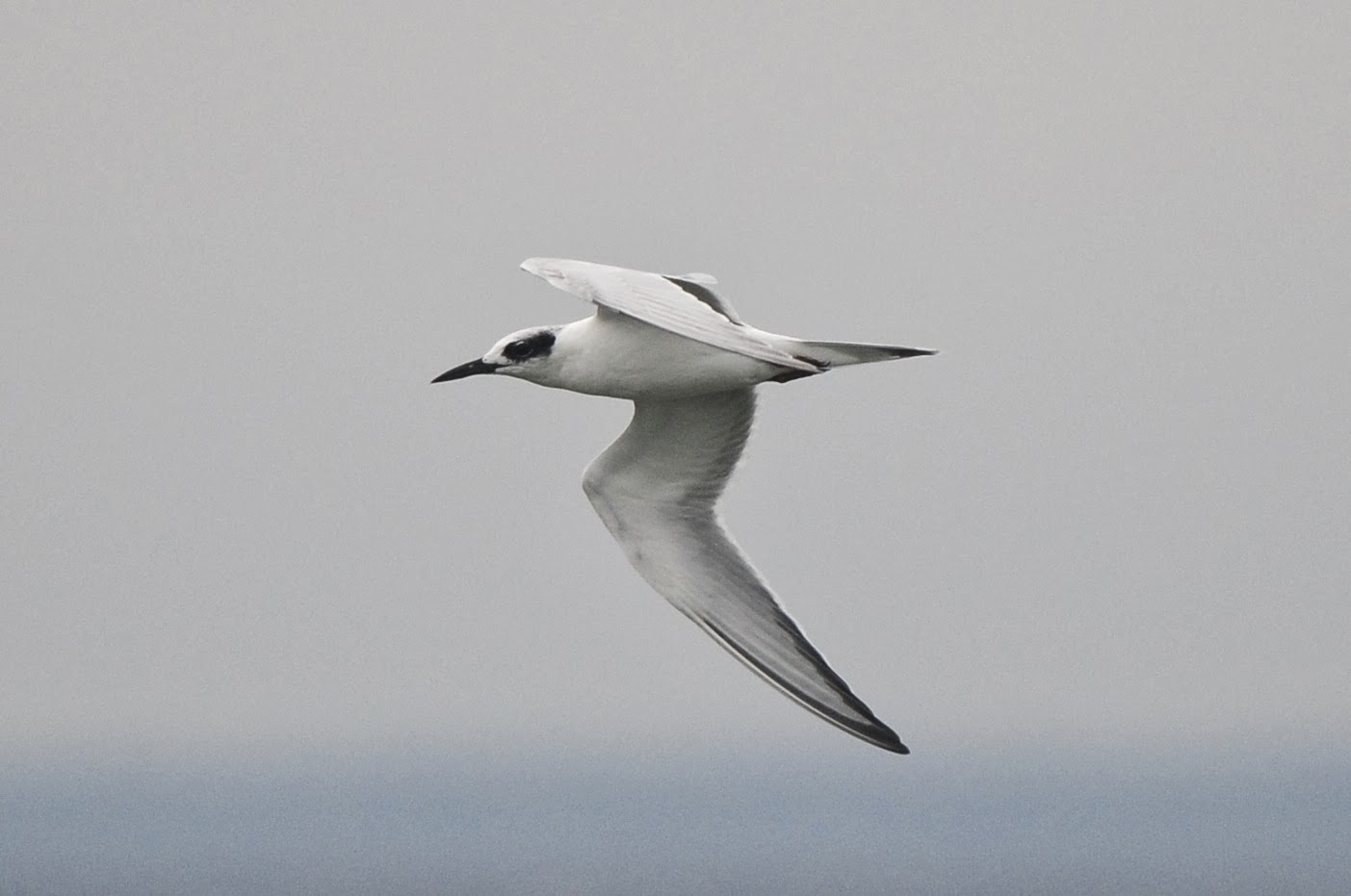
Strangely, FORSTER'S TERNS aren't usually too common up here.  However, we had a great fall for them; here's one sporting that distinctive isolated dark cheek patch:

With a background in shorebird ecology, it's no surprise that I'm quite fond the shorebirds that migrate through here.  It was actually a great fall for shorebird diversity here at the point.  Here are a few photos of various kinds including this BAIRD'S SANDPIPER:

... and SEMIPALMATED PLOVER:

One of the most abundant shorebird species here were the SANDERLINGS:

One of the rare shorebirds that showed up this fall (multiple times, too) was the STILT SANDPIPER.  Here's one in a puddle up at the point:

However, not all shorebirds are at home out on the beach.  Here's a SOLITARY SANDPIPER that found some flooded woods inland:

The raptors here can be pretty decent too although spring is better-known for the large congregations here.  Here's a NORTHERN HARRIER from early in the season:

The warmer months also gave me bugs to look at, primarily a few butterflies.  Here's a COMMON BRANDED-SKIPPER:

... and a NORTHERN PEARLY-EYE:

I was also happy to be around some new sulphurs which included the PINK-EDGED SULPHUR (whose larval foodplant is wild blueberries, btw):

The later in the season it got, the colder and more bleak things became:

There were still bright moments though, such as having 3 TOWNSEND'S SOLITAIRES at the point together:

... or this attractive first-cycle ICELAND GULL that stayed at the point for a day:

Of course, many birders that visit here hope to catch a glimpse of a JAEGER.  Generally speaking, this is one of the best spots in the Midwest to see jaegers (although they can be quite distant!).  During the course of the last three months, I've seen 40 different jaegers!  Here are a few random photos of PARASITIC JAEGERS:


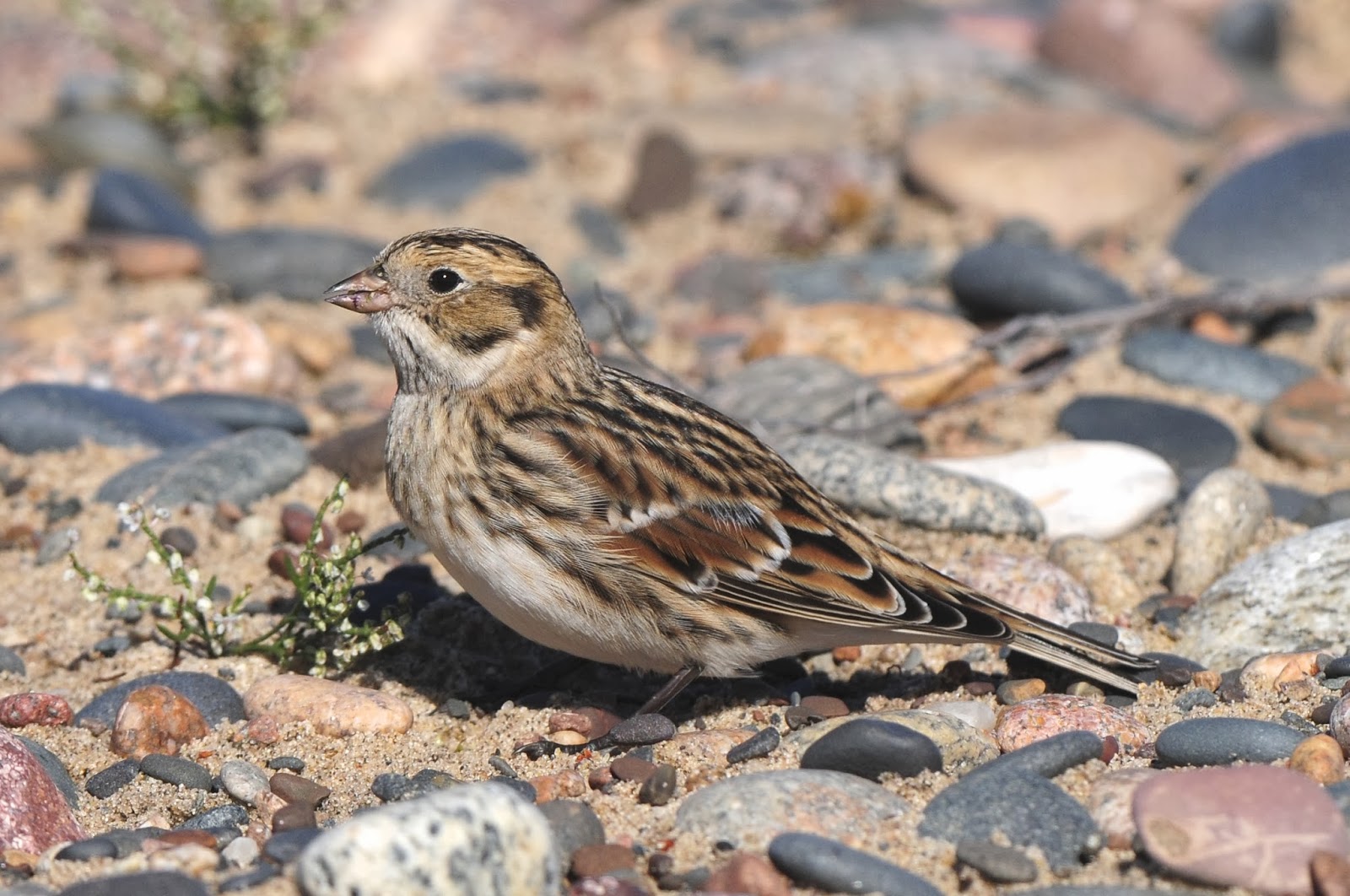
Then there are always songbirds to snap pictures of if you're in the mood.  Here's the first LAPLAND LONGSPUR of the fall:

The feeders here at Whitefish Point Bird Observatory have a long list of rarities that have spent time there.  Although nothing too crazy showed up this fall, it's always worth a check.  Here's a GRAY CATBIRD that lingered near the feeders for a while:

And although this isn't at the point, there are great spots to see LE CONTE'S SPARROWS here in Chippewa County too (as long as you're in season):

One of my favorites up here in the north woods is the SPRUCE GROUSE.  We had a great fall for these at the point; one day, several of us saw this male throughout the day at different spots:

There is plenty of wildlife besides birds and bugs though.  I saw both moose and bear tracks right on the beach near the waterbird shack!  Then there are things like this MINK that spent almost an entire day underneath the shack:

Being at Whitefish Point for a season gives you the chance to see an incredible array of clouds and sunrises.  Here are a few of my favorites:


Even the waves, especially on stormy days, can be quite magnificent out here:

However, it's time for me to keep moving.  Stay tuned as I target year birds as I venture west.  And, yes, hopefully, I'll keep this updated a bit more frequently now!

30 August 2013

CO, NE, SD, MN, WI --> MI

I found myself staying in western Colorado after my whirlwind trip through Utah.  I was keen to find some more year birds since I was passing through new territory for the year.  I still needed things like Pinyon Jay, White-tailed Ptarmigan, Brown-capped Rosy-Finch, any of the prairie longspurs, prairie-chickens, etc.

Before I left the hotel, I happened to use my new BirdsEye app on my phone that displays new year birds that have been seen nearby (by gleaning eBird records).  Sure enough, there was a pin for Pinyon Jay just down the road.  I figured I'd give it 30 minutes before zooming up into the mountains.  As I drove up, I realized why there were pins there... it looked like GREAT habitat... but no jays.  I stopped here and there and saw things like BLUE-GRAY GNATCATCHER and MOUNTAIN BLUEBIRD but never any jays.  At the top I turned around and headed back down.  "AHH!"  I saw a jay!  I pulled over, put my bins on it and, ta-dah... oh.. wait... it's a WESTERN SCRUB-JAY.  That's just cruel.  Grumbling by this point, I continued on my way.  I stopped again to look over some birds (robins, this time) but this time I thought I HEARD a Pinyon Jay.  Was I making it up?  Nope, I heard it again.  Within a couple of seconds, a very rewarding flock of PINYON JAYS flew directly over my car, calling the entire time:

Well, that was lucky!  Another target down.  Now it was time to zoom up into Rocky Mountain National Park for more targets.

At nearly 12,000 feet high, my first and main stop was at the Medicine Bow corner, THE reliable spot for WHITE-TAILED PTARMIGAN.  The scenery was NOT bad:

I huffed/puffed/wheezed around on the high-altitude tundra for a good while before finally finding a distant ptarmigan and three chicks up on the slope.  Here's the adult:

You'll notice it's wearing a radio-transmitter (a collar).  It was pretty cool to see that especially since I didn't know that they were being studied there.

I enjoyed the butterflies up there too and managed to snag a couple of lifers.  First up, the COLORADO ALPINE:

This MEAD'S SULPHUR was also new for me:

With those targets down (I forgot to mention, I saw some distant rosy-finches there too), it was time to head down to the grasslands of north-central and north-east Colorado to try for some prairie-loving longspurs.

The Pawnee National Grassland is surely some of the neatest prairie I can think of.  I first visited them back in June, 2000 when I was attending the ABA Youth Birding Conference.  Back then, we all saw both McCown's and Chestnut-collared longspurs here without trouble (I also found a McCown's Longspur nest that day; people were impressed with my nest-finding skills... I didn't tell them that I nearly stepped on the thing and it took no skill whatsoever).  Anyway, let's just say I was brainwashed into thinking it would be easy for me to repeat that again... in the heat of August.  Here's a view of some of the dry, short-grass prairie:


When I arrived, my new-for-the-year LARK BUNTINGS were waiting for me... everywhere.  I ended up seeing 500+ that afternoon: 

It was after I started walking around in some of the shortgrass prairie in the blazing afternoon heat that I started to have some concerns.  I knew McCown's should be findable but Chestnut-collared is much less common there and I didn't have any reliable spot for those down the road.  I needed BOTH, plain and simple.  Maybe it was my audible grumblings or kicking at cow crap that did it... a bird flushed in front of me and gave some unworldly call notes (ok, compared to the longspurs I grew up with).  I had a hunch and... yep, it was the first of many MCCOWN'S LONGSPURS.  Check out the tail pattern the chestnut in the wings:

I continued to flush longspurs (which is good fun) but I wasn't finding the rarer Chestnut-collared yet.  More longspurs got up.  More McCown's.  This time, some birds had pretty funky tail molt going on.  Here's the new-to-science "Fork-tailed Longspur":

You know how sneaky longspurs can be; you think there's nothing in front of you but bare ground, maybe some Prickly Pear, some grasses, and maybe a clump of... "what the deuce... the bird flushed from 2 feet in front of me?  How the hell did I NOT see that thing?!"  Anyway, it took a while before I was able to spot any birds on the ground.  Would THIS be my target bird?

Clean gray nape, dark bill, broad eyeline... as you can see, no, it's another McCown's.  It was getting late and I needed to get on the road.  In a very bad mood, I decided to ditch Colorado and head for western Nebraska.  Chestnut-collared Longspurs also breed in South Dakota and Nebraska so I'd try my luck elsewhere.  But first, I need sleep...

-ZZzzzzzzz-

The next day provided the new start I needed.  It was time to drive through my old haunts of western Nebraska.  I passed Chimney Rock.  Fire up the archaic computer, wait 30 minutes for it to boot up, stick in the 5.25" floppy disc... it's time to play Oregon Trail!

Actually, no, I was headed for Sioux County.  I had seen Chestnut-collared Longspurs there on several occasions but that was in April... not August.  Before I could get to the longspur spots, I noticed an all-too-familiar bird jump off of a shoulder.  I turned around.  YES, it was my new-for-the-year UPLAND SANDPIPER.  I had started to get worried because multiple people told me I wasn't going to find them.  This photo is dedicated to those people:

Oh no.  For the first (and maybe last) time, I took a scenic picture with horses in it!

Tim Hajda mentioned a spot that he had for the longspurs.  It was as good of a lead as I had.  I pulled off and after about 30 seconds of walking the fence line, a CHESTNUT-COLLARED LONGSPUR flushed from my feet.  THIS time the call note was right on.  And THIS time I got photos of the bird on the ground and even up on a fence for a bit.  Note the paler bill, streaked nape, not much of an eyeline... THIS was the bird I was after:

I was feeling better now; I had snagged two year birds that I could have easily missed.  I glanced behind me back towards the car.  Holy crap, some giant storms were brewing to the west!  Time to get moving up to South Dakota:

Traveling east through South Dakota provided me with a few options.  First, I would try for GREATER PRAIRIE-CHICKEN.  Also, I was looking forward to county listing in some very new areas.

So the next morning I was at the Fort Pierre National Grasslands to try my luck with an out-of-season prairie-chicken.  I spent several hours with nary a sniff of these sometimes-secretive chickens.  However, now that I had gotten UPLAND SANDPIPER and CHESTNUT-COLLARED LONGSPURS out of the way the day before, I found more of both of those species.  Here's a longspur:

I had started seeing some eastern species by now including this adult and young EASTERN KINGBIRD.  "But mommmm.... how do I CATCH these things?  They're too FAST for me.  DANG...."

Now it really was time for me to make up some ground.  I'd worry about the prairie-chicken later.  But first, I needed to drive through MN and WI to get up to Michigan.

Hmm... but why not pull off the interstate in Minnesota to grab a year bird?  The BirdsEye app showed there was one.  Exactly.  Here's a CLAY-COLORED SPARROW about 100 ft. from I-35:

More troubling year-bird issues were creeping into my mind.  I actually needed GOLDEN-WINGED WARBLER and EASTERN WHIP-POOR-WILL this year.  I knew that I was NOT going to get those at Whitefish Point... and that I wasn't leaving Michigan until November.  I needed to find these birds... and quickly.  I used my trusty BirdsEye app again; it showed several GWWA pins in northeast Wisconsin.  A quick detour, several hours of looking, and alas, a last-minute year-bird grab... a GOLDEN-WINGED WARBLER:

Due to the kindness of some local birders, I was able to find a couple of EASTERN WHIP-POOR-WILLS that night too.  I couldn't have been more appreciative to them for essentially finding these year birds for me (they too use eBird, I glean eBird... you get the idea).

Off to Whitefish Point I went.  I would be counting waterbirds that next morning (and many mornings thereafter).  My next post will probably have Lake Superior and some Jack Pines involved.  Stay tuned...