10 June 2017

SPAZ in AZ

Spring in Arizona.  Sounds pretty inviting, right?  And now I can assure you, it's great birding too!  I recently returned from one of our Field Guides tours to southern Arizona led by John Coons.  We enjoyed some unseasonably cool temps as we birded around Tucson, over to the Chiricahuas, westward to the Huachucas, to the remote California Gulch, and then some in the Santa Ritas.  Overall, it was a blast and we ended up seeing more than 200 species of birds!

We started out with some birding straight away... the deserts west of Tucson hosted goodies like this GILDED FLICKER peeking from behind a saguaro:
We had nice look at this RUFOUS-WINGED SPARROW as well, a range-restricted species here in the US:
The next day we ventured east through Willcox where, of course, we chose to bird the well-known Willcox pond.  It continued to host a rare-for-Arizona BLACK-BELLIED PLOVER which was a quality addition (although the picture isn't great):
We think it was probably the first time that species had been seen on this tour itinerary.

From there we ventured up into the Chiricahuas, an isolated but impressive mountain range tucked into the southeast corner of the state.  We wasted little time in getting up to a particular spot where, lucky for us, a very rare SLATE-THROATED REDSTART had been hanging out.  It took a little effort but we eventually found the bird singing and calling.  Photos were distant but diagnostic:
We spent several days exploring the many parts of the Chiricahuas including the town of Portal (and the lowlands below it).  One of our first stops was hosting this handsome BLACK-THROATED SPARROW, a common denizen of dry, desert regions:
One of our main targets in the lowlands below Portal was the BENDIRE'S THRASHER, a sometimes tricky thrasher to pin down.  As you can see, pin down we did:
Perhaps one of the most emblematic species of southeastern Arizona, at least for the many birders that visit, is the boldly-colored ELEGANT TROGON.  We tried our luck in the South Fork of Cave Creek and came up big.  What a beaut!
Nearby in Cave Creek, we stumbled onto another very tricky species, the secretive MONTEZUMA QUAIL:
Finding this species can be a nightmare so imagine our excitement when John heard some of these on the rocky slope near the road.  Before too long, we even managed to lay our eyes on them which is no small feat!

Portal gave us another bonus, a pair of THICK-BILLED KINGBIRDS had returned to "downtown" and we got excellent views of both.  You can see the big bill, pale lemon color on the belly, dark facemask, etc:
I'm going to change things up here and focus on owls for a bit.  Although Field Guides does a nightbirds-focused trip in Arizona (see link here), our tour was more of a general birding tour.  HOWEVER, that doesn't mean we skimped on the owls... here's a sampler of what we saw:

1)  GREAT HORNED OWL:
Portal in the Chiricahuas

Whitewater Draw

2)  ELF OWL:
Cave Creek in the Chiricahuas

3)  SPOTTED OWL:
Miller Canyon in the Huachucas

4)  FLAMMULATED OWL:
Cave Creek area in the Chiricahuas

5)  NORTHERN PYGMY-OWL:
Chiricahuas

6)  WHISKERED SCREECH-OWL:
Cave Creek in the Chiricahuas

And yet, I don't think I managed photos of the WESTERN SCREECH-OWL and BURROWING OWL which we also had.  Along with MEXICAN WHIP-POOR-WILL, COMMON POORWILL, and LESSER NIGHTHAWK, it was a great tour for nightbirds!

While we were high in the Chiricahuas, we were surprised to find this female WILLIAMSON'S SAPSUCKER lurking about.  This isn't a common species to find there at this point of the season and we wondered if maybe a pair or two might stick around and breed there this year.  Here's the lady:
If you've seen MEXICAN CHICKADEE in the US, you were probably in the Chiricahuas.  We had several nice looks at this high-elevation speciality:
We were still seeing migrant species as well including hoards of HAMMOND'S FLYCATCHERS, an empid that doesn't breed in the area.  Here's one of them sporting those nice, long wings/primary projection:
I'm not sure if I've ever seen a YELLOW-EYED JUNCO in a photo NOT on pine needles.  This is another range-restricted species that you've probably traveled to Arizona to see:
Always a fan-favorite, the RED-FACED WARBLER is truly a stunning bird.  We were lucky to have one come down to eye-level while we were high in the Chiricahuas:
Another warbler that breeds in the area, but one with yellow instead of red, this GRACE'S WARBLER also appeared a couple of times:
I might insert this photo here... the quintessential view of Cave Creek in the Chiricahuas.  What a beautiful place:
This visit to Arizona was rather unique for me though.  The reason wasn't the birds, really, it was more the temperature:  cold!  That's right... I was in southern Arizona AND it was downright chilly.  Here's a view looking uphill from Miller Canyon.  You can see the snow on the trees and ground:
Here's another view showing my first snowfall in the Huachucas:
No matter, no matter, we needed to bird on... so we did.  We were in the Huachucas now where this PAINTED REDSTART, a type of warbler, showed nicely in Miller Canyon:
We attempted to find one of the TUFTED FLYCATCHERS that had been around but alas, it looked like the cold snap had maybe pushed it to another area.  We still enjoyed the many BUFF-BREASTED FLYCATCHERS hanging around though.  This is another range-restricted species found mostly in SE Arizona:
In some of the grasslands near Sierra Vista, we searched for (and found!) BOTTERI'S SPARROWS:
Pretty nice of him to perch with a big, fat green plant in the way, huh?  Still, it's a fun species most folks certainly don't get a chance to see often.

We birded at the San Pedro House too and wow, the colors were vibrant; here is a collection of BLUE GROSBEAK, BLACK-HEADED GROSBEAK, HOUSE FINCH, WHITE-CROWNED SPARROW, and a LAZULI BUNTING:
A visit to the Huachucas wouldn't be complete without a trip to Mary Jo's feeders in Ash Canyon.  The main target at her wonderful yard was, of course, the LUCIFER HUMMINGBIRD.  After all, her feeders are the most reliable for this species in the entire country.  We enjoyed nice looks at a couple of males including this one:
There was another rarity we wanted to try to track down... and it was up in a canyon I hadn't birded before.  Hunter Canyon.  We made the mile hike in and saw some goodies along the way like this BLACK-CHINNED SPARROW that was out in the open and singing:
... but the REAL reason we were hiking in was to try for a rare warbler, one that would be a lifer for most of the folks on tour.  Problem was... we weren't finding it.  We settled in for a bit of a wait before, tada, it started singing!  Before we knew it, we were rushing to find it... and there it was, perched out in the open, the RUFOUS-CAPPED WARBLER:
The warbler stayed up just long enough for us all to see it before it dropped back down into the veg.  Whew!

Later yet in the tour, we visited Patagonia Lake State Park which, we were hoping, was hosting a couple of target birds.  It didn't take long for us to discover that our hunches were correct... there was a NORTHERN BEARDLESS-TYRANNULET singing near where we parked:
It may not look like much, but this tyrannulet is a type of flycatcher that is only found in a couple of southern states like Arizona and Texas.  It's named "Northern" because, well, it's found farther north than the Southern one.  Remember, it's all relative.

Just a few steps away, we looked up to find this COMMON BLACK HAWK doing lazy circles above us.  Woah!  This wasn't a species we were expecting to find on tour but we all had great, walk-away looks:
Luck kept on coming; we were in one of the dry washes when we located another rare bird, a BLACK-CAPPED GNATCATCHER:
This is a species I had only seen once or twice before so it was a real treat to see another one.  You can see the long bill and the black cap that extends below the eye.

Our tour included the famous (yet very remote!) California Gulch.  To get there, you must drive your way west through the deserts along terrain like this:
 
Once there, we wandered down into the gulch itself; it's a nice spot with some shade (but not much in the way of water):
Overhead at the gulch, this PURPLE MARTIN was using a nearby saguaro for a nest cavity:
This is kind of interesting too because that subspecies of Purple Martin is only found around saguaros in Arizona (and farther south).

The gulch had a bunch of CANYON WRENS too including this youngster that looked to be getting the hang of things:
The main reason we were in California Gulch though was actually a sparrow.  A sparrow, you say?  Seriously?  Seriously.  There is a rare and range-restricted species called the FIVE-STRIPED SPARROW and, for all intents and purposes, it's ONLY found in California Gulch (in the US, at least).  Most people get their lifer there as did I 13 years ago.  Anyway, we were there to find them and, drumroll... they didn't take long to find!
Actually, our views of this species couldn't be beat.  At times, this one was TOO close to focus on:
After we scampered out of the gulch and back to civilization, one of our last birding stops towards the end of the tour was to Montosa Canyon in the Santa Ritas.  We opted for this because we had yet to see a VARIED BUNTING, a species that was just then returning to breed for the summer.  Thankfully, we struck gold and found this dandy:
For good measure, we found another BLACK-CAPPED GNATCATCHER too!  Take a look at the black on the face:
See how the black extends below the eye (or in other words, the eye is completely encircled by the black)?  That alone tells you it's not a Black-tailed Gnatcatcher instead.

However, probably the rarest sighting in Montosa Canyon came from a random roadside.  Imagine our surprise when we spotted this GILA MONSTER crossing the road!
This was so incredibly exciting for me... my lifer Gila Monster.  I know birders that have spent 20 years in Arizona and not found one of these themselves.  Wow!

By this point, the tour was wrapping up.  We had one last birding stop and that was in Madera Canyon where we enjoyed watching the feeders where a myriad of visitors were tanking up.  Species like LAZULI BUNTINGS, LESSER GOLDFINCHES, ACORN WOODPECKERS, and the local hoard of MEXICAN JAYS were all numerous.  But hey, it wasn't too late to snag a new bird for the trip though!  This male CALLIOPE HUMMINGBIRD came in a few times much to the delight of all of us:
In the end, it was a fantastic trip full of amazing scenery, fun birds, and even an impressive list of herps.  I'll actually be returning to Arizona next month for the Second Spring tour so stay tuned for that report!

Speaking of reports, Field Guides is pretty cool in that it offers summaries of all our tours... publicly!  For example, you can read more about the sightings from this tour here.  Enjoy!

24 May 2017

Grousin' around in Colorado

As I prepare to leave for another tour (Maine, this time), I realized that I'm actually two tours behind here on my blog!  Unfortunately, this looks to be a reoccurring theme.

Anyway, I present to you a few photos from a tour to Colorado that Tom Johnson and I led (oh, if you're behind in the times, not to worry... I work for Field Guides Inc., a company based out of Austin, Texas.  And, actually, you can find my upcoming schedule here).

Colorado is, without a doubt, the best state to go looking for a good variety of sage-grouse, prairie-chickens, grouse, quail, etc., and this tour was focused mainly on those species.  The "chicken trip", some call it.

Our first "chicken" of the trip came in Kansas (yes, our tour swings into Kansas) where the threatened and vulnerable LESSER PRAIRIE-CHICKEN is the main target.  Roadside prairies in Kansas?  One of my favorite things.  Here's sunrise:
... and here's the prairie-chicken dancing, stomping, and displaying within view:
No, those aren't ears sticking up... those are neck feathers called "pinnae" that are erected when the grouse display. 

We had some other good lookin' birds early in the tour too including this YELLOW-HEADED BLACKBIRD looking as sharp as they ever do:
It was especially fun being in Colorado during migration because species like FRANKLIN'S GULL were moving through in large numbers.  Here's a look at one complete with the black hood:
After our Kansas stint, we headed to Wray, Colorado.  It was there that we had private access to a beautiful lek of GREATER PRAIRIE-CHICKENS (a "lek" is a staging ground where birds gather to display to females).  Very similar to the previous species, these were bigger, with different vocalizations, and orange neck sacs instead of the reddish ones you see above.  Here is a male with his air-filled neck sacs inflated:
I especially enjoyed watching the interactions between rivaling males.  Here's one that got lunged at... and rocketed upwards:
As we departed that lek, we found ourselves face-to-face with a GREAT HORNED OWL on a nest:
It also might be worth repeating... those "horns" ARE NOT EARS.  Those are tufts of feathers; the ears, which are on the sides of the head, are not visible.

Leaving the prairies behind us, we headed west up into the mountains.  Although we were en route to somewhere else, we stopped to do some birding and ended up snagging some really nice species including this WILLIAMSON'S SAPSUCKER:
While on the subject of cool woodpeckers, here would be a good spot to add in this image.  It's a LEWIS'S WOODPECKER which, in terms of woodpecker coloration, has to be one of the more unique ones out there:
We also had killer looks AMERICAN THREE-TOED WOODPECKER on this tour.  Here's a male with the yellow cap:
But the main target high in the mountains (and yes, fairly high, higher than 11,000 feet) was to try for the WHITE-TAILED PTARMIGAN, a camouflaged denizen of some extremely harsh terrain.  In fact, at this season, they're completely white!  Anyway, after quite a search (yes, we were getting worried), this distant white blob materialized on a ridge top about a mile away!  The pictures aren't grand but the feeling sure was!
Once we retreated to lower elevations, we were able to catch our breaths (literally) and then headed for the town of Gunnison.  It was there that we had another grouse in mind, the endangered GUNNISON SAGE-GROUSE.  Sadly, only about 5000 of these are left on earth... but luckily, we were at the best spot to see them!  We spent a couple of predawn hours in the blind waiting for it to get light but once it did, we spotted these distant sage-grouse on the ridge.  Again, the photos aren't going to win any competitions but we felt very lucky to be able to see this rare species at all:
Near there, up in Crested Butte, the folks in my van were lucky to watch this Coyote do a "mouse pounce":
This is a hunting maneuver where canines like dogs, Coyotes, and foxes jump up in the air and then pounce down with their front feet to break through the snow and to pin down prey.

We were lucky to see a lot of SWAINSON'S HAWKS on tour; many of them were just arriving from their wintering grounds in South America.  It really is a nice-looking bird if you see them well:
After leaving Gunnison, we made a special stop for yet another interesting grouse species... the DUSKY GROUSE.  We found one in short order and, thankfully, it hung around for all to see:
Many of you are probably familiar with PINE SISKINS... a small but widespread finch.  Here's one that posed for a bit showing its pointy bill, brown streaks, and notched tail:
The DARK-EYED JUNCOS are pretty cool looking in that part of the world too.  This is the "Gray-headed" subspecies:
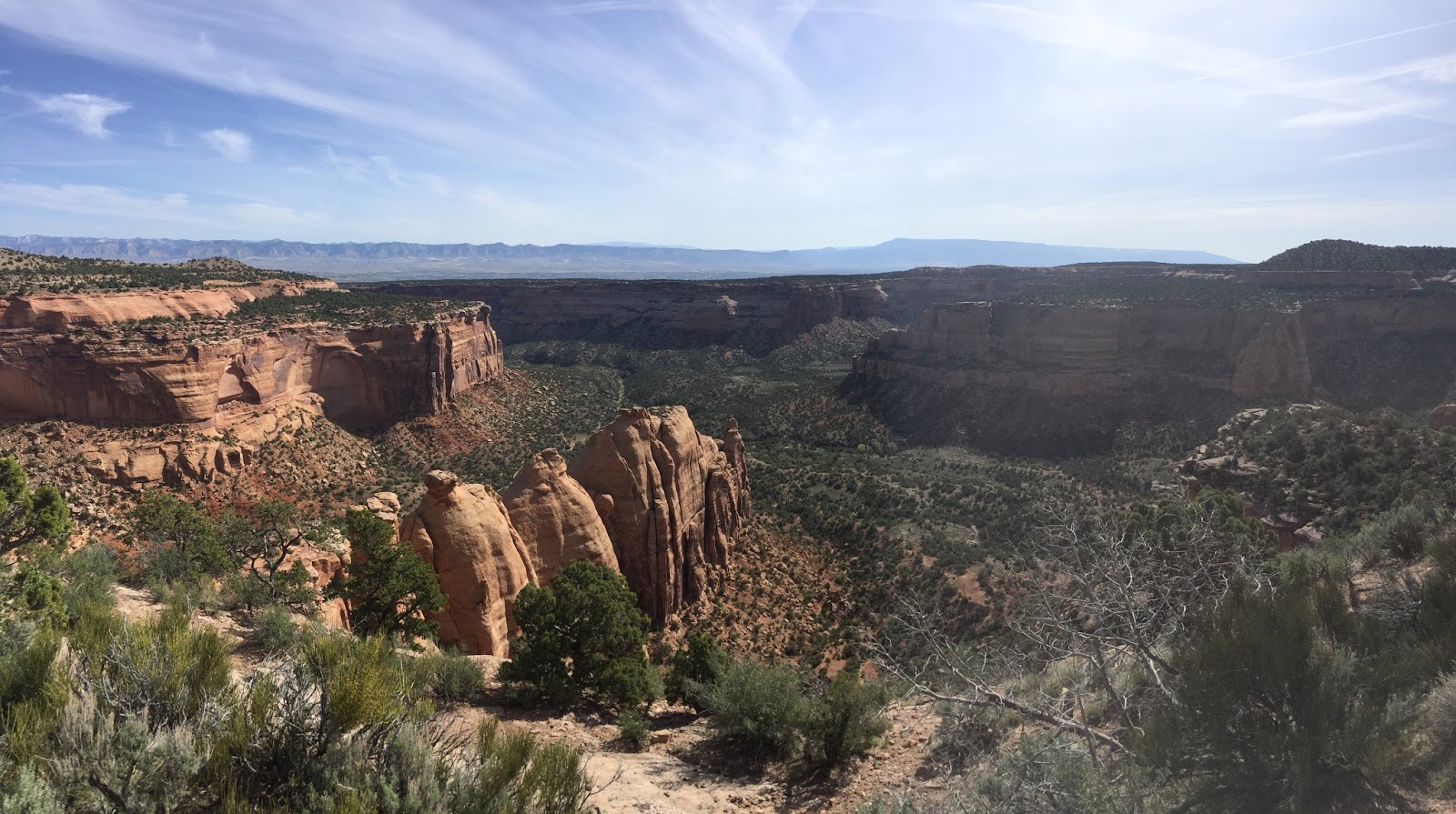
In western Colorado, the scenery changed into a more red-rock, canyon-land type habitat.  The scenery was great!
 
The dry and scrubby habitat hosted GRAY FLYCATCHER, PINYON JAY, BLACK-THROATED GRAY WARBLER, PLUMBEOUS VIREO, BEWICK'S WRENS, and many others.  Mixed in was this sky-blue MOUNTAIN BLUEBIRD trying to blend in with the sky.  :-)
This GAMBEL'S QUAIL also felt comfortable enough to perch up and sing which we all enjoyed...
We eventually wound our way up to northwest Colorado where we were targeting yet another grouse.  A sage-grouse, to be exact.  We had already seen the Gunnison Sage-Grouse... so it was time for its bigger cousin, the GREATER SAGE-GROUSE.  We positioned ourselves predawn and man, what a show unfolded in front of us:
 Here's a closer male that was displaying right next to our van!
Ha, no, those aren't yellow boobs.  That's a male with inflatable sacs that he pumps full of air and thrusts out during his display.  When you stand back and try to take it all in... that's one CRAZY looking bird!

Our last chicken of the trip required us to visit a new part of Colorado, a gorgeous part of the state with mixed prairies on the sandhills:
It was here that we connected with the SHARP-TAILED GROUSE:
Can you see the pointy tail sticking up?  That's the "sharp" tail.

Anyway, after cleaning up the chickens, it was time to make a dash to the Pawnee National Grasslands where we had a couple of targets in mind.  One of them materialized right on the side of the highway... the regal FERRUGINOUS HAWK (my favorite buteo, if I had to choose):
The main draw for our quick side-trip to the Pawnee?  This drab little shorebird called a MOUNTAIN PLOVER:
It had somehow eluded us earlier in the trip and so the special council (ahem... Tom and I) decided it was worth a try.  In the end, we're glad we did!

Once again, here's a photo of our fun group birding the prairie (we were enjoying the above species at that moment).  If you're able to find beauty away from oceans and mountains (I know I do), you might really love this part of Colorado:
Some of our best finds weren't even planned!  For example, we bumped into this LONG-EARED OWL at an oasis of trees during a bathroom stop:
Again, the tufts aren't ears.

So after it was all said and done, it really was a fun trip full of amazing and unique species (and hey, all within the comfort of Mercedes-Benz vans!)
Maybe I should mention.... Tom and I will be leading this tour again in 2018!  Woooo!  You can find more info about this tour on the Field Guides website here.  You can click around to find more images, a map of our route, and even past triplists.  Enjoy!