28 August 2016

Peru Two!

Sorry for the 11-day delay for Part II of my Peru trip but, well, Arizona got in the way.  :-)  More on that later... maybe.  If I have time.

So, our Machu Picchu tour had kicked off, we had flown into Cusco, visited Ollantaytambo briefly, taken the train to Aguas Calientes, seen Machu Picchu, and we were getting ready to bird the Mandor Valley.  We were at our lowest elevation of the entire tour here in Aguas Calientes (6,693').  What that meant was we were in the elevational range of a whole slew of different species, some just reaching our elevation from the Amazon Basin to the east.  And the view in town?  It was freaking incredible.  I'll just never forget the view of the steep topography that greeted us every morning:
On this particular hike, we walked alongside railroad tracks for several miles.  We weren't the only ones though; many folks were backpacking, locals were walking to the next village, etc.  You have to remember that since there are no roads connecting some of these towns to each other, the next best way to get around is hiking along the railroad tracks:
Soon after we started on our Mandor Valley hike out of Aguas Calientes, Jesse heard a CHESTNUT-CAPPED BRUSHFINCH and he even managed to coax it out.  For being a shadow-dweller, this skulker sure is a striking bird:
Although less striking, we saw several ASHY-HEADED TYRANNULETS (a type of flycatcher) on our hike as well including this one:
This GRAY-BREASTED WOOD-WREN popped out in nice light at one point.  Although common, I wish they all perched up like that!
One of the highlights was this BLACK-STREAKED PUFFBIRD that we spotted.  This secretive species, basically a fluffy baseball, is a "sit-and-wait" hunter meaning it sits motionless for long periods of time as it watches for insect prey:
Another fun species to hang out with, and another one with "streak" in the name, was the STREAK-NECKED FLYCATCHER.  The streaked breast and gray head were dead give-aways to its identity:
One of the more uncommon species we bumped into on our hike was this female VERSICOLORED BARBET.  Can you spot it amongst the leaves?
What's cool about this species is that it specializes in foraging on clusters of dead leaves.  And then take a look again at the bird in the photo... it's doing exactly that!

About where we turned around to start heading back to Aguas Calientes, we found a loose flock of GREEN JAYS.  Of course, these are of the South American subspecies known as the "Inca" Green Jay (Cyanocorax yncas yncas):
SLATE-THROATED REDSTARTS, which are wood-warblers, were abundant and probably one of the most numerous species we saw.  Here in South America, they are more yellow-bellied instead of the red-bellied variety we see up in Mexico:
Nearer town, the raucous screeches overhead gave away the presence of several MITRED PARAKEETS flocks flying around.  And nothing against the introduced ones in Florida... but these I felt GOOD about seeing.  :-)  Yes, they're native to Peru.  Here's a silhouette of a few:
The next day we birded on the grounds of our hotel, the InkaTerra Machu Picchu Pueblo Hotel.  The hotel, a 5-star ordeal, was a bit of paradise complete with waterfalls down the sides of the stairs, lush veg... it was just a very beautiful spot to hang out for a couple of nights.  And besides, the local LYRE-TAILED NIGHTJARS were heard calling every morning!

The birding on the grounds was productive as well and we saw several new species for the trip.  Here's an ANDEAN MOTMOT that was sitting mostly motionless:
Meanwhile, the rushing stream downhill from the hotel was host to dippers, Torrent Tyrannulets, and, maybe the coolest of them all, TORRENT DUCKS:
As most of you know, this species is a specialist of fast-flowing streams in the Andes (and it's one I have wanted to see for a loooong time).  We eventually found a pair of adults and several of their chicks braving the currents.

A pretty uncommon species that we had great luck with around Aguas Calientes is the SCLATER'S TYRANNULET.  It's a pretty drab flycatcher with subtle markings but I think I got the hang of them before I left.  Here's one trying to look like a Tennessee Warbler or something:
The RED-EYED VIREOS we had were rather interesting.  Do you see anything amiss?
So this race of Red-eyed Vireo (the "Chivi" subspecies) doesn't even have a red eye!  Maybe they'll change the name to Dark-eyed Vireo instead (not likely).

I mentioned the lush hotel grounds.... imagine our surprise when this male ANDEAN COCK-OF-THE-ROCK showed up above the pool!  What. the. what???
This giant, red, type-of-cotinga is easily one of the most recognizable birds of the South American Andes.  Because we hadn't seen one as a group yet (and because we were all split up packing for departure), I rushed around to make sure all of our participants got to see this stunning specialty.  The views were completely crippling:
The fruit feeders at this InkaTerra hotel were busy with a variety of species such as BLUE-GRAY TANAGERS, BLUE-NECKED TANAGERS, DUSKY-GREEN OROPENDULAS, THICK-BILLED EUPHONIAS, and, one of my favorites, the BLUE-NAPED CHLOROPHONIA:
Another species that was reliable here was the SILVERY TANAGER (formerly known as "Silver-backed Tanager").  You can see that that latter name was pretty accurate:
There were a variety of hummingbirds present here as well including the "GOULD'S" COLLARED INCA and this CHESTNUT-BREASTED CORONET:
Sadly, our itinerary had us moving out of the lower elevations of Aguas Calientes and back uphill to Ollantaytambo (9,160').  The last 3 days of our tour we'd spend birding the areas around Abra Malaga, an imposing mountaintop sitting amongst the clouds.

Our train ride from Aguas Calientes back to Ollantaytambo, climbing roughly 3,000 feet, provided a 2-hour look through the countryside.  You'll see dry hillsides, agriculture, introduced eucalyptus trees, and snow-capped peaks:
Our hotel in Ollantaytambo (Pakaritampu) served as a beautiful "base camp" for the next several nights.  Even behind the hotel, for example, we found an interesting mix of birds including this BLACK-THROATED FLOWERPIERCER:
A rather brilliant species we saw several times near the hotel was the BLACK-BACKED GROSBEAK.  That name works, to be sure, but so would Yellow-bellied Grosbeak!  Awesome bird with one massive bill:
The common robin-like birds were CHIGUANCO THRUSHES, a pretty cool species to have hopping around the hotel.  I've heard them described as "sturdy" and I couldn't agree more.
The most common species on the grounds though was RUFOUS-COLLARED SPARROW (which many of you are familiar with).  However, the second-most common sparrow around was BAND-TAILED SEEDEATER.  Note the gray plumage, yellow bill, and cinnamon-colored undertail coverts:
This was my first time around this species of seedeater but I was struck by how common they were.  Seeing a dozen feeding on the mowed grass lawn wasn't uncommon.

In order to be up on the slopes of Abra Malaga at the good times of day for birding, we often would depart around 5 AM and start the 1-2 hour drive up the switchbacks in the dark.  Once it got light, though, it was a heck of a lot to take in.  Take a look at this world-renowned road:
On the first Abra Malaga day, we birded on the western slope which is fairly dry.  Dry doesn't mean bad birding though; it wasn't long before we started seeing some very unique species like this CREAMY-CRESTED SPINETAIL:
This pale-headed furnarid is only found in Peru where it's endemic to the tropical, high-elevation shrubland.

A little farther up the road we saw our first tit-tyrants of the trip.  These little flycatchers resemble chickadees/titmice (which are known in parts of the world as "tits").  Here is the TUFTED TIT-TYRANT donning its spiky tuft:
As I write this more than a week or two removed from this Peru trip, I look back and can confirm that this next sighting was one of my favorites of the trip.  It's a hummingbird, actually.  A hummingbird that is only found in Peru and nowhere else on earth.  It's called a White-tufted Sunbeam:
This Peruvian endemic inhabits dry mountainsides where we were lucky to have several encounters.  The above photo was taken with my iPhone through my spotting scope.

Instead of Chiguanco Thrushes from the lower elevations, the thrushes we saw at these higher altitudes were GREAT THRUSHES.  And great they were:
It was on this foggy, drizzly day that I saw the largest flying bird I'd ever seen in my life.  This behemoth has a wingpan that approaches 11 feet long.  Think about that for a second.  This is, of course, an ANDEAN CONDOR:
Against the jagged, enormous cliffs above us, it was hard to gauge the size of this giant but when it would float down to ridges high above us, it slowly dawned on me how large they really are.  The cliffs above us, well, they just kept rising into the clouds.  It was breathtaking (or was that the elevation?!):
We were now at elevations up to 14,000 feet.  Think the elevation of Denver... and then make it twice as high as that.  Because of the altitude, we weren't surrounded by lush, tall forests.  Instead, we were in the land of steep hillsides peppered with potato fields, puna grasslands, and stretches of bunchgrass.  It was a cool habitat that I had never been in before.

As one would expect with such an interesting habitat... it hosted interesting birds as well.  The high-elevation bunchgrass hosted a couple different kinds of canasteros.  Here's a JUNIN CANASTERO which is endemic to Peru:
In much of the same habitat, we found STREAK-BACKED CANASTERO as well:
Besides the canasteros, another family I was eager to study up at this elevation were the cinclodes.  For example, the CREAM-WINGED CINCLODES were truly abundant; we saw dozens each of our days up there:
As our Mercedes bus drove higher, the weather got nastier and nastier.  Here's our group fully bundled in raingear and hats/gloves:
When you're at elevation like that, you might not think to yourself "Hmm, this looks like good antpitta habitat"... but you should!  The rocky slopes here are home to the STRIPE-HEADED ANTPITTA, a species that is still relatively little-known.  We had success in actually seeing these guys:
One of the highlights of this Peru tour, for me at least, was watching a variety of ground-tyrants, a family I had never seen before.  These are pretty self-explanatory... they're tyrants that hang out on the ground.  Most are dully-colored in grays/browns and some have "rufousy" patches on their heads.  Here's an OCHRE-NAPED GROUND-TYRANT on some high-elevation tundra-like-stuff:
We kept climbing.  The scenery as we drove into the clouds was stunning (and the road sinuous!):
Higher yet, this one at 14,000 feet near the pass, was an ANDEAN LAPWING at home in the fog and, yes, falling snow!
If you think it has the same shape as a Killdeer, you're on to something (lapwings are in the same family as Killdeer).

As we climbed, the weather transpired against us.  Here I am at 14,100 feet, in the mist.  We decided to stop for a while to let the mist clear before driving the windy roads.
On one of our Abra Malaga days, we ventured up and over the pass and down the east slope a bit.  This side of the pass was substantially more humid, lush, and it made sense once you realized that you were essentially looking downhill at the Amazon lowlands.

One of the fascinating birds we worked on seeing here was the DIADEMED TAPACULO.  This mouse-of-a-bird skulks around and getting any clear looks at it is a challenge.  However, I was lucky to have my camera pointed at the right place when it stuck its head out:
A much more gaudy species of the humid east slope was the SCARLET-BELLIED MOUNTAIN-TANAGER.  Pretty well-named, wouldn't you agree?
One of the targets on this humid slope was the PARODI'S HEMISPINGUS:
This species has a very limited range and is endemic to Peru.  In fact, this species was unknown to science only 50 years ago!

Nearby we had another species of tit-tyrant, this one known as the UNSTREAKED TIT-TYRANT:
Just like the hemispingus, this species is only found in Peru.  It's found in bamboo thickets on the eastern slope of the Andes, between 2700 and 3100 meters in elevation.  Birding here is all about putting yourself in that right elevation!

As a brief intermission to the bird photos... here's a pic of some humid characters in a very humid setting!  Our group pictured here is trying to figure out exactly what we can pull out of the mist:
One answer to that question was this PLUSHCAP!
Although the conditions weren't great for photography, you can see the bright yellow forecrown on this bamboo specialist.

Another bird we were able to dig out of the mist was another species of tapaculo; this secretive guy is a TRILLING TAPACULO:
I was happy to gain some more experience with chat-tyrants on this day.  We had at least 3 species on tour including this BROWN-BACKED CHAT-TYRANT:
It's here that I might mention the Polylepis forests.  This high-elevation genus of tree is a dwindling habitat, threatened by the need for firewood, building material, and clearing the land for grazing of domestic animals.  However, this forest hosts a highly-specialized variety of birds found nowhere else on earth.  We targeted several on this tour and, thankfully, we connected with our targets.  That includes this endangered WHITE-BROWED TIT-SPINETAIL:
Again, this species is found only in patches of Polylepis in the high-elevations of Peru.  It's estimated that there are fewer than 1000 of these left.

A similar species found in the same habitat is the TAWNY TIT-SPINETAIL:
Although they're not considered endangered (they are more widespread, found in Bolivia, etc), they're still listed as Near Threatened and the populations are thought to be decreasing.

Saving maybe the best for last, I was extremely lucky to be nearby when Jesse called out a bird I hadn't dreamt of seeing.  "ROYAL CINCLODES!"

It was a bit panicked as we all got into position and attempted to track down the bird but, in the end, we all got looks.  Here's proof!
This species was the rarest we saw on the entire tour (and was probably the rarest bird I've EVER seen).  In fact, it's considered Critically Endangered.  It's estimated that there are between 50 and 250 of these left on earth and some way, some how, we found one!  They typically aren't found as low as we were that day but the nasty, snowy weather had obviously pushed some Polylepis species down the mountain and, well, we struck it big!  It was the only bird on the entire tour that was a lifer for everyone, even Jesse who lives in Peru and has done this tour many many times.  It's an interesting bird from a beautiful place:
Before long, it was time to leave Ollantaytambo and head back to Cusco.  Our trip had nearly wrapped up... however, the birding wasn't quite over.  For example, we stopped outside of Ollantaytambo to eat lunch... but I was rather distracted by our first ANDEAN SWIFTS of the trip!  Kinda hard to get a decent picture though:
As we continued towards Cusco, we made a few more stops at places like Huaypo Lake and snagged new species like WHITE-TUFTED GREBE and BLACK-FACED IBIS.  At one point, we stopped for an APLOMADO FALCON sitting on a telephone pole.  The falcon was cool... but so was this EARED DOVE sitting nearby in splendid light:
Anyway, I'll end the Peru blog posts here with a panoramic view as we neared Cusco.  Adios, Peru.

16 August 2016

Peru!

"Hmm... this doesn't look normal" I thought as I stood in the hotel room staring at the wall, my battered duffel and backpack strewn by my sides.  It was 1:00 am and I desperately needed to sleep.

Just like my plane that coasted into Lima a short while earlier, I landed in bed and was promptly OUT.

The next day started early... too early (if I'm being honest) for the likes of me.  But once I remembered WHY I was getting up... it was all good.  Yes, I was in South America AND I had a day of birding around Lima before our Field Guides tour began.

I trudged down to the lobby where I met up with Dan, Jesse, and a few birders that were ready for our day trip.  Once loaded up in the van, we were off through the streets of Lima.

Our first stop was near Ventanilla just north of Lima.  We hopped out and I was instantly surrounded by new birds.  Although I had been to Peru 10+ years ago, none of that visit included birding along the coast and so this time around, lifers came fast and furious!  We had things like:

Slate-colored Coot
Andean Gull
Gray-hooded Gull
West Peruvian Dove
Many-colored Rush Tyrant
Wren-like Rushbird

Checklist here.

Next we headed to the ocean where the fogged-in beaches were a maze of birds and washed up trash.  Again, I was surrounded by a whole new array of species including 3 species of cormorants, a myriad of gulls, and even a new lifer shorebird:
This guy is a Peruvian Thick-knee (Burhinus superciliaris) and it's only found in Chile, Ecuador, and Peru.  If it looks sleepy... maybe it was (thick-knees are most active at night).  I had seen Double-striped Thick-knee before but that was ages ago and in Venezuela instead.  Being quite partial to shorebirds, this sighting still ranks quite high for me.

Once we paid more attention to scoping the sand, we found a variety of other shorebirds scooting around too including Semipalmated and Black-bellied plovers, Sanderlings, and a few American Oystercatchers.

In a nearby grassy area, a Yellowish Pipit (Anthus lutescens) was displaying, singing and flying up through the mist.  But before long, it was time to load up and venture south.  Checklist here.

We headed south a couple of hours to Pucasana but by the time we got there, I was feeling quite ill.  Maybe it was the lack of sleep or the exhaust fumes (which have bothered me in the past) but either way, I was pretty out of it for a few hours.  Thankfully, I came around after a while and was back in lifer-ville before I knew it.

Our final stop of the day trip was at Los Pantanos de Villa.  The beaches hosted Gray Gulls (Leucophaeus modestus), a new favorite of mine (although I don't often play the favorite game):
These are austral migrants in that they breed farther south but migrate towards the tropics (north) in the nonbreeding season (their winter, our summer).

One can't see Inca Terns (Larosterna inca) for the first time and not mention it!  These rather exquisite terns breed only in Chile and Peru and are limited to the Humboldt Current:
The bright red bill and feet contrast quite nicely with the dark gray body and white "whiskers":
I was no longer in the land of familiar gulls either.  Here, I was looking at dark-backed, yellow-legged, black-tailed gulls known as Belcher's Gulls (Larus belcheri):
Floating by through the pleasant, 65 degree seaside mist, the giant Peruvian Pelicans (Pelecanus thagus) always seemed cool, calm, and collected:
Think they're the same as the pelicans we have back in North America?  Well, think again!  These guys are huge, almost twice the size of the related Brown Pelican.  Impressive indeed.  They're found on the Pacific coast of South America.

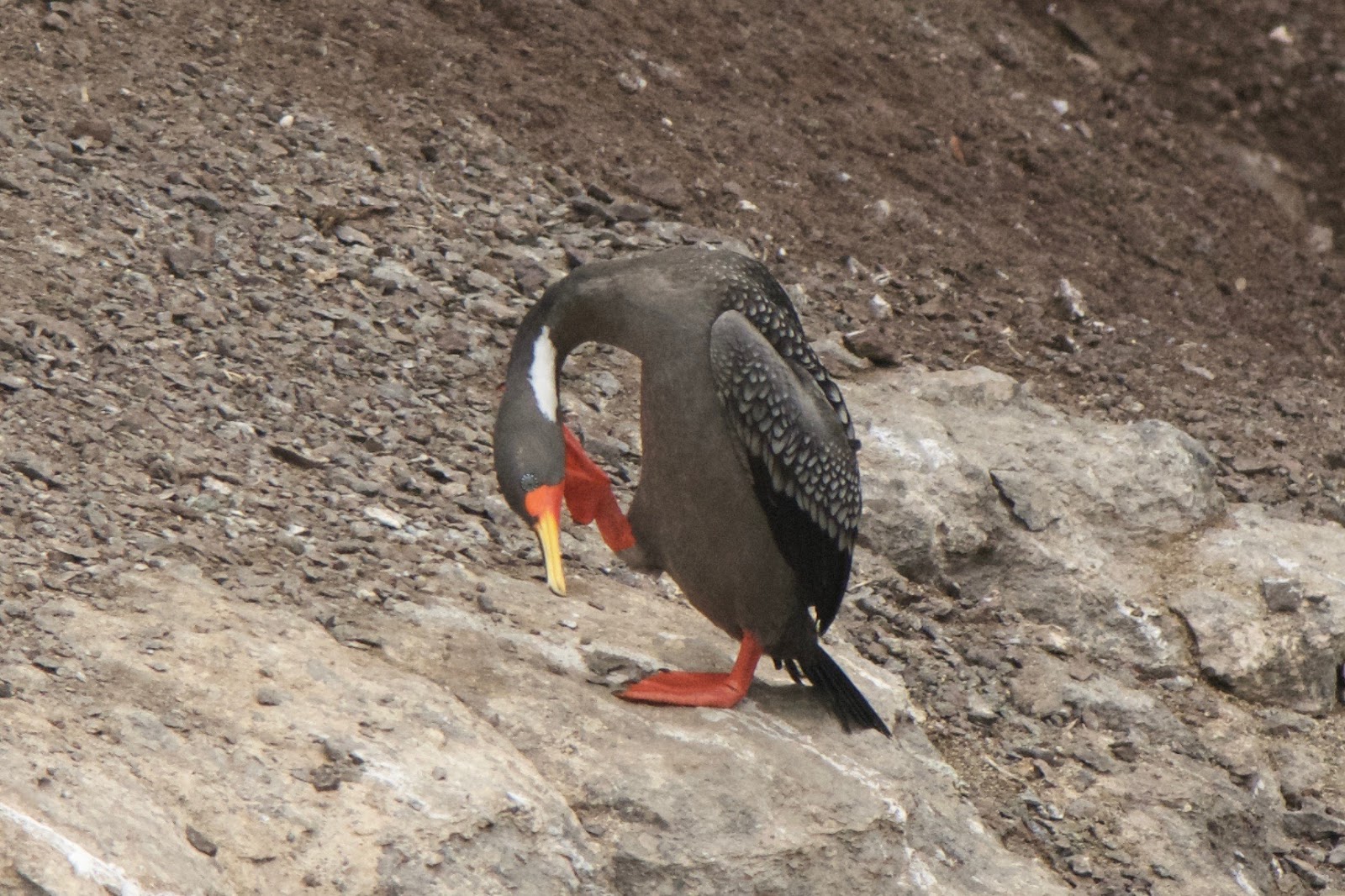
Almost on the Inca Tern level of gaudiness was this flashy cormorant known as a Red-legged Cormorant (Phalacrocorax gaimardi):
I couldn't help but remind myself that a year ago I was looking at Red-faced... but now I was looking at Red-legged!  What a year!

This idea of "Wow, I'm not in North America anymore" was hit home the hardest by this flying torpedo:
This, ladies and gentleman, was my first sighting of a wild penguin.  Humboldt Penguins (Spheniscus humboldti) breed in coastal Chile and Peru and I was actually giddy about seeing a species from this new order (Sphenisciformes).  

The Humboldt Current is amazing though.  It's said that it's the most productive marine ecosystem in the world.  Upwelling from this current occurs year-round off the coast of Peru and, trust me, you could tell just by looking offshore.  Birds... EVERYWHERE.  Thousands were streaming by:
One of the most numerous species we saw offshore were Peruvian Boobies (Sula variegata).  Check out this picture I captured of a diving booby just as it hits the water:
The booby is another species that's limited to the Humboldt Current and is only found in Peru and northern Chile.

In the same order as boobies, hundreds of Guanay Cormorants (Phalacrocorax bougainvillii) streamed past:
This species, which breeds on the coasts of Peru and Chile, is considered near-threatened due to habitat loss/degradation and over-fishing.  In fact, the population of this species has declined 30% in the last 30 years.  Hopefully that trend doesn't continue for another 70 years!

The beach and lagoon there at Los Pantanos de Villa hosted a number of other interesting things like this pair of American Oystercatchers (Haematopus paliatus):
... and, ahh, a bird I know... a Green Heron?
Not so fast.  Although related, this is a Striated Heron (Butorides striata).  These are actually quite widespread and reach places like Africa, Asia, and Australia.

A touch bigger (just kidding, WAY bigger) was this Chilean Flamingo (Phoenicopterus chilensis) we found loafing in the lagoon:
They ARE tall.  In fact, these guys stand more than 4 feet tall.  This is only my second flamingo species ever (the first coming earlier this year in Florida, actually).

Even after we left the lagoon, the commonplace yard birds were new for me.  For example, here's a Scrub Blackbird (Dives warczewiczi) chilling in some yard.  This species is only found in coastal Ecuador and Peru:
This big brute is a Long-tailed Mockingbird (Mimus longicaudatus):
Like the blackbird, this species is only found in coastal areas of Ecuador and Peru.

Anyway, our day trip had come to an end (our final checklist seen here) and I conked out pretty early, trying to catch up on sleep.  We had another early morning ahead of us but I was still looking forward to the next day, our first official day of tour.

We awoke dark and early, met up with our group downstairs, and ventured back across the road into the Lima airport.  Our hour-long flight to the southeast was uneventful (always a good thing) and before we knew it, we were in Cusco.

Cusco sits pretty high in elevation, higher than 11,000 feet (right, like double the elevation of Denver).  I thought Quito (Ecuador) was high but Cusco is nearly 2000 feet higher.  Anyway, we all enjoyed some coca tea when we arrived (to help with the elevation) and then it was on to Huacarpay Lakes.

Here's a picture I really like; a panorama of our group looking out into the marshes at Huacarpay:
Pretty quickly we started seeing some new birds like Yellow-winged Blackbirds (Agelasticus thilius).  Yes, think Red-winged Blackbird but with yellow replacing the red/orange in the wing.  This species is at its northern limit in Peru.

I was rather stunned when this hefty beast soared right over... a Black-chested Buzzard-Eagle (Geranoaetus melanoleucus):
Basically looking like a set of tapered wings (with almost no tail), the silhouette of these are pretty distinctive!

We worked the marsh edges and managed species like Plumbeous Rail, Many-colored Rush Tyrant, and Wren-like Rushbird.  In terms of ducks, we had Yellow-billed Teal, Puna Teal (below on the right), and Yellow-billed Pintail (below on the left) :
We also worked the dry hillsides and saw quality species like Streak-fronted Thornbird (Phacellodomus striaticeps) and this Rusty-fronted Canastero (Asthenes ottonis):
I've always been interested in seeing species that are limited geographically and so this Peruvian endemic (meaning it's not found in any other country) fit the bill.  In watching this bird, I managed to catch it in-between bushes:
If you want to see what else we saw at Huacarpay, you can see the checklist here.  Hint, there are things like chat-tyrants, ground-tyrants, negritos, and seedeaters on the list!

After reaching our lodge in Ollantaytamo, we ventured behind the hotel to bird the grounds and were quite happy with what we saw.  For example, how on earth can it get better than a Peruvian endemic that looks like THIS?!
This stunning hummingbird is a Bearded Mountaineer (Oreonympha nobilis) and it's only found in a small area of southern Peru.  Thankfully for us, it was quite easy to see at the hotel:
They're quite large too, reaching a length of nearly 7 inches!  In fact, that makes it larger than the following species...

This is a Cinereous Conebill (Conirostrum cinereum), a species that's limited to northwest South America:
We also saw this Golden-billed Saltator (Saltator aurantiirostris), a fairly widespread species in southern South America:
However, I think most people agreed that the highlight that afternoon (checklist here) was this little predator, a Peruvian Pygmy-Owl (Glaucidium peruanum):
I can't complain, the view over our lodge at dusk was a dandy one too:
The next day we got up early because, after all, we had a train (and bus) to catch!  We took a train from Ollantaytambo to Aguas Calientes (the town right below Machu Picchu).  However, we were met there with a 2-3 hour wait in line for the buses (when bus drivers go on strike, be prepared!).  No matter, we stood in line and slowly birded our way through Aguas Calientes.

Overhead we had a variety of swifts including White-tipped Swifts (Aeronautes montivagus), a species limited to northern South America:
Also in town, we had our first of many run-ins with a Golden-crowned Flycatcher (Myiodynastes chrysocephalus), a species we'd see often in the area:
Looking down alongside the rushing river, we saw several Torrent Tyrannulets (Serpophaga cinerea).  This distinctive species is, as the name suggests, found along rushing rivers and torrents.  And no, it doesn't eat snakes (like the genus suggests):
If you want to see more of this checklist, click here.

Anyway, we eventually got through the line, boarded a bus, and started up the steep hillside towards the ruins (there are 13 switchbacks, in case anyone is wondering).

Machu Picchu.  The name is even in our tour title.  It was finally time to visit this world-renowned site!  It was a bit surreal to be standing there, looking out over the sight you've seen in pictures a thousand times:
You've probably heard it said that "pictures don't do it justice" and, well, that's correct.  I found the surrounding topography of the extremely steep precipices just.... staggering:

Up close, the rock work of Machu Picchu, which is from the 15th century, is legend.  Such peculiar rock shapes!  You can see here how they were able to shape rocks exactly as needed to fill gaps:
Pay attention to the corner of this building... it's curved.  Yes, some of the individual rocks in this wall were rounded to fit exactly with the curve:
Up close even more, the way that the Incas were able to fit rocks together is quite amazing.  No mortar was used... and yet, you can't even slide a piece of paper between these rocks!
 Symmetry.  They had it down.
Visiting the ruins during the heat of the day really cut down on bird activity though, we saw fewer than 10 species!  Our best flock was waiting in line for the buses, actually.  Checklist here.  Turns out, the Blue-capped Tanager we saw there would be our only on tour.

In the end, it was a successful first couple of days.  We were staying in Aguas Calientes for another night or two and were planning on birding in the Mandor Valley the next day and a half.  Stay tuned for more posts about Peru!