12 September 2014

25th lifer

Although I suppose it was a bit overshadowed by the COMMON CHIFFCHAFF the day before, I snagged yet another lifer the following day, an ARCTIC WARBLER.  Here, although not a great look, you can see the long eyestripe and a faint wingbar:
This species, along with the Code 5 chiffchaff, belongs to a genus of Old World Warblers (Phylloscopus).  Although the ARCTIC WARBLER is a lowly Code 2 (it breeds in Alaska), I had been hoping for this species for months so imagine how happy I was to finally connect with it.

We flushed that bird up out of the wild celery patch near Antone Slough.  You see, we purposefully walk in lines through the large stands of wild celery hoping to flush rare birds.  Because we have no bushes or trees on the island, the wild celery is one of the few plants that provides a little bit of "understory", if you will.  It's a devil to walk through (just ask any of the visiting birders that expected an easy stroll around St. Paul) but it has provided amazing rarities through the years.  

Although not an amazing rarity, here is a YELLOW WARBLER, a new island bird for me, that we flushed out of the same celery patch:
St. Paul Island has a ridiculous list of shorebirds.  Of the 64 species seen on the island, one of those is the WHIMBREL.  They're not common here and this bird on Zapadni Beach was one of 4-5 records for the year so far:
Another shorebird, and one that is much more common, is the Northeast Asian-breeding SHARP-TAILED SANDPIPER.  How common are they?  Well, on the 3rd of September, as many as 28 were seen.  St. Paul Island is recognized as being one of the most reliable places in the ABA to see this Code 3 shorebird.  Here is a juvenile we saw today in Cup Pond:
I know I mentioned the crab pots in my previous post.  Well, here's a PACIFIC WREN that we found in the pots the other day.  This species is 1 of the 4 breeding passerines here on St. Paul (can you guess the other 3?):
They are LAPLAND LONGSPUR, SNOW BUNTING, and GRAY-CROWNED ROSY-FINCH.

Also lurking around the crab pots was one of the local ARCTIC FOXES:
Depending on where you live, you probably have large numbers of gulls like Ring-billed, Herring, California, or Glaucous-winged.  Here, we have kittiwakes!
We've ventured up to Hutch Hill several times since the COMMON CHIFFCHAFF to see if maybe it would reappear.  No luck with that but we have seen a couple of other uncommon species in the same patch like this WHITE-CROWNED SPARROW:
... and this DARK-EYED JUNCO:
Speaking of juncos though, we had two today including this one on the lip of Hutch Cut:
A quite uncommon species that we've had around lately are CHIPPING SPARROWS.  Here's one that's been hanging around in the northeast part of the island, along the road just shy of Webster House:
We're all keeping a close eye on this beast of a low pressure.  As evidenced by this wind map, we're due for a walloping in the coming 48 hours:
With sustained winds of 50 mph and gusts to 60, this will be our biggest wind event of the season so far.  The big question is... what birds will drop in?!

09 September 2014

CHIFFCHAFF!

We do a lot of thinking about vagrant birds here on St. Paul.  After all, that's one of the reasons why birding here is so intriguing (and popular).  It's far too broad of a topic to discuss in depth here but having been into birding most of my life, and hoping to see rare birds for much of it, being here for a season opened up all sorts of possibilities for new life birds.

Although most of the species we see here have been seen here before, there was always the chance that a vagrant would show up that has never been seen here before.  Maybe it would come from the east... maybe it would come from Russia or from Asia.  Who knows!  Well, our latest vagrant was a very rare one indeed, a new island record!  Doug and Scott found a COMMON CHIFFCHAFF at Hutch Hill yesterday!

This was only the 4th or 5th time this species has ever been seen in North America and was the first time it's ever been seen away from St. Lawrence Island.  So yes, when something that rare shows up, it's go time.  I was with a client back in town and when we heard the news, we strapped in and rushed to the scene as fast as we could.  Long story short... I managed to see the bird but not very well.  We all returned again today and this time, thankfully, saw the bird much better.  Although I haven't managed pictures of it yet, Doug's checklist has some sweet and IDable photos.  I wonder how long it'll stick around?

We had another new arrival yesterday but this one not so gripping, DARK-EYED JUNCO.  We had one in the road up near NE Point and then another in the lower cut at Polovina Hill.  Here's a grainy picture of the latter:
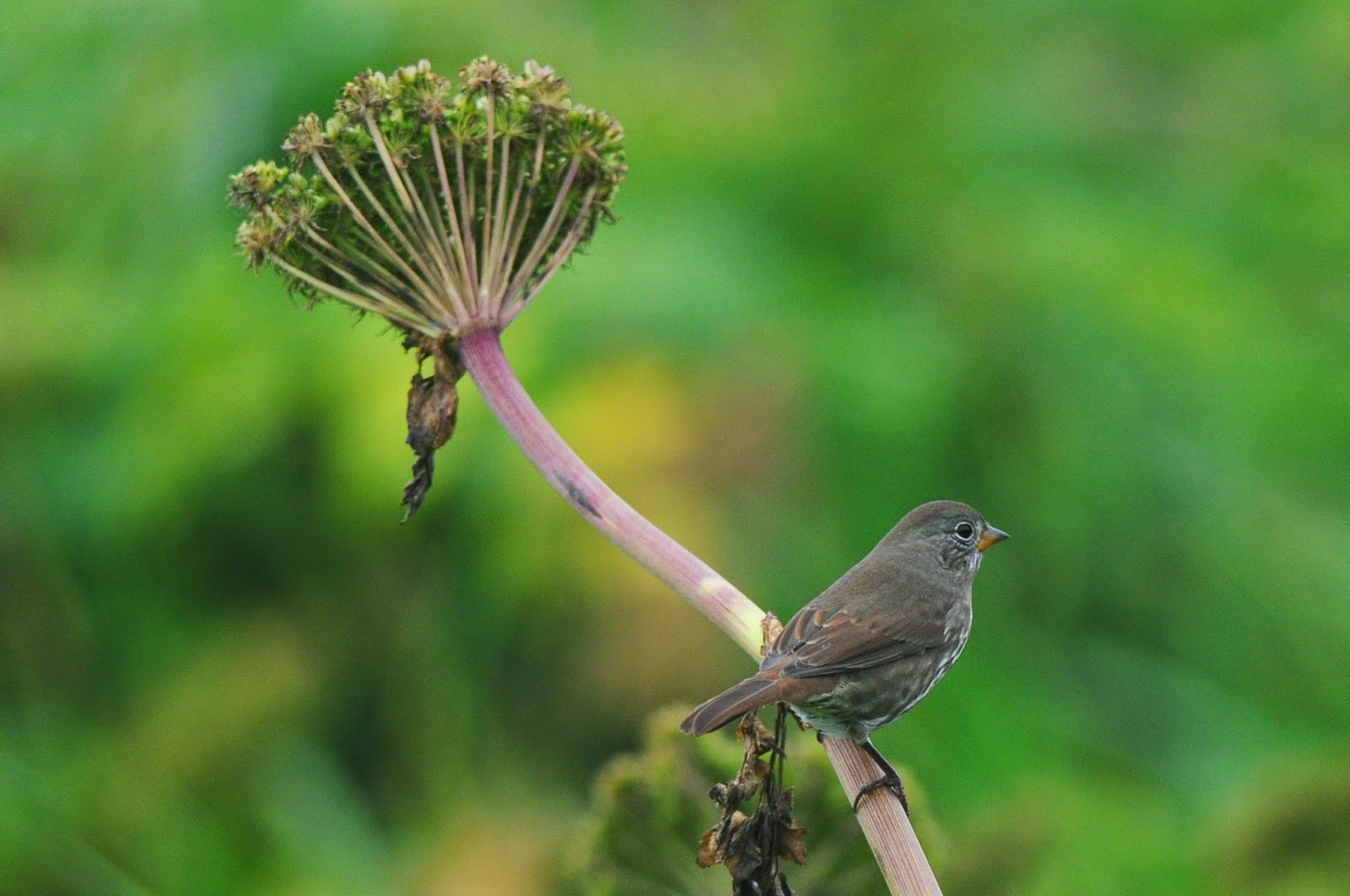
Another bird in the lower cut was this FOX SPARROW, a fairly expected migrant this time of year:
Although the junco and sparrow look at home scurrying around in the vegetation, remember that these birds literally flew hundreds of miles over a rough ocean and managed to find this speck of land in the Bering Sea.  It's rather remarkable when you pause and think about it.

We also noticed an increase in PACIFIC GOLDEN-PLOVERS yesterday; we saw between 30 and 40 in the Novastoshna area.  Here are a few of them:
One of the places we check every single day, rain or shine, are the crab pots.  Crabbing is one of the main industries in the Bering Sea and is a major part of life here on St. Paul Island.  The snow crab season doesn't begin until winter and so in the meantime, they stack the crab pots in big stacks here on dry land.  You can't miss them stacked along the road between the airport and town:
The reason we check these for birds is pretty simple; some birds get blown here by storms and many are probably extremely tired, looking for trees and other forms of vegetation to rest and feed in.  Well, we don't have trees on St. Paul Island and one of the only things here that stands tall and has plenty of structure, like trees, are stacks of crab pots.  Regardless of the wind direction, birds can always find a quiet place out of the wind and rain somewhere in the rows of crab pots.  Looking again at these stacks, you can see there are narrow corridors between the rows of pots:
Let me emphasize that these are not small, light, or flimsy.  Each crab pot weighs about 750 pounds and that's without the 60 pounds of rope that's stored inside.  Looking down a row of crab pots, you can see how high the stacks reach and how many nooks and crannies there are for birds to hide in:
What we do is walk every row, hopefully flushing the birds from their perches and into view.  Here I am standing between two rows of pots.  You can see that each pot is between 2 and 3 feet tall.  Some rows have pots stacked 7 high and so we're talking nearly 20 feet of cover for birds to use.
The list of rare birds that have been found in these crab pots is lacking neither in quantity or quality.  I'll start with the rarest ones, the Code 5 species:

Northern Boobook (2007; the first ever ABA record)
Asian Brown Flycatcher (2013; the 4th ABA record)

And here are some stellar Code 4 species:

Eurasian Hobby
Taiga Flycatcher
Dark-sided Flycatcher
Siberian Accentor 
Eurasian Bullfinch

The list of Code 3 species isn't bad either:

Eyebrowed Thrush
Siberian Rubythroat
Olive-backed Pipit
Rustic Bunting
Brambling

So yes, THAT is why we check the crab pots every day!

--WARNING, the following images will cause angst among your local Northern Fur Seal populations--

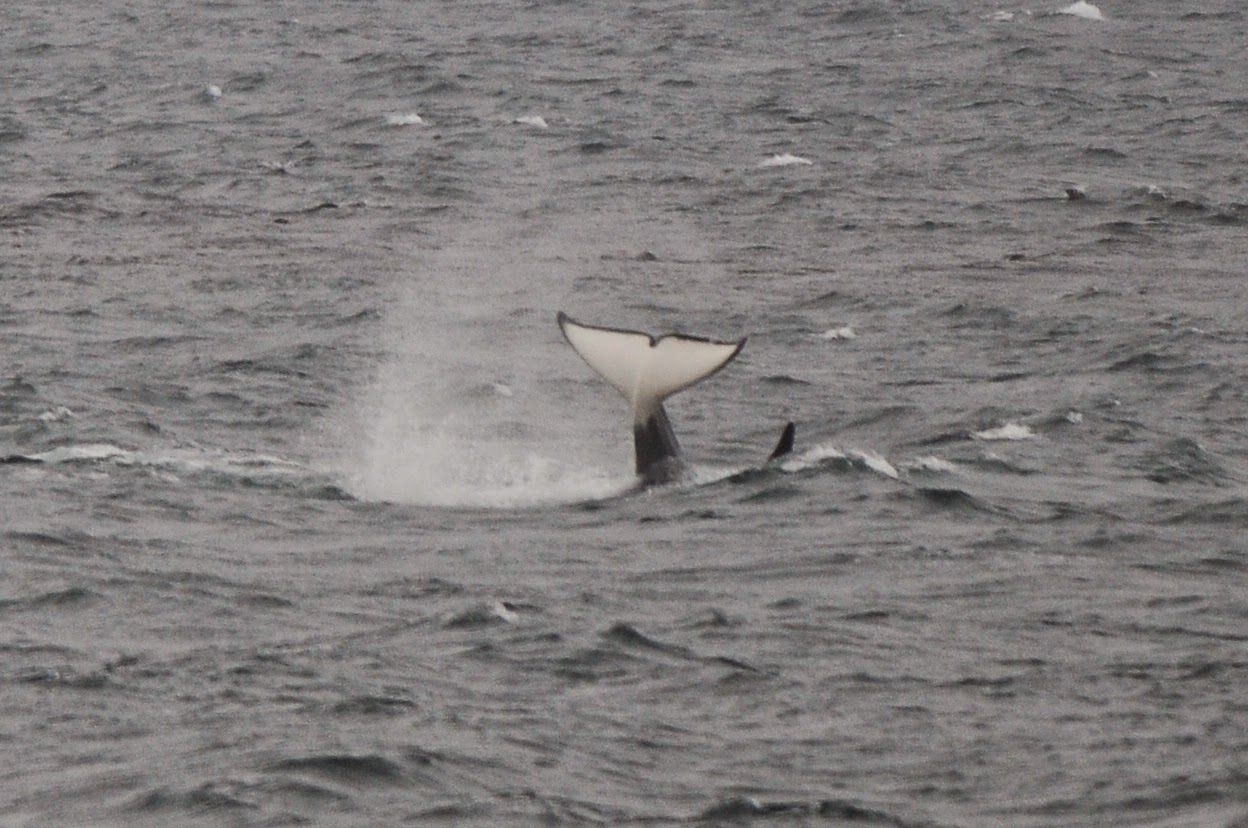
Lastly, I thought I'd leave you with a series of pictures of KILLER WHALES hunting seals off of Zapadni Beach the other day.  This was by far the closest I've seen them and they also showed a bit more than just their dorsal fins this time; for example, their flukes:
Each lobe of the tail is a fluke, so in fact, one tail has two flukes:
Here's a dorsal fin of a female; note how it's curved at the top, not straight up-and-down like a male's:
In contrast, here's the tall dorsal fin of a male.  Their dorsal fins reach the full height in about 15-25 years; this particular fin is about 5 feet tall, to give you some size reference:
You think Great White Sharks are badass?  Yeah, Killer Whales eat those!  Not only are Killer Whales bigger and faster than Great Whites, but they truly are the only predator of Great White Sharks.  Here's the male again, this time up enough to show some white near the head:
Here's the male and female as they left Zapadni Beach... for the time being:
By the way, the tiny-looking bird in the water behind them is a not-so-small RED-FACED CORMORANT.

That's all for now.  Hopefully I'll have more exciting things to report with my next update!

06 September 2014

Oh, just another sand-plover...

I suppose I should start by confirming that yes, the JACK SNIPE was still present here on St. Paul Island as of yesterday.  We revisited the pond and I managed another grainy, distant picture:
It is hard to believe though that we're past much of the shorebird migration already.  For example, some of the stints have very few records from here on out.   However, late-dates are made to be broken so I suppose we'll have to wait and see.

Besides, we still have some neat shorebirds around including the continuation of both kinds of tattlers.  At Marunich this morning, I stumbled on this GRAY-TAILED TATTLER showing nicely.  You can see the bold eyeline stretching behind the eye and the nasal groove that doesn't extend past 1/2 of the bill length.  It also look as if the eyelines might actually be joining on the forehead of this bird:
Luckily there was a WANDERING TATTLER nearby for comparison.  See the key differences?
There have been other Code 3 shorebirds around too.  Take for instance this LESSER SAND-PLOVER that was found on the Salt Lagoon this morning:
I should clarify though, it doesn't have to be rare to be an amazing species.  Even our PACIFIC GOLDEN-PLOVERS are crazy cool if you get to spend some time around them.  Lately, there have been a few around in the Novastoshna area:
Despite seeing this species every day for 4 months, I still enjoy seeing ROCK SANDPIPERS, now in their grayish basic (winter) plumage.  How cool is it that they still sit on upland tundra sometimes, probably out of habit, like they used to do during nesting.  It's a bit of a different look from before but it's a pleasant reminder of the changing seasons:
We were enjoying the view from the top of Hutch Hill yesterday when my group spotted some KILLER WHALES offshore to the north.  Not a whale, of course, it actually belongs to the dolphin family.  We don't see Killer Whales every day here but sightings aren't too unusual.  Here's male (which you can tell by the tall, triangular dorsal fin):
We still have some American sparrows around.  We were walking to the Webster Seawatch overlook yesterday when this FOX SPARROW popped up out of the celery patch:
More common than the Fox Sparrows though have been GOLDEN-CROWNED SPARROWS.  Here's one in the upper cut at Polovina Hill:
The wind map (found here) is showing a serious low pressure moving towards us from the southwest.  Although the winds won't be screaming out of the west, we're looking forward to some weather nonetheless and, perhaps, some American vagrants:

04 September 2014

I don't know Jack... oh wait, I DO!

Typical.  I was sitting at home watching Downton Abbey this evening when Doug called.  He suggested I drive to Tim's Pond... immediately.  I took his hint.

But first, a quick detour to the hotel.  I barged into the hallway and after yelling at a client in the shower the good news, there were two of us speeding towards Tim's Pond.  You see, Doug and his group had just found a JACK SNIPE and there were still a few of us birders on the island that desperately wanted to see this tiny denizen of marshes, bogs, and tundra.

We arrived at the spot, formed a tight line walking shoulder-to-shoulder, and moved in a sweeping formation around the edge of the marsh where it had last been seen dropping in.  Boom.  It flushed from right in front of me.  Like a bullet, it flew to the other end of the marsh but always staying rather low.  As it dropped down, I managed a feeble picture showing the bold, buffy stripes down the back, strong white trailing edge of the wings, and the short bill:
This is the 6th record of this tiny and secretive snipe here on St. Paul Island.  In fact, more have been seen here than anywhere else in the ABA area; I believe this is about the 13th-14th ABA record.  The first record from this island was in 1919 and was the first record for all of North America at that time.

If you want to see a truly amazing photo of this bird, I'd highly suggest this picture that Doug got.

So just like that, my beard of 9 days vanishes and I couldn't be more pleased.

03 September 2014

Danger... there's a rubythroat around.

 
This post will be about birds.  But if you aren't used to that by now, there's no sense in warning you of the danger.

So, it's come down to the final 6 weeks of the season here on St. Paul Island.  Traditionally, this is a great time for rarities and some evidence of that was when Doug found a SIBERIAN RUBYTHROAT yesterday in the crab pots (you can see his picture here).  Sadly, no one else relocated it but it's helpful to know that there is one skulking around somewhere (thankfully, I connected with this species this spring).

We also found a very rare BLACKPOLL WARBLER in a celery patch near Zapadni Beach.  It turned skulky and most people missed it but luckily Scott managed to relocate it.  Here's Doug's photo (I was on a nearby ridge, failing to photograph it).

Shorebirds are still of interest to us even though the peak diversity has since past us.  Besides the ROCK SANDPIPERS and RUDDY TURNSTONES, the most common shorebird we see on wetlands these days are SHARP-TAILED SANDPIPERS.  In fact, we had a few just on random roads this morning (yes, in the road).  It's not a sharp picture but here is one showing just how bright and rufousy they can be:
They will sometimes join the turnstones and sandpipers on the kelp line of various beaches as well.  Here's one from the beach kelp at Tonki Point:
And it's not uncommon to flush them from moist, dense wetlands too.  If so, you can try your hand at flight photography (of which I mostly fail):
Speaking of shorebirds, we were cruising along Big Lake last night when two tattlers flushed from the shoreline.  We rolled down the window just in time to hear the distinctive "tuwee tuwee" call of GRAY-TAILED TATTLER.  We stopped and subsequently spied them:
I know you've probably had your fill of tattler identification tips on this blog lately but I can't help myself; check out the pale supercilium that stretches behind the eye and the clean white flanks: 
As the fall progresses, we should see more and more species of ducks around.  All summer we've been "stuck" with NORTHERN PINTAIL, GREEN-WINGED TEAL, and LONG-TAILED DUCKS on inland wetlands.  However, things started to change when this NORTHERN SHOVELER decided to stick around on Weather Bureau Lake for a couple of days.  It's not a great flight shot but it does the trick:
Oh yes, fear not, the LAPLAND LONGSPURS are still here in full force.  If you drive roads to SW Point, Marunich, or NE Point, you're almost certain to see hundreds.  However, there is coming a time when they'll mostly clear out (yay!) which will help us locate odd birds flushing from roadsides.  Until then... here's one perched on a celery head:
Today at Marunich, there were banded RED-FACED CORMORANTS roosting on some shoreline.  The FWS does some banding here on the island so this probably isn't a big deal.  Still, it's fun to see how many banded birds you can find and see if you can make out the code.  I managed pictures of at least three different birds.  First #303:
#149:
... and #141:
That's all for now.  Perhaps my next post will have news of a mega!